

BioMap and Sanofi Forge $1B Strategic Partnership to Co-Develop Foundation Model for Biologic Drug Discovery
BioMap
Developer of Innovative Drug R&D Platform
Sanofi
Pharmaceutical Manufacturer
On October 10, 2023, BioMap announced a groundbreaking strategic collaboration with Sanofi. The partnership will focus on jointly developing advanced models for biopharmaceutical discovery based on BioMap's Life Science AI Foundation Model.This collaboration marks the first commercial partnership in the life sciences field based on a large model (Foundation Model), and proposes using model development rather than drug research progress as a milestone.Bring new cases to the unique MaaS (Model as a Service) business model in the era of large models.
According to the agreement,BioMap to Receive $10 Million in Upfront Payment and Multiple Near-Term Model Development Payments. Based on the achievement of preclinical development, clinical development, regulatory, and commercial milestone payments, BioMap is eligible to receive over $1 billion in total deal value.
In 2020, Robin Li, founder, chairman, and CEO of Baidu, and Liu Wei, CEO of Baidu Ventures (BV), co-founded BioMap. Within just one year, BioMap completed its Series A financing round worth hundreds of millions of US dollars. In the same year, it invested in frontier life science and technology companies such as AbcamBio and DP Technology. On the business front, BioMap has established partnerships with several cutting-edge enterprises including Crystal Bio, Harbour BioMed, GenomiCare Biotechnology, Precision Cancer Medicine, and NeoCura Biotech. Within three years, BioMap, equipped with an AI large model "x Trimo" that boasts over 100 billion parameters, has become an indispensable player in the AI pharmaceutical industry.
The Large Language Model of Proteins is the Focus
In 2023, the surge of artificial intelligence triggered by the explosive popularity of ChatGPT swept across the globe, once again revealing new possibilities for generative AI in the pharmaceutical field. In biopharmaceutical R&D, "Eroom's Law" (Reverse Moore's Law) implies that successfully developing a new drug requires an expenditure of $1 billion and a decade of time—commonly referred to as the "double ten rule."
Thanks to the foundational AI models in life sciences, which include task-specific AI models or large language models, researchers can innovate at every stage of the drug discovery process, including target identification, molecular design, and optimization. As these foundational models mature, researchers are gradually gaining zero-shot capabilities, accelerating the drug discovery process.
This collaboration will leverage BioMap's customized foundational models and world-leading artificial intelligence expertise, along with the MNC's proprietary data, protein engineering innovations, and extensive biologics development experience, to create leading protein large language models and AI character models for biologics design and multi-parameter optimization.
In March this year, BioMap launched the AIGP — AI Generated Protein (AI-generated protein) platform driven by large-scale life science models. The platform aims to leverage AI's ability to design innovative proteins and collaborate with industry partners to develop more cutting-edge drugs and other life science projects while driving technological advancements in the AIGP platform.
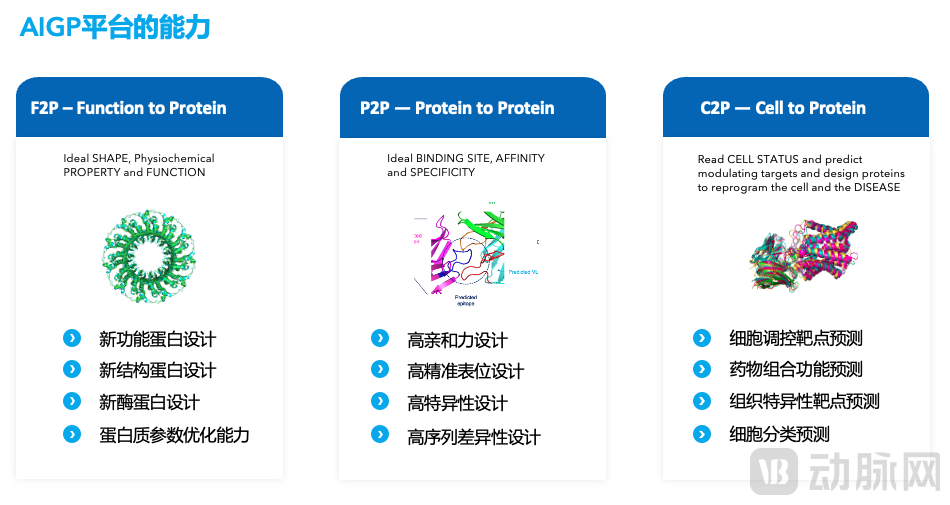
Behind AIGP is BioMap's "xTrimo" (The Cross-Modal Transformer Representation of Interactome and Multi-Omics), a cross-modal large model with over 100 billion parameters developed over three years, designed with a four-layer nested structure logic. Currently, xTrimo has achieved SOTA (state of the art) performance in 26 downstream prediction tasks including antibody structure, antibody function, drug discovery, disease treatment, and cellular research, and is still continuously iterating and evolving.
Using xTrimo, key principles are learned from cross-species and cross-modal biological information on how proteins form and function, interact with each other, and combine to regulate cellular functions, thereby deciphering the natural language of life — proteins. It is reported that the AIGP platform features three functional modules: Function to Protein Design (F2P, designing/optimizing proteins based on structure, function, developability, and other functional metrics), Protein to Protein Design (P2P, designing antibodies and other proteins that bind in specific ways to target proteins such as antigens), and Cell to Protein Design (C2P, discovering target proteins that regulate cellular functions given a cell and designing corresponding regulatory proteins).
July,BioMap's Protein Language Model "xTrimoPGLM" Debuts as the First and Largest Foundational Protein Language Model in the Life Sciences, Trained on 100 Billion Data Points from Billions of Protein Sequences.Based on the GLM (General Language Models) paradigm, xTrimoPGLM successfully integrates pre-training methods for two major categories of tasks: protein understanding and protein generation. Ultimately, across 15 protein-related tasks in four major categories—protein structure, protein developability, protein interactions, and protein function—xTrimoPGLM outperforms baseline models in 13 tasks, demonstrating comprehensive superiority over models such as Meta's ESM-2.
The xTrimo model, as an AI foundational model in the life sciences field, is the first and largest of its kind, providing a basis for BioMap to continuously develop large models with different objectives. Currently, BioMap has already initiated collaborative applications in fields such as tumor multi-omics and single-cell research using various large models under its umbrella.
Splashing Nearly 10 Billion, Sanofi Aims to Become the First Large-Scale AI-Driven Pharmaceutical Company
Notably, this is not the first time Sanofi has established a cooperative relationship with an artificial intelligence company.
In the past two years, Sanofi has launched comprehensive cooperation with multiple AI pharmaceutical companies, computer companies, and AI medical data companies through several acquisitions and collaborations.
In 2021, Sanofi collaborated with Owkin, whose AI-driven platform uses patient data from various medical centers to build models and predict patient responses to treatments.
In the same year, Sanofi collaborated with Baidu to apply Baidu's mRNA optimization algorithm, LinearDesign, to the research and development of mRNA vaccines for infectious diseases and cancer.
In 2022, Sanofi acquired Amunix Pharmaceuticals, a company that uses AI to design drugs which only act within tumor tissues without harming normal tissues.
In the same year, Sanofi reached a large-scale collaboration with Exscientia, an AI pharmaceutical company, with a $100 million upfront payment. The two parties will develop up to 15 drug candidates in the fields of oncology and immunology.
In 2022, Sanofi also collaborated with AI pharmaceutical companies Insilico Medicine and Atomwise to leverage their AI-driven platforms for accelerating drug development.
According to public information, in 2022 alone, Sanofi's four major collaborations with AI pharmaceutical companies amounted to over $8.7 billion in total value, with upfront payments exceeding $1.14 billion, accounting for 15.83% of its R&D investment that year. Among these, the largest single deal had an upfront payment of $100 million. This is considered a "groundbreaking" presence in the entire AI pharmaceutical industry.
In June this year, Sanofi took it a step further by announcing an "All In" approach to artificial intelligence and data science to accelerate breakthroughs for patients. Its current CEO, Paul Hudson, made a high-profile announcement:"Our goal is to become the first large-scale AI-driven pharmaceutical company."
Compared with other giant pharmaceutical companies, Eli Lilly's CEO David Ricks also mentioned in an interview that artificial intelligence is "one of the most exciting technologies he has seen in a long time," with the potential to disrupt the entire industry. So far, Eli Lilly's largest investment in China's AI pharmaceuticals field has been a $250 million collaboration with XtalPi.
This is enough to show Sanofi's determination and confidence in the AI pharmaceuticals field.
Before fully dedicating itself to the AI drug discovery field, Sanofi, as the world's largest vaccine development company, faced repeated setbacks in the development of a COVID-19 vaccine. It failed to seize the mRNA vaccine opportunity, lagging behind Pfizer, BioNTech, and Moderna in both progress and commercialization.
In 2021, in order to make a comeback in the mRNA field, Sanofi spent $3.2 billion acquiring Translate Bio, an mRNA company, betting on the next generation of mRNA technology. However, not long after, Sanofi deemed the COVID-19 vaccine market to be saturated and suspended the development of its mRNA-based COVID-19 vaccine.
According to a June announcement, Sanofi will promote digital transformation across the entire company and has launched an AI application called plai. Currently, in research, Sanofi has established multiple artificial intelligence programs that shorten research time by improving predictive models and automating time-consuming tasks. In clinical trials, increasing digitization and leveraging insights provided by plai enable Sanofi teams to rethink how to conduct clinical trials more effectively. In manufacturing and supply, Sanofi is digitizing its quality assessment processes.
Players Are Flocking In: Global Pharmaceutical Companies Are Mining AI Drug Development
Since the establishment of the first AI pharmaceutical company, Schrodinger, in 1990, the global AI pharmaceutical industry has entered its golden age after more than 30 years of development.
Since 2015, a number of AI pharmaceutical startups such as XtalPi, EDDA Technology, StarMap Science, Viva Biotech, and SinoPac Pharmaceuticals have emerged like mushrooms after rain.
Traditional pharmaceutical companies are also striving to keep up, entering the AI drug discovery track through strategic cooperation, equity investment, and other methods. For instance, WuXi AppTec has successively invested in multiple companies that use AI to empower drug research and development; Hengrui Medicine has reached a collaboration with Iktos, a French company specializing in the development of artificial intelligence platforms for new drug design, to introduce an AI-powered new drug R&D platform.
Besides, leading internet companies are also striving to gain a share in the blue ocean market of AI-driven drug research and development. In 2020, BioMap, which collaborated with Sanofi this time, and Denovo Biopharma, an external investment of BioMap, were founded by Baidu; in the same year, Tencent launched its first AI-driven drug discovery platform, DeepChem; Alibaba also cooperated with the Global Health Drug Discovery Institute in this year to develop an AI drug research and big data platform. Afterwards, other internet companies such as Huawei and ByteDance have successively built drug R&D platforms based on their own AI algorithm advantages.
After 2020, the AI pharmaceuticals industry entered a phase of rapid development, with the field gradually becoming more crowded. The frequency, scope, and depth of collaborations between AI-driven drug discovery companies and pharmaceutical enterprises continued to expand. Some AI-powered drug research companies also began independently applying and developing full-process drug pipelines, marking the emergence of businesses operating under an AI Biotech business model.
This collaboration between BioMap and Sanofi represents the largest-scale partnership in the life sciences field based on foundational models. Previously, the Chinese AI drug discovery company XtalPi also signed an AI small molecule novel drug discovery collaboration with Eli Lilly, targeting an undisclosed innovative target. XtalPi utilized its proprietary small molecule drug discovery platform, ID4Inno™, to develop a first-in-class drug to address unmet clinical medication needs, with upfront payments and milestone-based revenues potentially reaching up to 2.5 billion US dollars.
Globally, Novartis has partnered with Microsoft to utilize Microsoft's AI tools for discovering, developing, and commercializing new drugs; Roche and Moderna have made significant acquisitions of AI startups. Pharmaceutical giants are pursuing three parallel routes—independent development, acquisitions, and collaborative development—to ensure they don't fall behind in the new wave of AI-driven drug research and development.
This collaboration between BioMap and Sanofi, which focuses on model development rather than drug research progress as a milestone, has added another level of confidence for AI pharmaceutical companies.After all, in the biopharmaceutical field that strictly follows the "Double Ten Rule," any technology that can shorten the R&D time will make countless biopharmaceutical companies willing to pay for it.