

First Time! Keytruda Significantly Extends Overall Survival in Early-Stage Lung Cancer Patients, FDA Decision Expected Within a Week

MSD
Pharmaceutical R&D and Manufacturer
▎WuXi
Edited by Kant Content Team
MSD announced today,重磅 PD-1 Inhibitor Keytruda Achieves Primary Endpoint of Overall Survival (OS) in Pivotal Phase 3 Clinical Trial KEYNOTE-671 for Resectable Stage II, IIIA, or IIIB Non-Small Cell Lung Cancer (NSCLC)Keytruda in combination with chemotherapy as neoadjuvant treatment before surgery, and as a single-agent adjuvant treatment after surgery, showed statistically significant and clinically meaningful improvement in overall survival compared to placebo plus chemotherapy as neoadjuvant treatment and placebo as post-surgery adjuvant treatment. The press release noted that this isThe first Phase 3 clinical trial to demonstrate a statistically significant overall survival benefit in this patient population.

MSD has previously submitted a supplemental Biologics License Application (sBLA) to the U.S. FDA based on event-free survival (EFS) data.Expected to obtain the review results by October 16。
Lung cancer is one of the most common types of cancer and a leading cause of cancer-related deaths. In 2020 alone, more than 2.2 million people worldwide were diagnosed with lung cancer, resulting in over 1.8 million deaths. Lung cancer can be broadly divided into two main categories: non-small cell lung cancer (NSCLC) and small cell lung cancer (SCLC), with NSCLC being the most prevalent type, accounting for approximately 81% of lung cancer cases. About 44% of patients with non-small cell lung cancer are diagnosed at an advanced stage.
Keytruda is a humanized anti-PD-1 monoclonal antibody that blocks the binding of PD-1 to its ligands PD-L1 and PD-L2, thereby activating T lymphocytes. This action may enhance the ability of the immune system to detect and resist tumor cells.In September 2014, Keytruda was first approved by the FDA for the treatment of advanced melanoma and was subsequently approved as a first-line therapy for patients with metastatic NSCLC. In China, Keytruda has also been approved for multiple indications, covering melanoma, NSCLC, head and neck squamous cell carcinoma, colorectal cancer, esophageal cancer, and liver cancer.

Previously, in the first interim analysis of the KEYNOTE-671 trial,The perioperative treatment regimen based on Keytruda significantly improved patients' event-free survival and reduced the risk of disease recurrence, progression, or death by 42% (HR=0.58, [95% CI, 0.46-0.72], p
. The median EFS for patients receiving the Keytruda-based treatment regimen has not yet been reached (95% CI, 34.1-NR), while the EFS for patients receiving chemotherapy alone was 17 months (95% CI, 14.3-22).
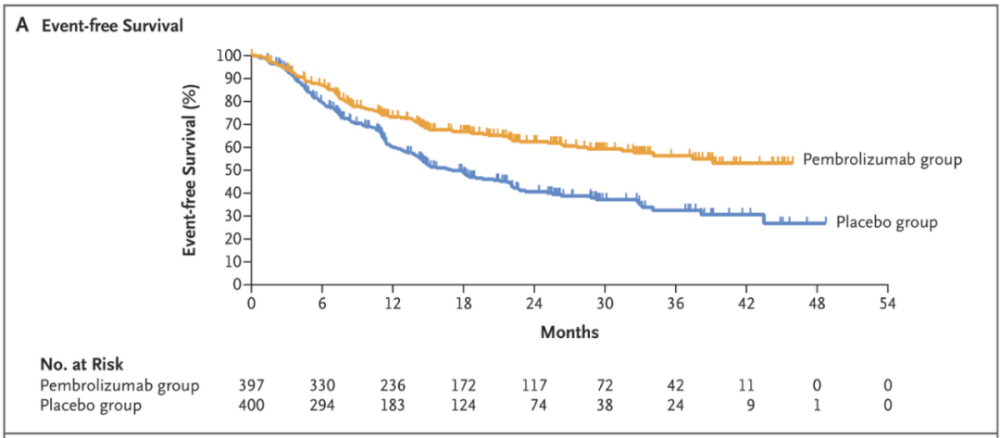
▲Event-free Survival Results of the KEYNOTE-671 Trial (Image Source: Reference [2])