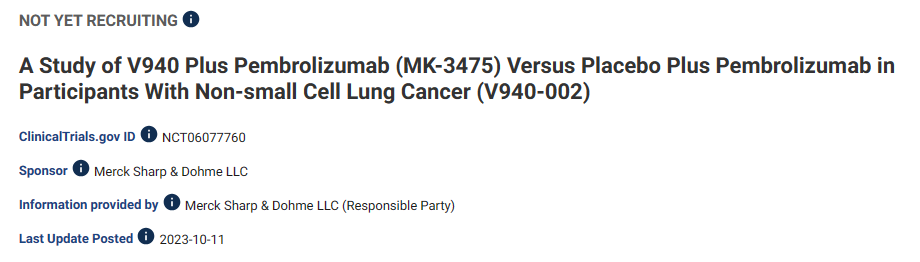
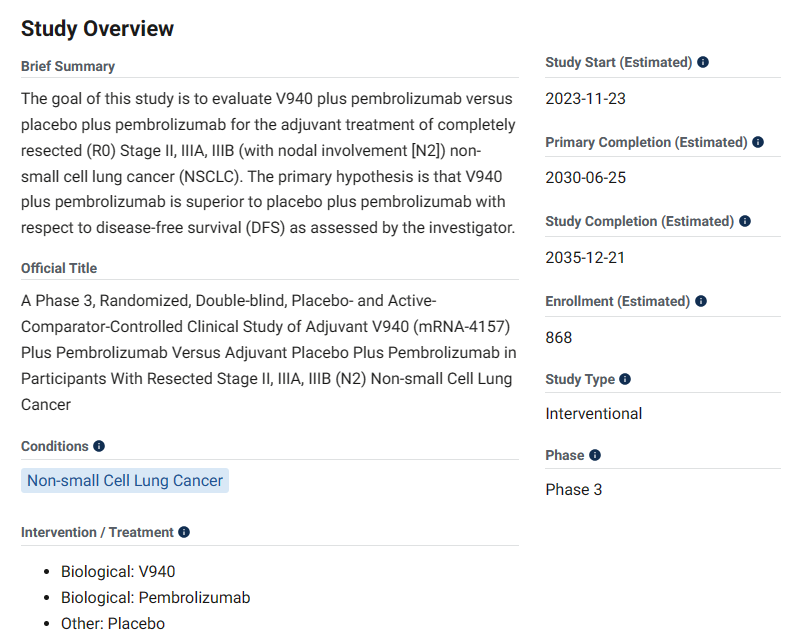
This study aims to evaluatemRNA-4157 in combination with Pembrolizumab(Keytruda, K drug) comparisonPlacebo Combined with K Drug for Adjuvant TherapyComplete Resection of Stage II, IIIA, and IIIBEfficacy and Safety in Patients with Non-Small Cell Lung Cancer (NSCLC).The study plans to enroll 868 patients with NSCLC, with an expected launch in November this year and completion in June 2030. Patients in the experimental group will receive up to 9 doses of mRNA-4157 (intramuscular injection, once every 3 weeks) and up to 9 doses of Keytruda (intravenous injection, once every 6 weeks). The primary endpoint of the study is disease-free survival (DFS).mRNA-4157 is a personalized tumor neoantigen vaccine developed by Moderna targeting the unique tumor mutations of each cancer patient. It can enhance T-cell immune responses to endogenous neoantigens and induce epitope spreading to new antigens capable of driving anti-tumor responses.
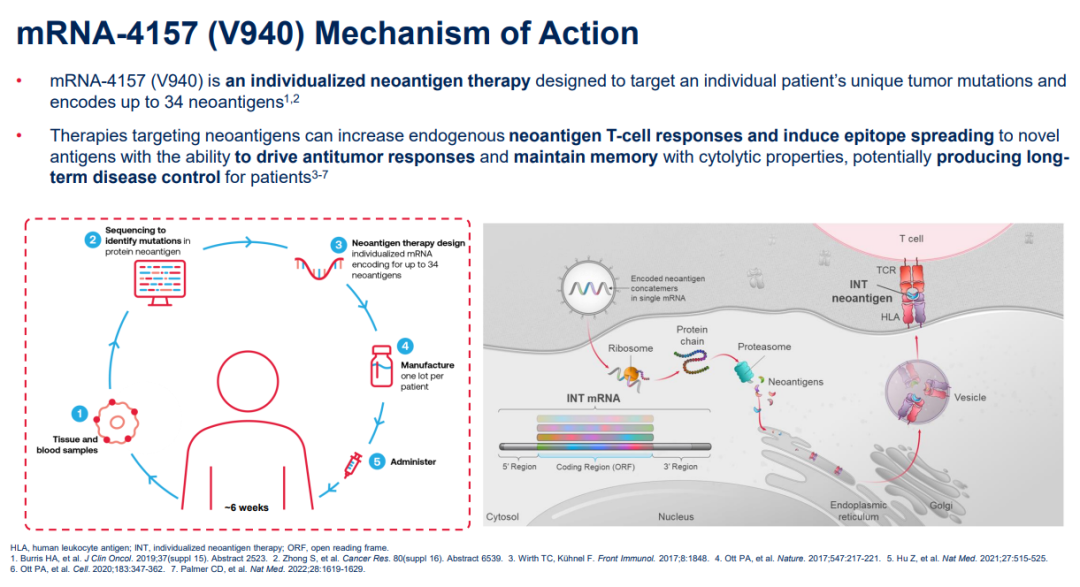
Source: Moderna Official Website
The preparation process of mRNA-4157 takes approximately 6 weeks, including four steps: extraction of tumor tissue and blood samples, sequencing to identify protein neoantigen mutations, designing mRNA sequences expressing neoantigens (up to 34 types), and production.In June 2016, MSD invested $200 million as an upfront payment in Moderna to develop mRNA-4157. In August 2017, mRNA-4157 entered Phase I clinical trials for the first time (KEYNOTE-603). Two years later, Moderna reported positive results: among 20 solid tumor patients who received at least one dose of mRNA-4157 (0.04-1.0mg) and Keytruda treatment, 6 achieved objective responses.
In November 2020, the HPV-negative subgroup of squamous cell carcinoma of the head and neck in the KEYNOTE-603 study also achieved positive progress. Among 10 patients receiving combination therapy, 5 achieved objective responses, with PFS reaching 9.8 months, showing better results compared to the previous Keytruda monotherapy group (14.6% objective response rate, PFS only 2.0 months).In December 2022, MSD announced that the Phase IIb study (KEYNOTE-942) of mRNA-4157 in combination with Keytruda (K药) as adjuvant therapy for completely resected stage III/IV melanoma met the primary endpoint of recurrence-free survival (RFS), significantly reducing the risk of recurrence or death by 44% in patients. Based on these results, the FDA granted this combination therapy Breakthrough Therapy Designation in February this year, and the EMA granted it Priority Medicines (PRIME) designation in April this year.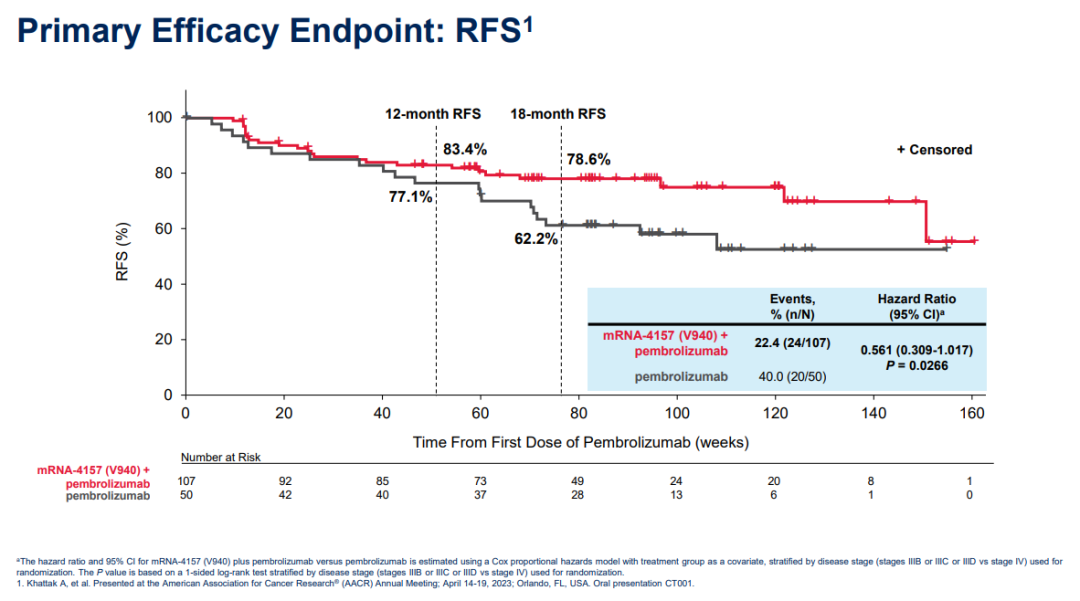
Source:Moderna Official WebsiteIt can be said that mRNA-4157 has had a smooth journey so far, with funding supported by MSD, and its efficacy data has never failed, bringing a lot of positive signals to the prospects of mRNA vaccines in cancer applications.Copyright © 2023 PHARMCUBE. All Rights Reserved.
Welcome to forward, share, and reasonably cite. When citing, please clearly indicate the source of the article in a prominent position;For reprint, please leave a message or send a message to the WeChat Official Account backend, and indicate the name and ID of the official account.
Disclaimer: The information in this WeChat article is for general reference only and should not be used directly as decision-making content. PharmaCube assumes no responsibility for any loss incurred by any party due to the use of the content herein.Online Live Streaming & Offline Salon ↑ Long pressScan the code, Schedule Live ↑