

FDA Approves Pfizer’s Braftovi and Mektovi Combination Therapy for BRAF V600E-Mutant Metastatic NSCLC with 75% ORR in Treatment-Naïve Patients

Pfizer
Pharmaceutical R&D Developer
▎WuXi
Edited by Kant Content Team
Pfizer announced today that the FDA has approved the supplemental New Drug Application (sNDA) for its combination therapy of Braftovi (encorafenib) and Mektovi (binimetinib) to treat patients with metastatic non-small cell lung cancer (NSCLC) harboring BRAF V600E mutations, as detected by an FDA-approved test.
Lung cancer is the second most common type of cancer and the leading cause of cancer-related deaths. In 2020 alone, more than 2.2 million people worldwide were diagnosed with lung cancer, resulting in over 1.8 million deaths. Lung cancer can be broadly classified into two main types: non-small cell lung cancer (NSCLC) and small cell lung cancer (SCLC), with NSCLC being the most prevalent subtype, accounting for approximately 80-85% of all lung cancer cases. Some lung cancers are associated with acquired genetic abnormalities. For instance, about 2% of NSCLC patients carry the BRAF V600E mutation, which alters the MAP kinase (MAPK) signaling pathway, thereby promoting the growth and proliferation of tumor cells. Targeting components of this pathway may potentially inhibit uncontrolled tumor growth and proliferation caused by BRAF mutations.
Braftovi is an oral small-molecule BRAF kinase inhibitor, and Mektovi is an oral small-molecule MEK inhibitor, targeting key proteins (RAS-RAF-MEK-ERK) in the MAPK signaling pathway.Abnormal activation of this pathway has been found in many cancers, including melanoma, colorectal cancer (CRC), and NSCLC. The combination therapy of Braftovi and Mektovi was approved by the FDA in 2018 for the treatment of patients with unresectable or metastatic melanoma harboring BRAF V600E or V600K mutations. In 2020, Braftovi was approved for use in combination with cetuximab to treat adult patients with metastatic CRC carrying the BRAF V600E mutation after prior therapy.
The approval of this sNDA was mainly based on the positive results of the PHAROS trial, which was an open-label, multi-center phase 2 trial designed to evaluate the safety, tolerability, and efficacy of Braftovi in combination with Mektovi for the treatment of patients with metastatic NSCLC harboring the BRAF V600E mutation.
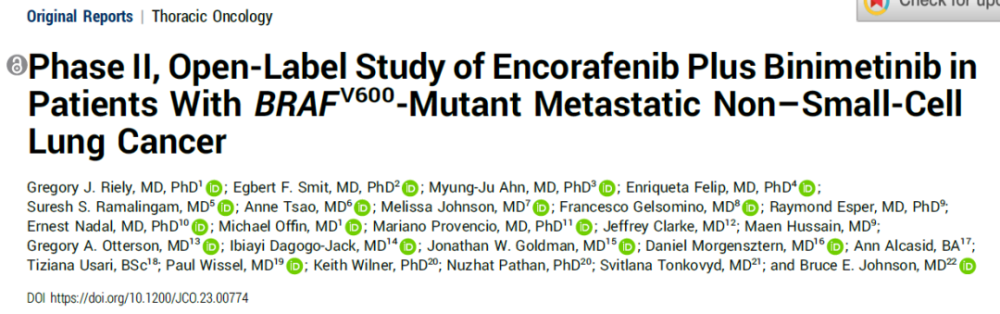
PHAROS Study Meets Primary Efficacy Endpoints of Objective Response Rate (ORR) Assessed by Independent Review Committee (IRC) and Duration of Response (DOR) in Two Treatment Groups.The ORR for treatment-naive patients (n=59) was 75% (95% CI: 62, 85), with 59% of patients experiencing relief for at least 12 months.At the data cutoff, the median DOR for this group was still not estimable (NE).The ORR for previously treated patients (n=39) was 46% (95% CI: 30, 63), with 33% of patients achieving at least 12 months of relief.The median DOR was 16.7 months (95% CI: 7.4, NE). These data were published in the Journal of Clinical Oncology.
The most common (≥25%) all-cause adverse reactions observed in the PHAROS trial were fatigue, nausea, diarrhea, musculoskeletal pain, vomiting, abdominal pain, vision disorders, constipation, dyspnea, rash, and cough.