

AbbVie Advances JAK Inhibitor Upadacitinib into Phase 3 Clinical Trials for Vitiligo Following Positive Phase 2b Results

AbbVie
Innovative Drug Developer
▎WuXi
Edited by Kant Content Team
AbbVie Inc. announced today that itsJAK Inhibitor Upadacitinib Meets Primary Endpoint in Phase 2b Clinical Trial for Non-Segmental Vitiligo (NSV) in Adult PatientsCompared with placebo, 11 mg and 22 mg doses significantly improved the change from baseline in the Facial Vitiligo Area Scoring Index (F-VASI) at Week 24. The improvement from baseline in F-VASI at Week 52 was numerically greater than the results at Week 24. No new safety signals were identified beyond the known safety profile of upadacitinib. Based on these data,AbbVie is advancing the upadacitinib project for the treatment of vitiligo into Phase 3 clinical trials.
Vitiligo is a chronic autoimmune disease that affects up to 2% of the global population. Patients experience depigmented white patches on the skin, most commonly around the mouth and eyes, fingers and wrists, armpits, and groin. The most troublesome patches appear on the face, making F-VASI a key indicator for patients and dermatologists to assess clinical improvement in vitiligo. Non-segmental vitiligo (NSV) is the most common form, affecting approximately 80% of patients. Individuals with vitiligo also experience emotional and psychological burdens, which can impact their quality of life.
Upadacitinib, a JAK inhibitor discovered and developed by AbbVie scientists, has received approval for seven indications and is currently under investigation in several immune-mediated diseases. In cellular assays,Upadacitinib preferentially inhibits JAK1 or JAK1/3 signal transduction.

At week 24, both the 11 mg and 22 mg doses of upadacitinib achieved the primary endpoint of percentage change from baseline in F-VASI compared to placebo.F-VASI is a tool for measuring facial repigmentation, used to evaluate the degree of repigmentation and treatment response in clinical trials. Compared with placebo, higher response rates were also observed in the upadacitinib group at secondary endpoints, including a higher proportion of patients achieving F-VASI 75 (≥75% reduction from baseline in F-VASI) at week 24 in both the 11 mg and 22 mg dose groups, and T-VASI 50 (≥50% reduction from baseline in Vitiligo Area Scoring Index [T-VASI]) at week 24 in the 22 mg dose group.
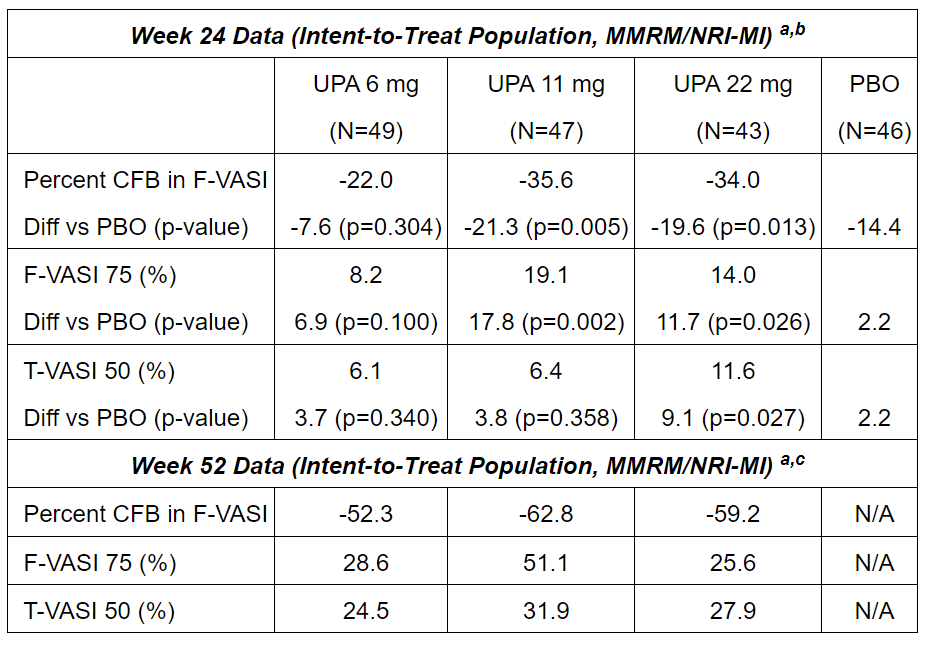
▲Efficacy data of Upadacitinib in treating vitiligo at 24 weeks and 52 weeks (Image source: Reference [1])
In all upadacitinib dose groups, the mean percentage decrease in F-VASI from baseline at Week 52 was numerically greater than the results at Week 24.Moreover, in all upadacitinib dose groups, the response rates for F-VASI 75 and T-VASI 50 observed at Week 52 were numerically higher than those at Week 24.