

Lecanemab (Leqembi®), a Groundbreaking Disease-Modifying Therapy for Early Alzheimer's Disease, Approved in Boao Lecheng, Hainan

Biogen
Neuroscience Drug Developer
Eisai
Pharmaceutical Product R&D and Manufacturer
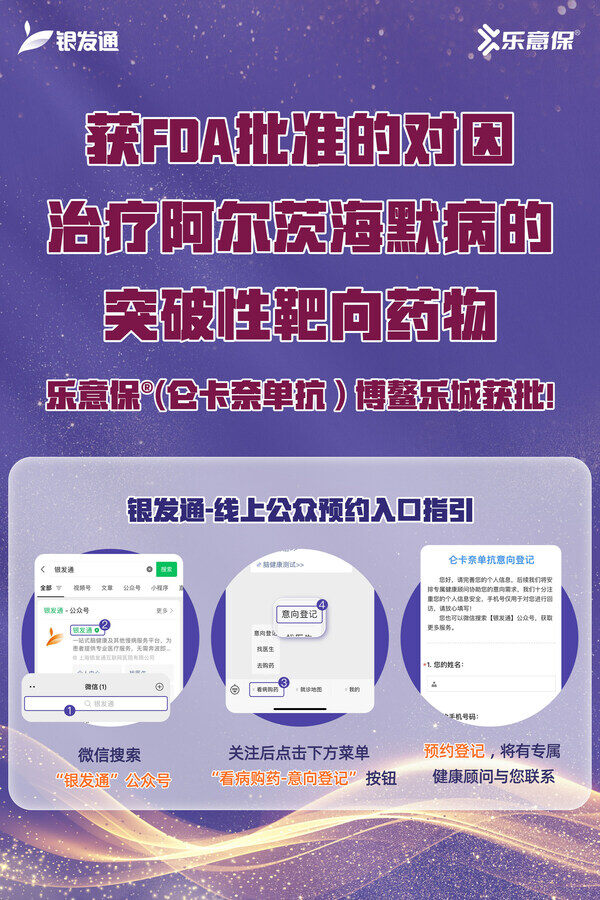
Boao, HainanOctober 13, 2023/PR Newswire/ --RecentlyLeqembi® (Lecanemab), a groundbreaking new drug for early Alzheimer's disease jointly developed by Eisai/Biogen, has been approved in Boao Lecheng, Hainan, China.
Heavy disease burden, huge clinical demand
Currently, China has become the country with the largest number of Alzheimer's disease (AD) patients globally, with nearly 10 million patients. It is predicted that by 2050, the number of Alzheimer's patients will range between 27.65 million and 91.94 million. An article in The Lancet Neurology shows that China spends up to $167.7 billion annually on Alzheimer’s disease, more than half of which are indirect costs, such as losses incurred from missed work due to caregiving by patients and their families. By 2050, this cost is expected to increase tenfold, reaching $1.89 trillion. Currently, effective clinical treatments in China are very limited. Available drugs primarily include cholinesterase inhibitors like donepezil and NMDA receptor antagonists such as memantine, which mainly provide short-term symptom relief but have no impact on the progression of the disease, leaving a significant unmet clinical treatment need.
Early Detection, Early Intervention: Maximizing Patient Benefits
Alzheimer's disease is a neurodegenerative disorder that develops insidiously and progresses over time. It is clinically characterized by comprehensive dementia symptoms, including memory impairment, aphasia, apraxia, agnosia, visuospatial skill damage, and executive dysfunction, with the exact cause still unknown. Cases that develop before the age of 65 are referred to as early-onset Alzheimer's disease, while those developing after 65 are called late-onset Alzheimer's disease. The general public currently lacks sufficient awareness of early intervention, often missing the "golden window" for treatment, such as during the mild cognitive impairment (MCI) stage or even earlier preclinical stages.
Disease-Modifying Treatment Brings Hope to Early AD Patients
Due to the complex pathogenesis of AD and the long-term and complex nature of clinical trials, the emergence of "Disease-Modifying Therapy" or DMT holds "epoch-making significance." Its core lies in intervening in the disease's pathogenic mechanisms, rather than merely alleviating symptoms or managing them.
The main pathogenesis of AD is the overproduction of Amyloid Beta (Aβ) in the brain, coupled with a reduced clearance capacity. This leads to the deposition of abnormal proteins forming "plaques," which result in neuronal death and impaired neural signal transmission. One principle of DMT is to target and eliminate these "plaques," addressing the problem at its source. In 2023, lecanemab (Leqembi®), the first anti-Aβ disease-modifying drug to receive full FDA approval in the U.S. in 20 years, indicates that Alzheimer's disease treatment has transitioned from the "symptom management era" to the "cause-based treatment era," opening new doors of hope. The approval of lecanemab in China’s Boao Lecheng will enable some Chinese patients to access advanced global AD medications earlier.
Eisai has been深耕 in the field of brain health in China for more than twenty years, always adhering tohhc(human health care, Concern for Human Health) corporate philosophy, focusing on neuroscience as a key development area and committing to the research and development of new drugs in this field to meet unmet medical needs, ultimately further contributing to the improvement of patients' and their families' well-being.