

Roche's BTK Inhibitor Fenebrutinib Shows Promise in Crossing Blood-Brain Barrier to Directly Target Brain Inflammation in Multiple Sclerosis

Roche
Oncology Drug Research, Development, and Manufacturing
▎WuXi
Edited by Kant Content Team
Roche today announced that its investigational oral Bruton's tyrosine kinase (BTK) inhibitor, fenebrutinib, met the primary endpoint in the Phase 2 clinical trial FENopta for the treatment of multiple sclerosis (MS).Fenebrutinib Reduces T1 and T2 Lesions Detected by Gadolinium-Enhanced Imaging in Patients' Brains by More Than 90%. At the same time,Biomarker testing shows that fenebrutinib can cross the blood-brain barrier and reach levels in the brain that directly inhibit inflammation.The press release noted that this means fenebrutinib can, to a certain extent, slow the progression of MS by acting directly within the brain.

Multiple sclerosis is a chronic disease that affects more than 2.8 million people worldwide. When the immune system erroneously attacks the myelin sheath that protects nerve cells in the central nervous system, it causes inflammation and nerve damage. This damage leads to a wide range of symptoms, including muscle weakness, fatigue, and vision difficulties, which may eventually result in disability. Most MS patients experience their first symptoms between the ages of 20 and 40, makingThis disease has become the leading cause of non-traumatic disability among young people.An important goal in treating MS is to slow down, stop, and prevent disease activity and progression as early as possible.
Fenebrutinib is an investigational oral, reversible, and non-covalent BTK inhibitor.BTK is an enzyme that regulates B-cell development and activation and is also involved in the activation of myeloid cells in the innate immune system, such as macrophages and microglia. Preclinical data show that fenebrutinib is potent and highly selective, with 130 times greater selectivity for BTK than for other kinases. High selectivity and reversibility may reduce off-target effects of the molecule.Fenebrutinib is a dual inhibitor of B-cell and microglial activation. This dual inhibition may reduce MS disease activity and disability progression, potentially addressing a key unmet medical need in patients with MS.
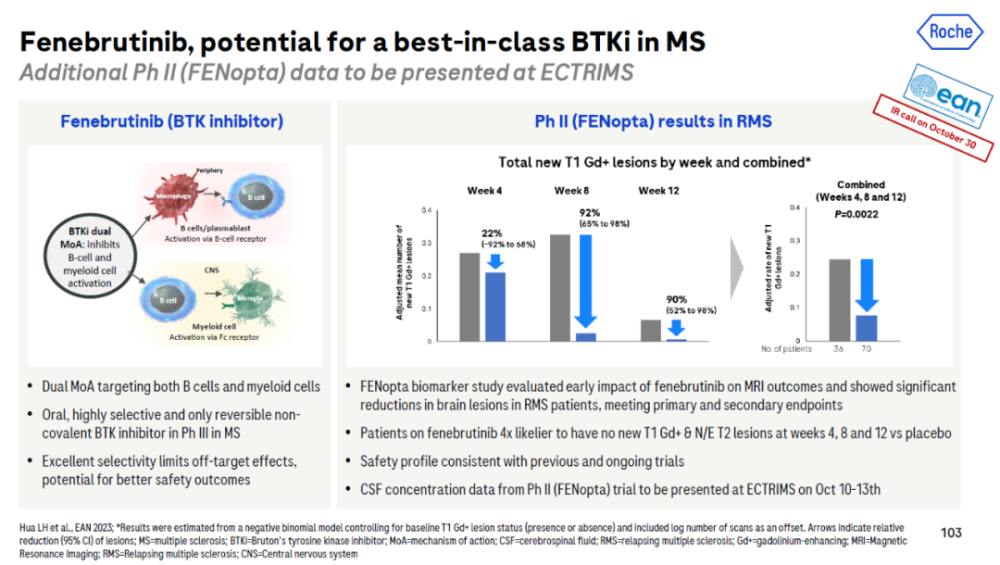
▲Introduction to Fenebrutinib (Source: Roche Official Website)
The test results showed,Fenebrutinib significantly reduced the total number of new T1 gadolinium-enhanced (T1 Gd+) brain lesions, a marker of active inflammation, as well as the total number of new or enlarging T2 brain lesions, representing disease burden or chronic lesion load.Rapid shrinkage of the lesion was observed at 4 weeks, and relative shrinkage of the T1 Gd+ lesion was observed at 8 weeks and 12 weeks.92% and 90%, T2 lesions relatively reduced90% and 95%Moreover, compared with patients receiving placebo treatment, patients treated with fenebrutinib were four times more likely to have no new T1 Gd+ brain lesions and no new or enlarging T2 brain lesions at weeks 4, 8, and 12 combined (odds ratio 4.005, p=0.0117).
By measuring the levels of fenebrutinib in the cerebrospinal fluid (CSF) of a subgroup of 11 patients with relapsing MS,After 12 weeks of continuous treatment, the average fenebrutinib concentration was 43.1 ng/mL. In preclinical studies, similar concentrations produced near-maximal inhibition (IC90).Therefore, it can be imagined that the levels of fenebrutinib in the brain and central nervous system may be sufficient to reduce MS disease activity and progression in patients.
The safety profile of Fenebrutinib is consistent with previous and ongoing clinical trials conducted to date in over 2,500 individuals. No new safety issues were identified in the FENopta study. The overall incidence of adverse events was 38% in the Fenebrutinib group and 33% in the placebo group. The most common adverse events that occurred at a higher rate in the Fenebrutinib group compared to the placebo group were abnormal liver enzyme levels (5.5% in the Fenebrutinib group vs. 0% in the placebo group), headache (4.1% vs. 2.8%), nasopharyngitis (2.7% vs. 0%), and upper abdominal pain (2.7% vs. 0%).