OX40, also known as CD134, is a key co-stimulatory molecule of T cells. Its immunomodulatory effects can enhance immune activity by regulating the proliferation and survival of effector T cells, as well as suppress the activity and proliferation of regulatory T cells (Tregs). The design goal of OX40 agonists is to enhance the efficacy of T cells, thereby strengthening the immune response. Therefore, antibodies developed based on OX40 as a target are expected to be highly effective in treating various immune-related diseases, including cancer and atopic dermatitis.
Previously, Amgen's Rocatinlimab (AMG 451/KHK4083), a potential "first-in-class" monoclonal antibody targeting the OX40 protein, showed promising results in moderate to severe atopic dermatitis.
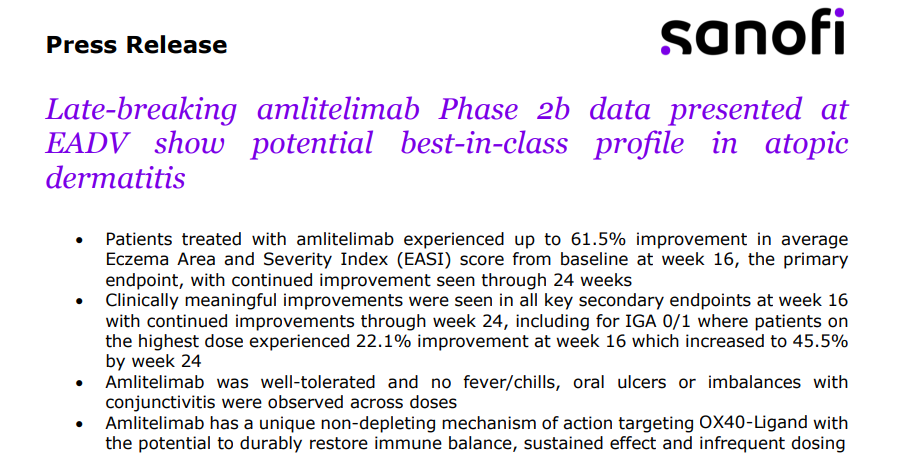
This time, Sanofi announced at the European Academy of Dermatology and Venereology that its anti-OX40L antibody amlitelimab has successfully passed the Phase IIb clinical trial (STREAM-AD) and met the primary endpoint. The Phase III trial is planned for 2024.
-
Patients treated with amlitelimab showed an average improvement of up to 61.5% in the Eczema Area and Severity Index (EASI) score from baseline at week 16 (primary endpoint), with continued improvement over 24 weeks.
-
At Week 16, all key secondary endpoints showed clinically meaningful improvements, which continued to improve through Week 24, including IGA 0/1. Patients on the highest dose experienced a 22.1% improvement at Week 16, increasing to 45.5% by Week 24.
-
Amlitelimab was well tolerated, with no imbalances in fever/chills, oral ulcers, or conjunctivitis observed across dose levels.
-
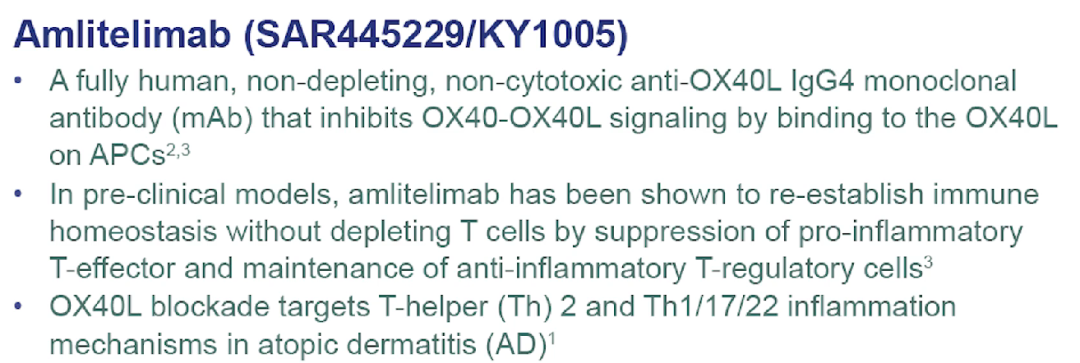
Amlitelimab is a fully human, non-depleting, non-toxic, IgG4 Fc subtype inhibitor targeting OX40L, with the potential for durable restoration of immune balance, sustained efficacy, and reduced need for frequent dosing.
 It should be noted that atopic dermatitis has a significant characteristic: itching, which becomes more intense with scratching. A key factor here is IL-31, also known as the "itching factor." IL-31 triggers itching, and when scratched, it exacerbates the inflammatory response while further promoting the expression of IL-31, resulting in an itch-scratch cycle.
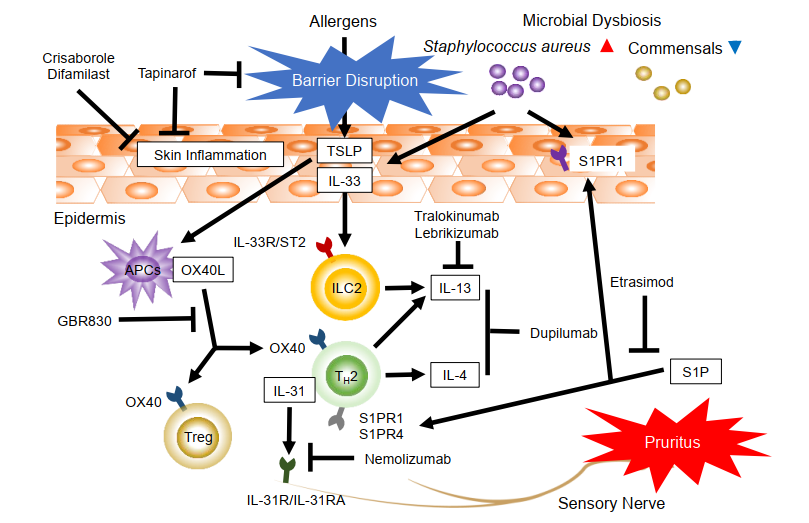
IL-4Ra inhibitors cannot solve this problem. OX40–OX40L, as the secondary co-stimulatory signal of T cells, their interaction plays a central role in the pathogenesis of AD (atopic dermatitis), associated with the Th1/Th2/Th17/Th22 pathways. OX40L inhibitors can partially address the issue of pruritus. The signaling pathway is shown in the figure below.
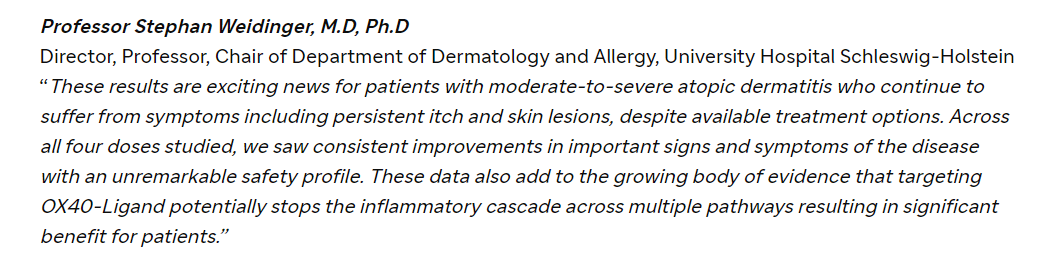
Professor Stephan Weidinger mentioned in Sanofi's press release that despite the availability of current treatment options, patients still suffer from itching and skin damage. However, under the treatment of an OX40L inhibitor, the important signs and symptoms of the disease are continuously improved without causing safety issues. These data further demonstrate that targeting OX40L may prevent inflammatory cascades through multiple pathways, thereby bringing significant benefits to patients.
At all doses in Week 16 and Week 24, treatment with amlitelimab significantly reduced biomarker levels in patients with atopic dermatitis, including Th2-related IL-13 and TARC, Th17/Th22-related IL-17A and IL-22, as well as blood eosinophils. This lays a foundation for broadening the indications of OX40L inhibitors.
Currently, the amlitelimab 250 mg Q4W with 500 mg loading dose (LD) group has shown the best performance. In terms of IGA scores, 22.1% and 45.5% of patients in the treatment group achieved IGA 0/1 (complete clearance/almost complete clearance) at weeks 16 and 24, respectively, compared to 5.1% and 11.4% in the placebo group (P=0.0022 and P<0.0001). Regarding the week 16 data, dupilumab vs placebo showed 38% vs 10% and 36% vs 9% in two clinical trials. Due to significant differences between various trials, this is for reference only. In terms of data, amlitelimab is slightly inferior.
Regarding the EASI-75 score, among patients receiving the same dose of treatment, 40.3% and 54.5% in the treatment group achieved EASI-75 at weeks 16 and 24, respectively, compared to 11.4% and 17.7% in the placebo group (both P<0.0001). Week 16 data showed dupilumab vs placebo as 51% vs 15% and 44% vs 12%, respectively. The two sets of data are similar.
Amlitelimab Shows Significant Potential in Atopic Dermatitis Indication; In China, Innovent Is Developing an OX40L Inhibitor with No Other Companies Disclosing Similar Efforts. Previously, OX40 Was Mainly Targeted in the Oncology Field.
Amlitelimab was initially developed by Kymab as a fully human monoclonal antibody targeting OX40L. In November 2021, Sanofi acquired Kymab for $1.45 billion to bring this drug into its portfolio.
It should be noted that atopic dermatitis has a significant characteristic: itching, which becomes more intense with scratching. A key factor here is IL-31, also known as the "itching factor." IL-31 triggers itching, and when scratched, it exacerbates the inflammatory response while further promoting the expression of IL-31, resulting in an itch-scratch cycle.
IL-4Ra inhibitors cannot solve this problem. OX40–OX40L, as the secondary co-stimulatory signal of T cells, their interaction plays a central role in the pathogenesis of AD (atopic dermatitis), associated with the Th1/Th2/Th17/Th22 pathways. OX40L inhibitors can partially address the issue of pruritus. The signaling pathway is shown in the figure below.
Professor Stephan Weidinger mentioned in Sanofi's press release that despite the availability of current treatment options, patients still suffer from itching and skin damage. However, under the treatment of an OX40L inhibitor, the important signs and symptoms of the disease are continuously improved without causing safety issues. These data further demonstrate that targeting OX40L may prevent inflammatory cascades through multiple pathways, thereby bringing significant benefits to patients.
At all doses in Week 16 and Week 24, treatment with amlitelimab significantly reduced biomarker levels in patients with atopic dermatitis, including Th2-related IL-13 and TARC, Th17/Th22-related IL-17A and IL-22, as well as blood eosinophils. This lays a foundation for broadening the indications of OX40L inhibitors.
Currently, the amlitelimab 250 mg Q4W with 500 mg loading dose (LD) group has shown the best performance. In terms of IGA scores, 22.1% and 45.5% of patients in the treatment group achieved IGA 0/1 (complete clearance/almost complete clearance) at weeks 16 and 24, respectively, compared to 5.1% and 11.4% in the placebo group (P=0.0022 and P<0.0001). Regarding the week 16 data, dupilumab vs placebo showed 38% vs 10% and 36% vs 9% in two clinical trials. Due to significant differences between various trials, this is for reference only. In terms of data, amlitelimab is slightly inferior.
Regarding the EASI-75 score, among patients receiving the same dose of treatment, 40.3% and 54.5% in the treatment group achieved EASI-75 at weeks 16 and 24, respectively, compared to 11.4% and 17.7% in the placebo group (both P<0.0001). Week 16 data showed dupilumab vs placebo as 51% vs 15% and 44% vs 12%, respectively. The two sets of data are similar.
Amlitelimab Shows Significant Potential in Atopic Dermatitis Indication; In China, Innovent Is Developing an OX40L Inhibitor with No Other Companies Disclosing Similar Efforts. Previously, OX40 Was Mainly Targeted in the Oncology Field.
Amlitelimab was initially developed by Kymab as a fully human monoclonal antibody targeting OX40L. In November 2021, Sanofi acquired Kymab for $1.45 billion to bring this drug into its portfolio.
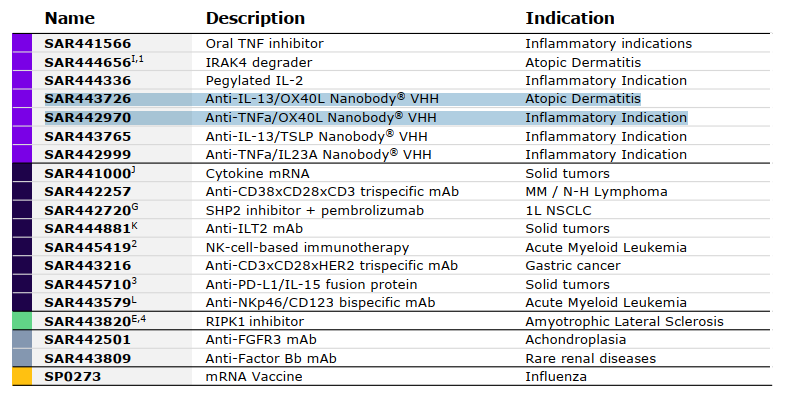
Meanwhile, Sanofi is also developing the OX40L/TNF-α bispecific antibody SAR442970, which has currently entered a Phase II study for the treatment of hidradenitis suppurativa.
Rocatinlimab (AMG 451/KHK4083) is a potential "first-in-class" monoclonal antibody targeting the OX40 protein. On December 23, 2022, the website of the Center for Drug Evaluation (CDE) under the National Medical Products Administration (NMPA) of China showed that the clinical trial application of rocatinlimab for atopic dermatitis has been successfully submitted and accepted.
According to the multi-center, double-blind, placebo-controlled Phase 2b clinical trial data for atopic dermatitis published in December 2022, adult patients with moderate to severe atopic dermatitis showed significant improvement in symptoms after 16 weeks of treatment with rocatinlimab. Most patients maintained the therapeutic effects for a period of time after discontinuation, and the treatment was well-tolerated.
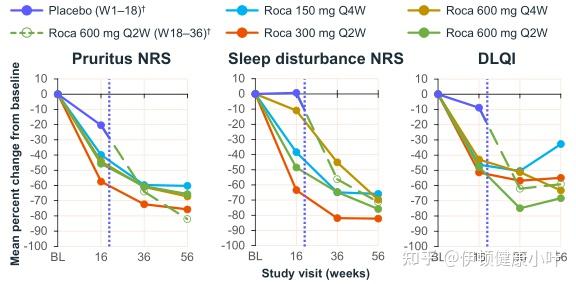
In addition, rocatinlimab has shown very promising effects in improving pruritus. A clinical study lasting 56 weeks and involving 267 adult patients with moderate to severe atopic dermatitis demonstrated that after 16 weeks of treatment with rocatinlimab, pruritus in atopic dermatitis patients was significantly improved, and a certain level of continued improvement was still observed during the subsequent 40 weeks of ongoing treatment.
As of October 9, 2023, there are 56 investigational drugs targeting OX40, covering 54 indications, with the participation of 71 research institutions. These efforts have led to 97 clinical studies and a total of 19,501 patent applications.
#OX40##Target#May become#Atopic Dermatitis#New Star Target!#OX40L Monoclonal Antibody##amlitelimab#The Phase IIb clinical trial met its primary endpoint. Previously#Rocatinlimab#Similarly, the effect is remarkable.Making atopic dermatitis, from#IL-13#, #IL-17#, #IL-21#Different targets, further expanding to OX40L, may allow for combination therapies in the future, which could yield better outcomes for patients who do not respond well to single treatments. Additionally, there is a necessity to develop treatments for atopic dermatitis in infants and young children, as this is a critical clinical need.#Eczema#