

AstraZeneca's Tagrisso Combined with Chemotherapy Granted FDA Priority Review for First-Line Treatment of EGFR-Mutated Advanced NSCLC, Demonstrating Over 9-Month PFS Improvement

AstraZeneca
Biopharmaceutical Manufacturer
▎WuXi
Edited by Kant Content Team
AstraZeneca today announced that the U.S. FDA has accepted and granted Priority Review to a supplemental New Drug Application (sNDA) for Tagrisso (osimertinib), its epidermal growth factor receptor (EGFR) tyrosine kinase inhibitor (TKI), in combination with chemotherapy for the treatment of adult patients with locally advanced or metastatic EGFR-mutated (EGFRm) non-small cell lung cancer (NSCLC). This decision was primarily based on the results of the Phase 3 FLAURA2 clinical trial. The data showed,Compared with standard treatment, the median progression-free survival (PFS) of patients using Tagrisso combination therapy was extended by nearly 9 months.The U.S. FDA is expected to complete the review in the first quarter of 2024.
It is estimated that approximately 2.2 million people worldwide are diagnosed with lung cancer each year, of which 80-85% are diagnosed with NSCLC. According to statistics, 10-15% of NSCLC patients in Europe and the United States have EGFR mutations, while this figure is 30-40% in Asian countries and regions.
Tagrisso is a third-generation, irreversible EGFR-TKI., which has been clinically proven to be effective for NSCLC. The approved indications for Osimertinib include the treatment of locally advanced or metastatic EGFRm NSCLC, first-line treatment of patients with locally advanced or metastatic EGFR T790M mutation-positive NSCLC, and adjuvant treatment for early-stage (IB, II, and IIIA) EGFRm NSCLC. In August 2023, Tagrisso in combination with chemotherapy was granted Breakthrough Therapy Designation by the U.S. FDA for the first-line treatment of adult patients with locally advanced or metastatic EGFRm NSCLC.
In the FLAURA2 trial,Compared with Tagrisso monotherapy (the global standard first-line treatment), the combination of Tagrisso and chemotherapy reduced the risk of disease progression or death by 38% (HR=0.62; 95% CI: 0.49-0.79; p
According to the investigator assessment, the combination therapy extended median PFS by 8.8 months compared to Tagrisso monotherapy. The PFS results from the blinded independent central review were consistent, showing that the combination of Tagrisso and chemotherapy extended patients' median PFS by 9.5 months (HR=0.62; 95% CI: 0.48-0.80; p=0.0002).
Notably, clinically meaningful PFS benefits were observed across all pre-specified subgroups, including patients with central nervous system metastases. In this subgroup,Compared with Tagrisso monotherapy, the combination therapy reduced the risk of disease progression or death by 53% (HR=0.47; 95% CI: 0.33-0.66), and extended the median PFS by 11.1 months compared with Tagrisso monotherapy.
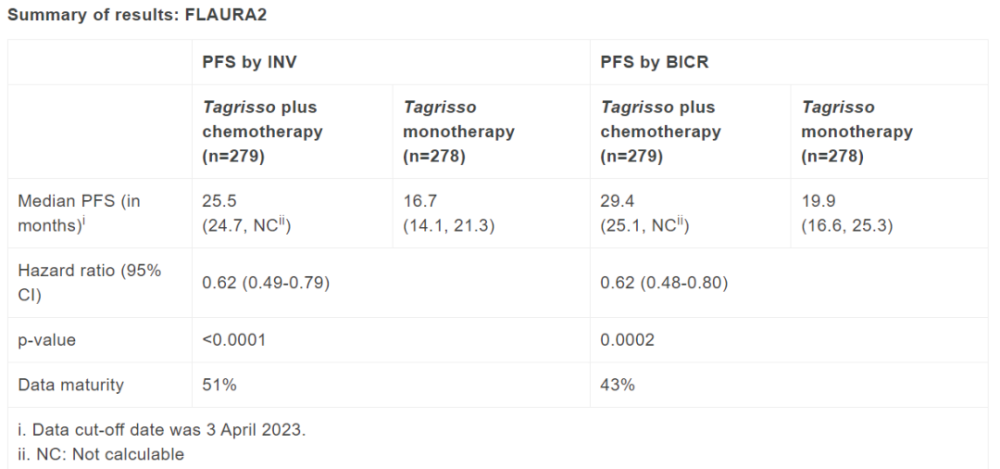
▲Efficacy results of the FLAURA2 trial (Image source: Reference [2])
At the time of analysis, overall survival (OS) data were not yet mature, but a favorable trend was observed with Tagrisso combination therapy. The trial continues to evaluate OS as a key secondary endpoint.
The safety profile of Tagrisso combination therapy is generally manageable and consistent with the established characteristics of the different components in the combination regimen.