

Early-Stage Lung Cancer Patients Receive New Hope as Keytruda Gains FDA and EMA Approvals for Expanded Indications

MSD
Pharmaceutical R&D and Manufacturer
▎WuXi
Edited by Kant Content Team
Today, information on the FDA's official website shows,重磅PD-1抑制剂Keytruda已获美国FDA批准,与含铂化疗联用作为术前新辅助治疗,并在术后单药作为辅助治疗,用于治疗可切除(肿瘤≥4厘米或淋巴结阳性)的非小细胞肺癌(NSCLC)患者。(Tumor ≥4 cm or lymph node positive). Meanwhile, Keytruda received approval from the European Commission (EC) as a single-agent adjuvant therapy for NSCLC patients at high risk of recurrence after complete resection and platinum-based chemotherapy.

Lung cancer is one of the most common types of cancer and a leading cause of cancer-related deaths. In 2020 alone, more than 2.2 million cases of lung cancer were diagnosed globally, resulting in over 1.8 million deaths. Lung cancer can be broadly categorized into two main types: non-small cell lung cancer (NSCLC) and small cell lung cancer (SCLC), with NSCLC being the most prevalent type, accounting for approximately 81% of lung cancer cases. About 44% of patients with non-small cell lung cancer are diagnosed at an advanced stage.
Keytruda is a humanized anti-PD-1 monoclonal antibody that blocks the binding of PD-1 to its ligands PD-L1 and PD-L2, thereby activating T lymphocytes.This effect may enhance the ability of the immune system in the body to detect and resist tumor cells. In September 2014, Keytruda was first approved by the FDA for the treatment of advanced melanoma and was subsequently approved as a first-line therapy for patients with metastatic NSCLC. In China, Keytruda has also been approved for multiple indications, covering melanoma, NSCLC, head and neck squamous cell carcinoma, colorectal cancer, esophageal cancer, and liver cancer.

The FDA's approval is mainly based on the Phase 3 clinical trial named KEYNOTE-671, which was recently released.Overall Survival DataResults show that the perioperative treatment regimen based on Keytruda demonstrated a statistically significant and clinically meaningful improvement in overall survival compared to the control group. This is the first phase 3 clinical trial to show a statistically significant overall survival benefit in this patient population. Previously published event-free survival (EFS) data indicated that the Keytruda group reduced the risk of disease recurrence, progression, or death by 42% compared to the control group (HR=0.58, [95% CI, 0.46-0.72], p
The median EFS for patients receiving the Keytruda-based regimen has not yet been reached (95% CI, 34.1-NR), while the EFS for patients receiving chemotherapy alone was 17 months (95% CI, 14.3-22).
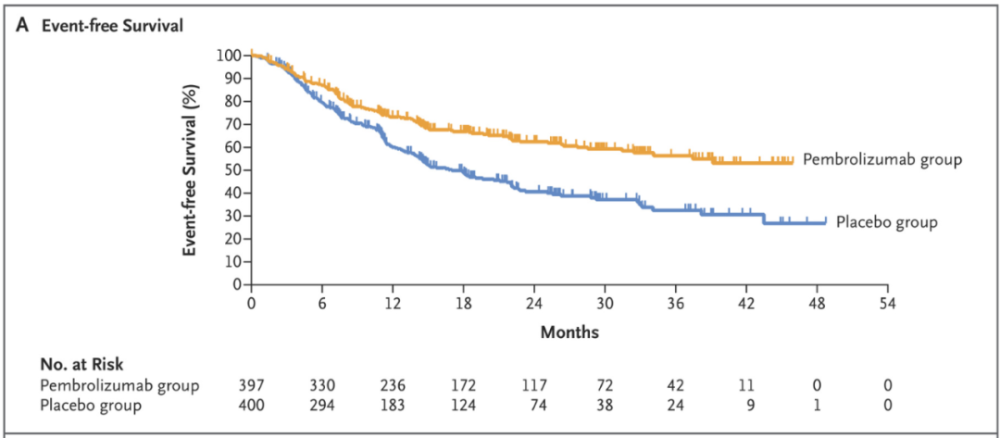
▲Event-free Survival Results of the KEYNOTE-671 Trial (Image Source: Reference [2])
The approval by the European Commission was based on the Phase 3 clinical trial KEYNOTE-091, which showed that at a median follow-up time of 46.7 months,Keytruda Brings Clinically Meaningful Improvement in Disease-Free Survival, Reducing the Risk of Disease Recurrence or Death by 24% (HR=0.76, [95% CI, 0.64-0.91])。