Lilly's Tirzepatide Achieves Record-Breaking Weight Loss of 29.2 kg in Phase 3 SURMOUNT-3 Trial

Eli Lilly
Global Pharmaceutical R&D and Production Company

Text by Wang Cong
Editor | Wang Duoyu
Typesetting丨Shuicheng Wen
The adverse effects of obesity on physical health, as well as the benefits of weight loss, are well-known. Losing weight5-10% can reduce the risk of type 2 diabetes and also improve cardiometabolic risk factors.(e.g., hypertension)And other obesity-related complications(e.g., osteoarthritis)。
Intensified lifestyle intervention is recommended for obesity management, including reducing caloric intake and increasing physical exercise. However, its overall effectiveness is limited by two factors.First,The weight loss effect of lifestyle intervention is generally modest, with less than 20% of people able to lose more than 15% of their weight.SecondlyWeight loss achieved through lifestyle interventions typically regains one-third of the weight within a year and gradually returns over time.
In recent years, withGLP-1Novel weight-loss drugs based on receptor agonists have been approved for marketing, which can support and enhance the outcomes of lifestyle interventions.Semaglutide(Semaglutide)Developed by Novo Nordisk.GLP-1Receptor agonist, approved for controlType 2 Diabetes and Weight Loss.For obese or overweight individuals without diabetes, semaglutide can reduce body weight over a period of up to two years.15%(Placebo is 2-3%)Semaglutide mainly reduces appetite by altering hunger and satiety signals in specific neural regions, thereby decreasing calorie intake.
Tirzepatide(Tizepatide)It is a new drug developed by Eli Lilly and Company.Is aGlucose-dependent Insulinotropic Polypeptide(GIP)Receptor andGlucagon-Like Peptide-1(GLP-1)A dual agonist of receptors, capable of producing synergistic effects on appetite, calorie intake, and metabolic function.It has been approved in regions such as the United States, the European Union, and Japan for the management of type 2 diabetes and is currently under review for use as a weight-loss drug.
Last year, it was announced under the name ofThe phase 3 clinical trial results of SURMOUNT-1 show that,Obese or overweight individuals who have not developed diabetes during the72-week treatment(Once weekly injection, 15mg each time)Later, the weight decreased.20.9%(3.1% in the placebo group), and accompanied byReduction of Cardiometabolic Risk Factors.
The expert team recommends that the use of weight-loss drugs after intensive lifestyle intervention can induce additional weight-loss effects, or at least prevent weight rebound.
On October 15, 2023, Eli Lilly and Company, in collaboration with a research team from the University of Pennsylvania and other institutions, published in a top international medical journal.Nature MedicinePublished an article titled:Tirzepatide after intensive lifestyle intervention in adults with overweight or obesity: the SURMOUNT-3 phase 3 trial 's Phase Clinical Research Paper.
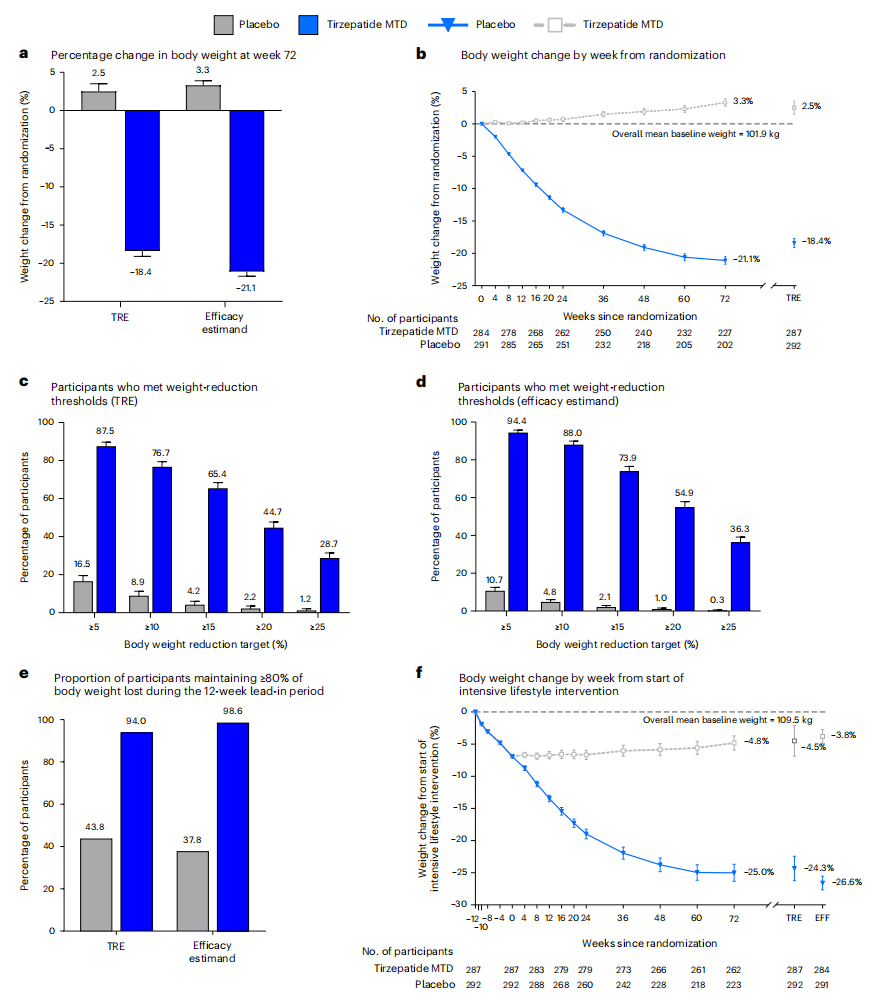
This project is namedResults from the Phase 3 clinical trial of SURMOUNT-3 show, over a 12-week periodStrengthenLifestyle Intervention(Including low-calorie diet, exercise, and frequent counseling)After useTirzepatide(Tizepatide)Over a treatment period of 72 weeks, totaling 84 weeks,Participants who are obese or overweight but do not have diabetesThe average weight loss was26.6%(29.2 kg), while the placebo group was only 3.8%.(4.1 kg)。
In thisNamedSURMOUNT-3In the Phase 3 clinical trial, a total of806 participants,At the start, their average weight was 109.5 kilograms, theseAdults who are obese or overweight but do not have diabetes over a 12-week periodLifestyle InterventionLead-in Period(Including low-calorie diet, exercise, and frequent counseling)At the end, there579 participants who lost 5% or more of their body weight, theirBody weight decreased by an average of 6.9%(7.6 kg), and then randomly assigned to receive a placebo orTirzepatide(Tizepatide)Treatment for 72 weeks,The starting dose is 2.5mg, increasing by 2.5mg every four weeks until the maximum tolerated dose is reached.(10mg or 15mg)。
The results showed that at 72 weeksTirzepatide(Tizepatide)During the treatment period, participants lost an average of 21.1% of their body weight. Since the start of the study, theyAn average weight loss over a total of 84 weeks26.6%(29.2 kg),This is alsoThe Best Drug Weight Loss Effects Achieved in Clinical Trials So Far,The placebo group experienced an average weight loss of only 3.8% over 84 weeks.(4.1 kg)。
Tirzepatide(Tizepatide)The overall safety profile in this Phase 3 clinical trial was consistent with findings from previous clinical trials. The most common adverse events were gastrointestinal-related, generally mild to moderate in severity. Compared with placebo, the most common adverse event in the tirzepatide treatment group was nausea.(39.7% vs. 14.0%), Diarrhea(31.0% vs. 9.2%), Constipation(23.0% vs. 6.8%),COVID-19(23.0% vs. 25.3%)And Vomiting(18.1% vs. 1.4%)Adverse events led to 10.5% of participants in the tirzepatide treatment group and 2.1% of participants in the placebo group discontinuing study treatment.
Senior Vice President of Product Development at Eli Lilly and CompanyJeff EmmickDr. said,In this study, people who used tirzepatide after dietary and exercise interventions experienced more significant and sustained weight loss compared to those who received a placebo. While intensive lifestyle intervention is an important component of obesity management, the results of this clinical trial highlight the difficulty some individuals face in maintaining weight loss through diet and exercise alone.
https://www.nature.com/articles/s41591-023-02597-w