

Pfizer Cuts 2023 Revenue Outlook by $9 Billion Amid Paxlovid and Comirnaty Sales Decline
Pfizer
Pharmaceutical R&D Developer
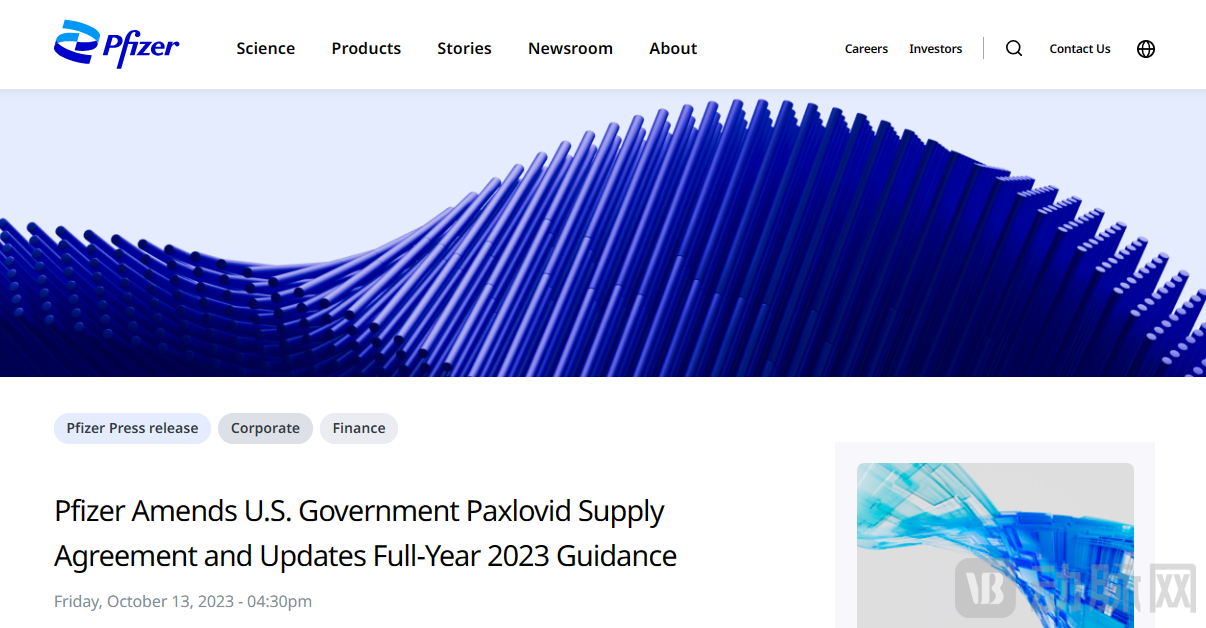
Pfizer Releases Announcement on "Pfizer Amends U.S. Government Paxlovid Supply Agreement and Updates 2023 Financial Guidance" After U.S. Stock Market Close on Friday, October 13, Eastern Time, Indicating Impact of COVID-19 Products Leads to Another Cut in Financial Forecast
The current forecast for the full-year revenue range this year is between $58 billion and $61 billion, a significant reduction of $9 billion from the previously guided range of $67 billion to $70 billion, representing a decrease of approximately 12.9% to 13.4%.Among them, the company reduced its full-year revenue forecast for Paxlovid in 2023 by approximately $7 billion and cut its full-year revenue forecast for Comirnaty in 2023 by approximately $2 billion.
 Source of the image: Screenshot from Pfizer's official website
As Paxlovid (Nirmatrelvir Tablets/Ritonavir Tablets) has transitioned from government emergency supply to commercial market supply, the government is expected to return the drugs distributed across the country, totaling approximately 7.9 million courses of treatment. Due to these returns and refunds, Paxlovid's sales this year will be $7 billion lower than the company's previous forecast.
Affected by the expected revenue decline of COVID products and inventory write-offs, the company has also lowered its earnings per share guidance to $1.45-$1.65. In response, the company immediately initiated a cost adjustment plan, which mainly includes severance payments and implementation costs. Based on adjustments to long-term revenue expectations, the overall plan aims to save $3.5 billion. Approximately $1 billion is expected to be achieved in 2023 to offset part of the 2023 earnings impact, with at least an additional $2.5 billion to be realized in 2024.
In addition to reducing expected revenue and implementing cost adjustment plans, Pfizer has also revised its supply agreements with the government to adjust the U.S. commercial availability pathway for Paxlovid in 2024, aiming to eliminate numerous uncertainties.
After the U.S. government returns Paxlovid products labeled with EUA at the end of the year, it will receive credit for products labeled with NDA from Pfizer. Meanwhile, Pfizer will continue to provide Paxlovid free of charge to Medicare patients through a patient assistance program until 2024, and to uninsured/underinsured patients until 2028, while generating some revenue upon product delivery. Additionally, 1 million courses of Paxlovid will be provided by Pfizer to the U.S. government as part of the national strategic reserve.
In this regard, Dr. Albert Bourla, Chairman and Chief Executive Officer of Pfizer, Inc., also stated that revenue related to the COVID-19 pandemic will continue to contribute to the company’s business for some time in the future.
This strategic adjustment will not only improve patients' access to the Paxlovid product but also provide the company with clearer market insights during the current commercial transition phase, promptly eliminating uncertainties regarding future business expectations. As there is a deeper understanding of COVID vaccination rates and treatment demands, Pfizer will continue to evaluate and adapt its supply levels to meet public health needs.
This announcement also indicated that the company's non-COVID product portfolio continues to grow strongly. In 2023, confidence in such products remains high, with expected revenue growth of 6%-8% year-over-year.
RSV Vaccine Abrysvo for Adults Receives FDA Approval in May and CHMP Positive Opinion for Maternal Immunization in July
The second-phase PHAROS study results of Braftovi combined with Mektovi for the treatment of BRAF V600E mutant metastatic non-small cell lung cancer (NSCLC) also showed positive outcomes, and the FDA's relevant review comments will be announced in the fourth quarter of 2023.
Litfulo, a product for treating severe alopecia areata in adolescents (over 12 years old), was approved by the U.S. FDA in June this year. The CHMP also gave a positive opinion in July, and the final result is expected in the coming months.
Ngenla (somatrogon-ghla), a human growth hormone analog administered once weekly, also received FDA approval in June this year. The product is indicated for the treatment of growth failure in pediatric patients aged three years and older due to insufficient endogenous growth hormone secretion. It has already been approved in over 40 markets for the treatment of pediatric growth hormone deficiency, including Canada, Australia, Japan, and EU member states.
In the same month, the US Centers for Disease Control and Prevention (CDC ACIP) unanimously voted to recommend Prevnar 20 (20-valent pneumococcal conjugate vaccine) for routine vaccination of all children under 2 years old, as well as routine vaccination for eligible children aged 2-18 with certain underlying conditions, and to provide catch-up doses for children who have not completed their pneumococcal vaccination series.
Talzenna (an oral poly ADP ribose polymerase (PARP) inhibitor) in combination with Xtandi (enzalutamide) for the treatment of adult patients with metastatic castration-resistant prostate cancer (mCRPC) harboring homologous recombination repair (HRR) gene mutations was also approved by the FDA in June this year. The approval was based on statistically significant and clinically meaningful data regarding radiographic progression-free survival (rPFS).
In addition to the pipelines that received marketing approval earlier this year, Pfizer has also prepared a large number of R&D pipelines. As of August 1, 2023, the company had 90 pipelines in clinical research, with 29 in Phase I, 28 in Phase II, and 23 in Phase III, while 10 pipelines were in the registration stage. In terms of indications, there are 32 oncology pipelines, 11 internal medicine pipelines, 9 rare disease/non-malignant hematology pipelines, and 15 vaccine pipelines.
Source of the image: Screenshot from Pfizer's official website
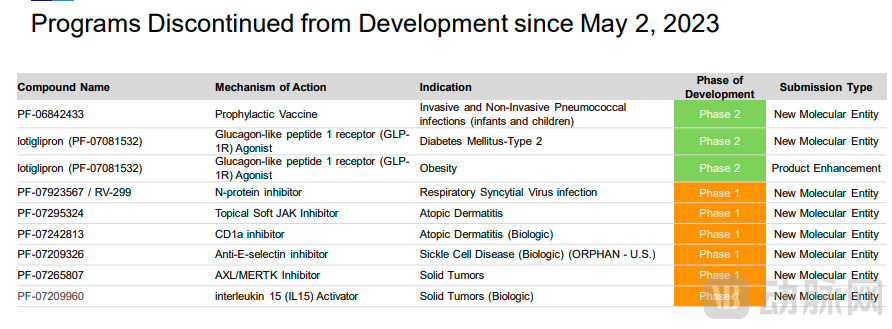
As of May 2, 2023, a total of 9 pipeline projects have been halted.
It can be seen that although the "achievements" of Paxlovid and Comirnaty are hard to surpass at this stage, in the current post-epidemic commercial transition period, Pfizer is also actively challenging itself and striving to find a new commercial balance.