

Roche's ALK Inhibitor Alecensa Reduces Risk of Recurrence or Death by 76% in Phase 3 Trial for Early-Stage ALK-Positive NSCLC

Roche
Oncology Drug Research, Development, and Manufacturing

Genentech
Pharmaceutical R&D Manufacturer
▎WuXi
Edited by Kant Content Team
Roche's Genentech recently announced that its ALK inhibitor Alecensa (alectinib) met the primary endpoint in the Phase 3 ALINA trial.Compared with platinum-based chemotherapy, Alecensa reduced the risk of disease recurrence or death by 76% in patients with ALK-positive early-stage non-small cell lung cancer (NSCLC)!According to the press release,Alecensa is the first ALK inhibitor to significantly improve disease-free survival (DFS) compared to chemotherapy.,PossibleProvide an effective new treatment strategy for ALK-positive NSCLC patients undergoing tumor resection。Detailed data were also published in the online abstract of the European Society for Medical Oncology (ESMO) Congress.
Lung cancer is one of the most common cancers, with NSCLC accounting for 80% to 85% of all lung cancer cases. Despite adjuvant chemotherapy, approximately half of early-stage lung cancer patients (45-76%, depending on disease stage) still experience cancer recurrence after surgery. Some innovative therapies, including immunotherapy, have improved outcomes for certain early-stage NSCLC patients. About 5% of NSCLC patients are ALK-positive. ALK-positive NSCLC is commonly seen in younger patients (typically aged 55 or younger), who usually have a limited smoking history or are non-smokers. For IB–IIIA stage ALK-positive NSCLC patients undergoing tumor resection, postoperative treatment with platinum-based chemotherapy is recommended, but it has shown limited improvement in patient survival.
Alecensa is a second-generation ALK inhibitor., approved for the treatment of patients with metastatic non-small cell lung cancer harboring ALK gene mutations.
ALINA is a global, open-label Phase III trial evaluating the efficacy and safety of Alecensa as an adjuvant therapy compared to chemotherapy in patients with completely resected ALK-positive NSCLC. A total of 257 patients were randomized to receive either Alecensa (n=130) or chemotherapy (n=127).
The study results showed that, in patients with completely resected stage IB (tumor ≥4cm) to IIIA ALK-positive NSCLC, compared with platinum-based chemotherapy,Alecensa can reduce the risk of disease recurrence or death by 76% in patients (HR=0.24, 95% CI: 0.13-0.43, p
In addition, a clinically meaningful improvement in central nervous system (CNS)-DFS was observed in the Alecensa group (HR=0.22; 95% CI: 0.08-0.58). Detailed trial results are as follows:
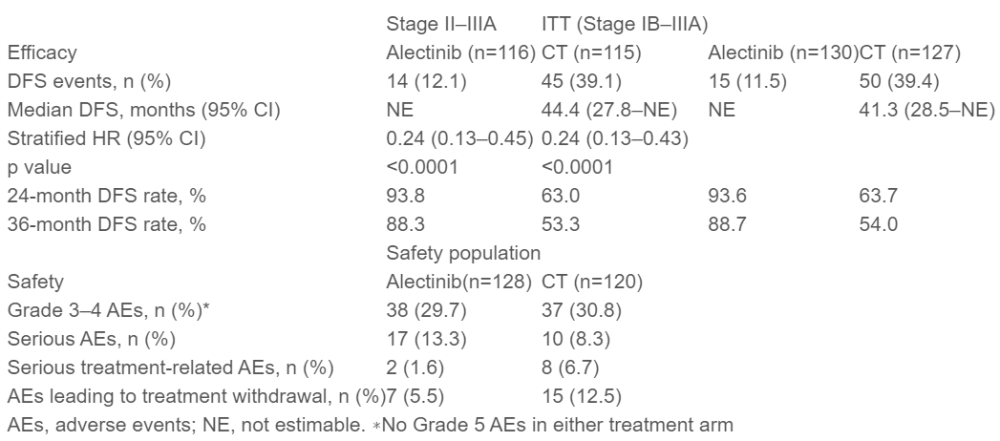
▲Summary of ALINA Phase 3 Clinical Trial Results (Image Source: Reference [2])
The safety and tolerability of Alecensa in this trial were consistent with previous trials, and no unexpected safety findings were observed. At the time of this analysis, overall survival data were not yet mature, and follow-up was ongoing.