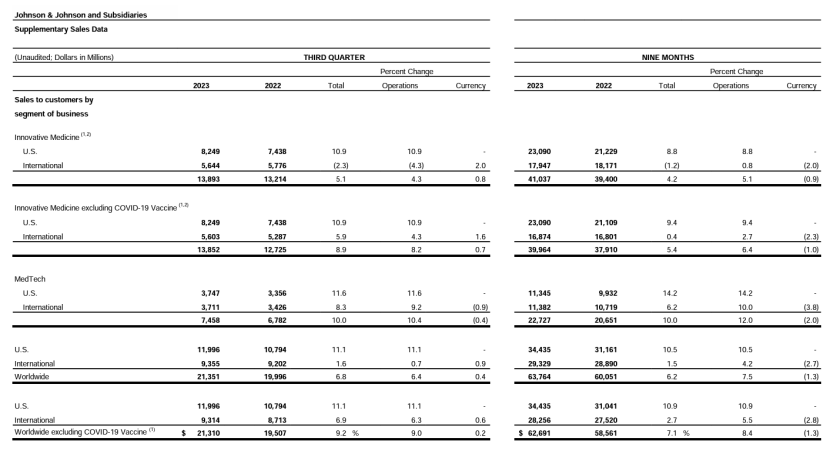
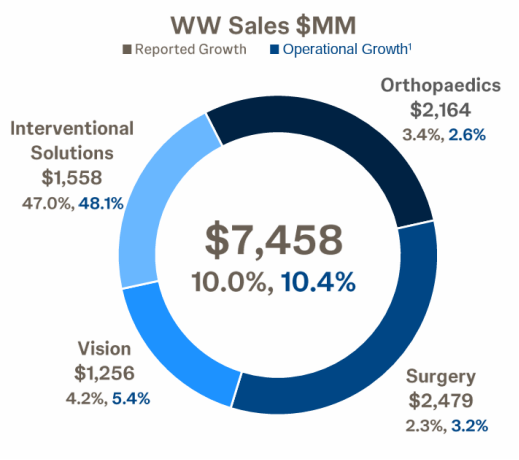
Source | CPhI China Medical DevicesWriting| Dongtai Many signs in the market show that the development logic of the orthopedic consumables market is changing.Leading companies are adjusting their layouts and increasing their stakes.At the same time, the orthopedic market in China is showing new characteristics against the backdrop of centralized procurement. 01Johnson & Johnson Restructures Orthopedics Business, Exits Some Markets and Product Lines On October 17, Johnson & Johnson released its Q3 2023 financial report and disclosed the progress of its orthopedics business restructuring. Johnson & Johnson CFO Joe Wolk stated,Johnson & JohnsonJohnson & Johnson took measures this quarter to improve the future profitability of its Medical Technology (MedTech) sector, implementing a restructuring plan aimed at streamlining and centralizing the operations of its orthopedics business.The reorganization is expected to be completed by the end of 2025 at a cost of $700 million to $800 million, but it will enhance the division's ability to meet product demand. Joe Wolk pointed out,A two-year restructuring plan will affect the company's orthopedics division."Exit 'low-profit markets and product lines'", in order to improve the profitability of this department, which previously reported a 2.6% increase in sales for the third quarter. Jessica Moore, Vice President of Johnson & Johnson Investor Relations, stated,Considering the market and product line exits, DePuy Synthes' total revenue will decrease by approximately $250 million over the next two years., but we believe that these initiatives will enhance our ability to meet demand, accelerate growth, and improve profitability. The financial report shows,Johnson & Johnson's third-quarter sales were $21.351 billion, a year-on-year increase of 6.8%, with a business growth rate of 9.0% excluding the COVID-19 vaccine; net income was $4.309 billion, basically flat compared to the same period last year. Among them, the sales of MedTech reached 7.458 billion US dollars, with a global adjusted operating sales growth of 6.0%, mainly driven by electrophysiology products in interventional solutions, wound closure products in general surgery, contact lenses in ophthalmology, and biosurgery products in advanced surgery. The global operational sales of MedTech increased by 10.4%, including a contribution of 4.6% from the acquisition of Abiomed. Focusing on orthopedic-related businesses,Johnson & Johnson's orthopedic surgery business sales reached $2.164 billion in the third quarter of this year, increasing by 2.6%.Among them, the sales of hip products were 375 million US dollars; the sales of knee products were 338 million US dollars; the sales of trauma products were 742 million US dollars; the sales of spine, sports medicine and other products were 710 million US dollars. Johnson & Johnson CEO Joaquin Duato expressed optimism about DePuy Synthes, firmly believing that the company will achieve significant growth in the coming years. The company is on a path to improving its orthopedics business, aiming to be a leader in every competitive market segment. Although this goal has not yet been reached, the company will continue to make progress through investments and expansion in the fastest-growing areas. 02
Orthopedic Giant Makes Frequent Moves, Entering a New Cycle in the Chinese Market
As early as March this year, news of Johnson & Johnson's restructuring and layoff plans had surfaced. Insiders revealed that the layoff plan was mainly focused on the company's medical technology-related departments.At least 1,000 layoffs expected in departments related to sports medicine and shoulder reconstruction, as well as in the minimally invasive surgical robotics project. Rajit Kamal, the then Global President of Johnson & Johnson's Sports Medicine and Shoulder Reconstruction Division, posted on LinkedIn that,This restructuring will integrate the company's sports medicine, shoulder reconstruction, and limb trauma businesses into the "Joint Reconstruction" business. In fact, global orthopedic giants have made significant moves in recent years. Behind the many measures such as internal adjustments, investment and mergers, and spin-offs for public listing lies increasingly fierce market competition. On one hand, multinational device companies are reducing costs and increasing efficiency through various means, while on the other hand, they are continuously strengthening their core capabilities. In March last year, ZimVie was spun off from Zimmer Biomet and went public. The former mainly includes dental, spinal, and bone healing businesses. In September this year, NuVasive and Globus Medical, two leading global orthopedic companies, announced the completion of their merger. It is estimated that the combined company will become the world's second-largest spinal technology company, only after Medtronic. In China, the orthopedic market is also experiencing significant changes. Under the full coverage of volume-based procurement, the mainstream products in the three major fields of trauma, spine, and joints have seen price reductions exceeding 80%. The price changes and market redistribution brought about by centralized procurement have significantly impacted multinational medical device companies, leading some enterprises to selectively withdraw from certain markets. In August, Stryker revealed in its financial report that the company had failed in the bidding for the volume-based procurement project of spinal products in the third quarter of 2022, and therefore is exiting the spinal business in China. In March, ZimVie announced that, affected by the national spinal procurement in China, it plans to completely withdraw its spinal business from the Chinese market. By comparison, the market share of leading orthopedic companies in China has increased, offsetting to some extent the profit fluctuations caused by price reductions. The profit margins of agents for multinational device companies have significantly shrunk, with some practitioners shifting towards domestic enterprises. Under market changes, senior management changes in companies are also relatively frequent. In August, John Collings, President of Stryker Asia Pacific, announced the new President of Stryker China. It was previously rumored that Greg Holman, President of Stryker China, planned to leave. According to the latest information, the position will be filled by Shao-bin Zhang, Senior Director of Stryker's Orthopedic Implants Division and Sales & Marketing. In March, Julia Chen, General Manager of the Orthopedics Division at Johnson & Johnson Medical Technology China, submitted her resignation to the company, deciding to pursue external development opportunities. Wei Han, former Vice President of the Spine and PCMFT Divisions at Johnson & Johnson, assumed the position on March 1, 2023, becoming the new leader of the Johnson & Johnson Orthopedics Division. Looking at the medical device market, the orthopedics sector is undoubtedly a key industry stronghold. Driven by factors such as an aging population, the market is expected to maintain steady growth. The competition among global orthopedic giants will continue to unfold in this relatively positive market environment.
Author: DongtaiWeChat ID: sssqy1218
Editor: Qin Jiu
WeChat ID: nrzx0321
Welcome to add for communication and submission(Please indicate industry + position) Scan the QR code below to enterCpharm Medical Device Exchange Group