

Novo Nordisk and GE HealthCare Collaborate to Explore Ultrasound-Based Therapy for Type 2 Diabetes and Obesity

GE Healthcare
Digital Solution Provider

Novo Nordisk
Insulin Developer and Manufacturer


On October 19, 2023, GE HealthCare announced a collaboration with Novo Nordisk to further advancePeripheral Focused Ultrasound (PFUS, Peripheral Focused Ultrasound Stimuli)Clinical and product development aims to use ultrasonic new technology to specifically modulate metabolic functions within the body, applying non-invasive bioelectronic medicine to support the treatment of chronic diseases such as type 2 diabetes and obesity.
This collaboration builds on the extensive foundational research conducted by the GE Healthcare team to date,The existing PFUS technology was developed by a group of scientists at GE Healthcare's Technology and Innovation Center, which was formerly part of GE Research.
As part of the collaboration, GE and Novo Nordisk will contribute their respective expertise in ultrasound medical technology and the treatment and management of metabolic diseases. Together, they will develop Peripheral Focused Ultrasound (PFUS) solutions to enhance patient care.
Other terms of the agreement were not disclosed.
About PFUS
Peripheral Focused Ultrasound (PFUS) is a non-invasive bioelectronic medicine that uses ultrasound to activate the nervous system to stimulate responses potentially capable of treating diseases.
Preclinical proof-of-concept and preliminary early clinical studies have shown that it can influence glucose metabolism in patients with diabetes through personalized ultrasound stimulation of neural pathways.
If further clinical evidence validates, PFUS may represent a non-pharmacological approach to normalizing blood glucose levels in patients with type 2 diabetes.
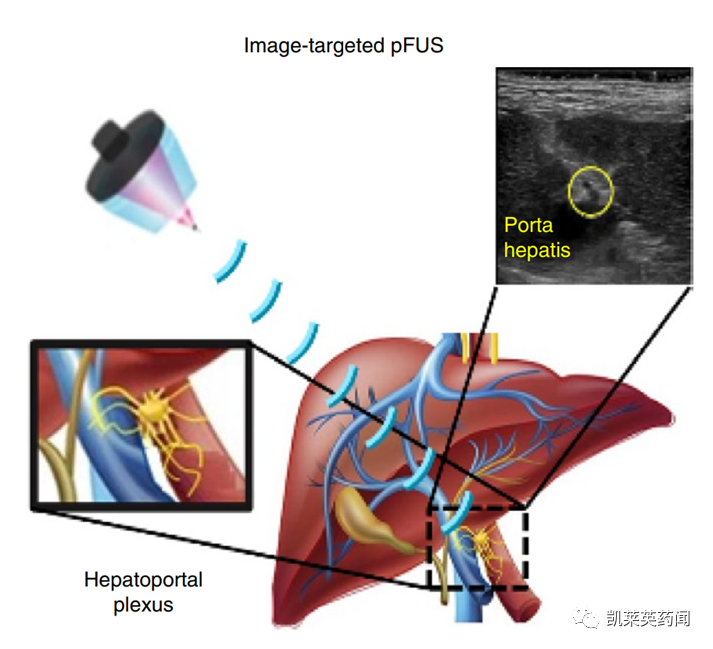
Schematic Diagram of Peripheral Focused Ultrasound Stimulation Technology
The journal NATURE BIOMEDICAL ENGINEERING (IF: 25.671) published a research article on PFUS:
Researchers used PFUS technology to explore stimulation of the liver region, which contains the hepatic portal plexus responsible for transmitting information such as glucose and nutrient status to the brain. However, due to its neural structure being too small for individual stimulation with implanted electrodes, it has been difficult to study.
New research shows,In ChinaTargeted burst action using PFUS in the liver area successfully reversed the onset of hyperglycemia, and it was also found that this treatment was effective in three different animal models of diabetes (Mice, rats, and pigs)Effective in China.
Study finds: In animal models of diabetes, using PFUS technology to stimulate specific sensory nerves in the liver for just 3 minutes a day can restore blood sugar levels to normal. This non-pharmacological approach holds promise for the prevention or reversal of type 2 diabetes.
Novo Nordisk's Recent Collaborative Explorations in the Diabetes Field




"Views"Click once