

Iambic Therapeutics Files for IPO Following $100M Series B Round and NVIDIA Partnership to Accelerate AI-Driven Drug Discovery

Iambic Therapeutics
Small Molecule Therapy Developer

Ascenta Capital
Private Equity Investment Firms

Abingworth
Venture Capital Firms
NVIDIA
Artificial Intelligence Computing Service Provider

Illumina Ventures
Venture Capital Firms

Gradiant
Water Treatment and Digital Solutions Provider

Nexus Ventures
Early-stage Investment Firms

Catalio Capital Management
Biomedical Investment Institutions

Coatue Management
Sponsors of Private Hedge Funds

Freeflow Ventures
Pre-seed and Seed-Stage Venture Capital Firms

OrbiMed
Investment institutions dedicated to the biomedicine and life sciences fields

HongShan
Business Consulting, Enterprise Management Consulting Investment Institutions
Recently, VCBeat reported that AI pharmaceutical company Iambic Therapeutics (formerly "Entos," hereinafter referred to as Iambic) announced the completion of a $100 million Series B financing round. This round was co-led by Ascenta Capital and Abingworth, with participation from new and existing investors including NVIDIA, Illumina Ventures, Gradiant Corporation, Nexus Ventures, Catalio Capital Management, Coatue, FreeFlow, OrbiMed, HongShan, and board member Bill Rastetter. The funds will be used to advance the continuous innovation of its AI platform and the clinical development of its drug candidates.
In addition, Iambic also announced a collaboration with NVIDIA in AI technology. NVIDIA's computing technology is an indispensable component of the drug discovery platforms used by many AI pharmaceutical companies. This partnership will enable Iambic to leverage technologies such as the NVIDIA DGX Cloud AI supercomputing platform and NVIDIA BioNeMo cloud services to accelerate new drug development.
Iambic Therapeutics, Inc. was founded in 2019 as a biopharmaceutical company that develops small-molecule drugs using AI technology. The company is committed to leveraging AI algorithms to drive high-throughput experimental platforms for the identification of unique biochemical substances, thereby advancing the development of highly differentiated drug candidates.
Currently, Iambic Therapeutics has developed four molecules discovered by AI, with two major R&D pipelines, IAM-H1 and IAM-C1, expected to enter Phase I clinical trials next year.
In just four years, Iambic Therapeutics has developed four molecules, with its R&D pipeline currently in the IND application stage. The company has garnered attention from prominent investors such as HongShan, OrbiMed, and NVIDIA Corporation, backed by an excellent team.
Tom Miller, the co-founder and CEO, is a scientific entrepreneur dedicated to linking artificial intelligence, chemistry, and biology. In 2005, he earned his Ph.D. in theoretical chemistry from the University of Oxford in the UK, at a time when advancements in computer technologies such as data mining and deep learning were increasingly being applied in the field of chemistry.
In 2008, he joined the California Institute of Technology as a chemistry professor. During this time, he primarily focused on researching how to use computational theories and methods to understand various molecular processes, such as enzyme catalysis and the kinetics of computational chemical and biological systems. He has published over 130 peer-reviewed articles.
In 2019, based on the consideration of transforming scientific achievements into technology and solving the challenges in the field of drug discovery, Tom Miller and Fred Manby co-founded Iambic. Fred Manby is an expert in quantum theory and AI software engineering and has served as a professor of theoretical chemistry at the School of Chemistry, University of Bristol for 20 years. He now serves as the Chief Technology Officer at Iambic.
In an interview, Tom Miller stated, "Drug discovery is not only about finding new targets; targeting already-druggable targets with new approaches is also an important area of research. Therefore, a thorough understanding of how molecules interact with known disease targets can help drug developers design molecules with better druggability. We hope to use AI technology to predict these properties, thereby accelerating and optimizing the drug discovery process."
In order to achieve the goal of improving the efficiency of drug research and development, Iambic Therapeutics has built a team covering the fields of bioscience and AI technology, with members including AI engineers, experts in computational chemistry, and drug research and development scientists.
Scientific Advisor Frances H. Arnold is an expert with professional experience in both academic research and enterprise development. She earned her Ph.D. in Chemical Engineering from the University of California, Berkeley. She is also a pioneer in the field of molecular directed evolution, completing the first directed evolution experiment of an enzyme in 1993 and being awarded the Nobel Prize in Chemistry in 2018 for her work on directed evolution.
In addition to her role at Iambic Therapeutics, she is a board member of Alphabet, the parent company of Google, and Illumina, a leader in gene sequencing. She also serves as the Linus Pauling Professor at the California Institute of Technology and the Director of the Donna and Benjamin M. Rosen Bioengineering Center. Furthermore, she is a co-founder of biotechnology companies such as Gevo and Provivi, and acts as a scientific advisor to several biopharmaceutical enterprises.
In 2022, Iambic Therapeutics appointed Dr. Chao Zhang, a seasoned biotechnology executive, as Chief Scientific Officer. Dr. Zhang earned his Ph.D. in Structural and Systems Biology from the University of California, Berkeley, and is skilled in leveraging novel platform technologies to advance drug discovery and development. His industry expertise spans oncology, immunology, and rare diseases.
Before joining Iambic Therapeutics, Zhang Chao served as the CEO of Plexxikon, a small-molecule drug discovery company. During his tenure, he and his team advanced 14 new chemical entities into clinical development, two of which were approved for marketing: Zelboraf® (vemurafenib) and Turalio® (pexidartinib).
Under Zhang Chao's leadership, Iambic Therapeutics advanced and expanded its oncology-focused drug development pipeline, while enhancing the precision and speed of its AI-driven high-throughput experimental platform.
New drug development mainly includes three stages: drug discovery, preclinical research, and clinical trials. The entire process generally takes about 10 years. Long R&D cycles, low success rates, and high costs are the three major challenges faced by biopharmaceutical companies. Therefore, pharmaceutical companies generally hope to use technological innovation to accelerate the speed of new drug development, improve success rates, and reduce costs. Currently, there are usually two approaches in the AI-driven pharmaceutical field to achieve this goal.
One is the adoption of a "physics-based" drug discovery approach, using software to run simulations of small molecule interactions with proteins, thereby gaining a better understanding of molecular dynamics and subsequently identifying potential drug targets. Companies utilizing this model include Nimbus Therapeutics, Relay Therapeutics, and Schrödinger.
The other is to generate data through experiments, and then obtain new biological and chemical insights by analyzing and querying the data. Based on the data and analysis results, effective drug targets are identified. Biopharmaceutical companies such as Exscientia and Recursion Pharmaceuticals have adopted this approach.
Iambic Therapeutics, Inc. has combined the above two methods to develop a high-throughput experimental platform driven by a physics-based AI technology algorithm. This platform integrates AI technology with Iambic's OrbNet technology, which not only identifies new molecules with efficacy and safety but also reveals the properties of these new molecules, such as the effects of target molecules, toxicity profiles, and how the molecules move and interact within the body.
OrbNet was co-developed by Tom Miller and Anima Anandkumar, Director of Machine Learning Research at NVIDIA, at the California Institute of Technology. OrbNet is a graph neural network capable of performing chemical modeling at the atomic level, simulating the energy and forces between potential drugs and proteins to construct an accurate molecular simulation model. This molecular model can explore chemical space and enable the on-demand generation of molecules with desired physical, chemical, or biological properties, improving the efficiency of data collection and analysis in the R&D process and ultimately accelerating drug discovery.
In addition, Iambic optimized OrbNet using NVIDIA's NeuralPLexer algorithm. NeuralPLexer is a diffusion model framework that can directly predict protein-ligand complex structures and their fluctuations using only protein sequences and ligand molecular graph inputs.
Data released on the Iambic Therapeutics, Inc. official website shows that, with the support of NeuralPLexer, OrbNet can accurately simulate various target molecular properties. Compared with traditional quantum chemistry methods such as Density Functional Theory (DFT), it can increase the speed of molecular property prediction by a thousand times.
Therefore, by combining OrbNet with automated experimental platforms, researchers are able to complete a "design-make-test" cycle weekly, finishing the process from designing novel molecules to generating new biological data within a week, thereby accelerating the identification of potential first-in-class and best-in-class drug therapies.
Currently, Iambic Therapeutics has two main R&D pipelines, IAM-H1 and IAM-C1.
IAM-H1: HER2 Inhibitor
IAM-H1 is a tyrosine kinase inhibitor (TKI) that selectively targets human epidermal growth factor receptor-2 (HER2, also known as ERBB2) and HER2 mutants. HER2 induces protein overexpression on the cell membrane through high-level amplification, thereby causing cells to acquire carcinogenic properties. Its amplification and mutations are important causes of various cancers, including breast cancer and lung cancer.
Do-Youn Oh and Yung-Jue Bang's research results on HER2 show1In approximately 20%-30% of breast cancer patients, the HER2 gene is overexpressed. Breast cancers with HER2 overexpression are highly invasive, with early recurrence and metastasis, and patients have a poor prognosis.
IAM-H1 is a selective small-molecule inhibitor that effectively targets all known oncogenic forms of HER2, including the rare mutation in EGFR—exon 20 insertion mutations. Moreover, IAM-H1 blocks the abnormal proliferation signaling pathways of HER2 and HER2 mutants without affecting the role of EGFR in normal tissue development and function.
Clinical research data show that IAM-H1 demonstrates good efficacy, tolerability, pharmacokinetics (PK), and safety in a series of HER2 tumor models, including intracranial models. Additionally, IAM-H1 exhibited a high CNS (central nervous system disease) exposure rate in PK evaluations, with the ability to penetrate the blood-brain barrier, and showed excellent efficacy in intracranial tumor models.
Iambic Therapeutics is expected to begin the Phase I clinical trial of IAM-H1 in early 2024.
IAM-C1: CDK2/4 Inhibitor
Cyclin-dependent kinases (CDKs) play a crucial role in regulating various biological processes and transcriptional activities, but their overexpression can lead to the development of multiple cancers. Currently, the three CDK inhibitors approved by the FDA are Pfizer's Ibrance (palbociclib), Novartis' Kisqali (ribociclib), and Eli Lilly's Verzenio (abemaciclib), which are重磅 products for the treatment of breast cancer.
IAM-C1 is a small-molecule inhibitor targeting CDK2 and CDK4, which can selectively inhibit CDK2/4 while preserving other normal CDKs (including CDK1, CDK6, and CDK9). Preclinical study data show that, compared with approved CDK4/6 inhibitors, IAM-C1 demonstrates favorable efficacy and resistance, and can be administered at minimal doses, thereby reducing drug toxicity and side effects, thus enhancing safety.
Currently, IAM-C1 is in the IND application stage and is expected to enter Phase I clinical trials in 2024.
In addition, Iambic's pipeline projects also include the research and development of allosteric inhibitors and allosteric PPI (protein-protein interaction) inhibitors.
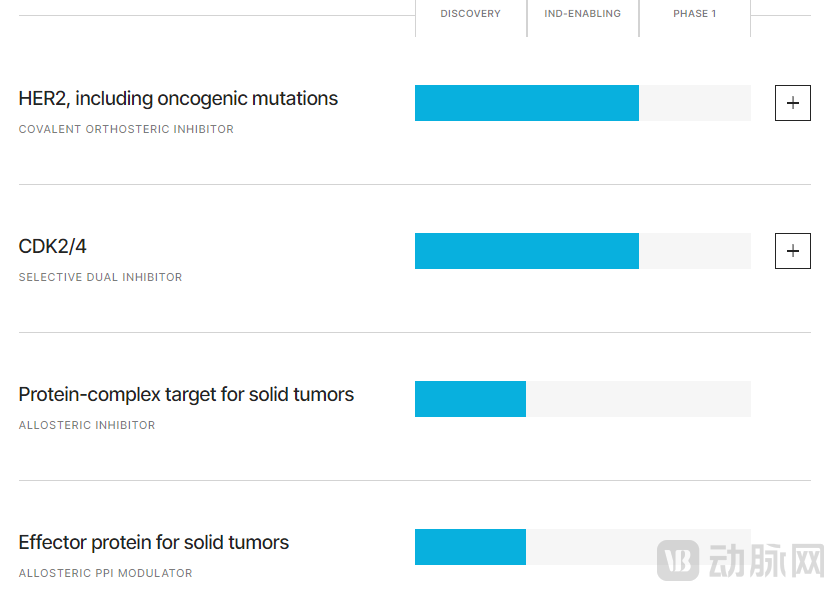
Iambic Therapeutics' Pipeline Under Research
References:
1.Oh DY, Bang YJ. HER2-targeted therapies - a role beyond breast cancer. Nat Rev Clin Oncol. 2020 Jan;17(1):33-48. doi: 10.1038/s41571-019-0268-3. Epub 2019 Sep 23. PMID: 31548601.