

Pathological Complete Response Doubled in Early Gastric Cancer: Imfinzi Plus Chemotherapy Shows Superiority Over Chemo Alone in Phase 3 MATTERHORN Trial

AstraZeneca
Biopharmaceutical Manufacturer
▎WuXi
Edited by Kant Content Team
Today, AstraZeneca announced that the interim analysis results of the Phase 3 trial MATTERHORN showed,PD-L1 Inhibitor Imfinzi (Durvalumab) Combined with Standard Neoadjuvant Chemotherapy, in treatmentResectable, Early, and Locally Advanced (Stage II, III, IVA) Gastric Cancer and Gastroesophageal Junction (GEJ) CancerIn patients, compared with neoadjuvant chemotherapy alone, the key secondary endpointPathological complete response (pCR) shows statistically significant and clinically meaningful improvement。
Gastric cancer is the fifth most commonly diagnosed cancer globally and the fourth leading cause of cancer-related deaths, with approximately 1.1 million new cases diagnosed worldwide in 2020 and 768,000 deaths attributed to the disease. The five-year survival rate for patients with advanced gastric cancer is only 6%.
Imfinzi is an anti-PD-L1 monoclonal antibody that解除肿瘤细胞对免疫反应的抑制 by blocking the binding of PD-L1 with PD-1 and CD80 proteins.It has been approved in multiple countries and regions for the treatment of extensive-stage small cell lung cancer, and has received FDA approval for the treatment of non-small cell lung cancer and advanced bladder cancer.
According to the assessment by the Blind Independent Central Review (BICR),The pCR rate for Imfinzi + neoadjuvant chemotherapy was 19%, compared to 7% for patients treated with neoadjuvant chemotherapy alone (a difference in pCR rate of 12%; p
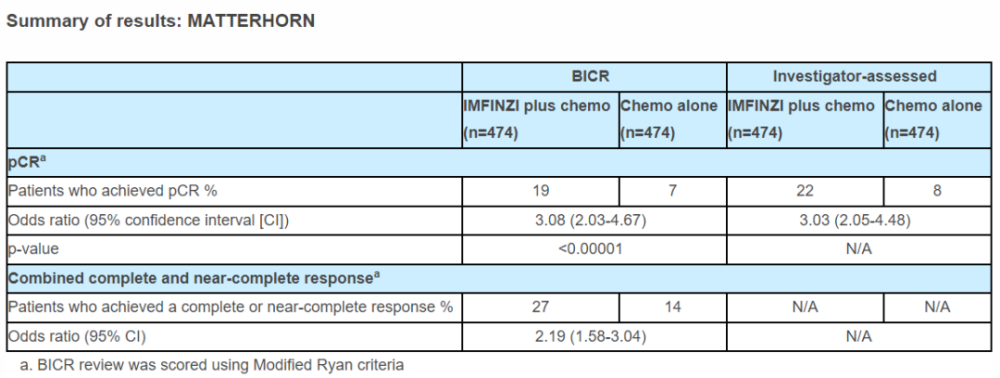
▲Phase 3 clinical trial data of Imfinzi (Image source: Reference [1])
Imfinzi is generally well-tolerated, with no new safety signals observed during neoadjuvant therapy. Furthermore, the safety and tolerability of adding Imfinzi to neoadjuvant chemotherapy are consistent with the known characteristics of this combination treatment. The incidence of all-cause grade 3 or higher adverse events was similar between the two groups, with a rate of 69% in the Imfinzi regimen group and 68% in the neoadjuvant chemotherapy alone group.
The trial is evaluating Imfinzi in combination with chemotherapy as a perioperative treatment (before and after surgery) and will continue as planned to assess the primary endpoint of event-free survival (EFS) and the key secondary endpoint of overall survival (OS).