

IDEAYA Biosciences Advances Synthetic Lethality Pipeline with Over $300M Raised and Strategic Collaborations with Amgen, GSK
IDEAYA Biosciences
Targeted Therapy Drug Developer

GSK
Pharmaceutical R&D Manufacturer

Amgen
Developer of Treatment Drugs for Serious Diseases

Pfizer
Pharmaceutical R&D Developer
The synthetic lethality mechanism is the "Achilles' heel" of tumors.
In recent years, the concept of synthetic lethality (SL) has flourished, especially after the first approval and market launch of poly ADP-ribose polymerase (PARP) inhibitors, which has continuously fueled the industry's enthusiasm for the theory of synthetic lethality. Currently, several Biotech companies at home and abroad, including Merck, AstraZeneca, Pfizer, Inpac Pharma, and SaintDomain Bio, have positioned themselves in the synthetic lethality field.
Synthetic lethality refers to the presence of two genes, where the cell can survive if one gene mutates or becomes nonfunctional, but cell death occurs when both genes mutate or fail to express simultaneously.
This theory can be traced back to 1992 when American scientist Calvin Bridges discovered in his research on fruit flies that those with both pd and Pdr gene mutations could not survive, whereas a mutation in either gene alone would not cause death in the fruit flies.1In 1946, Theodore Dobzhansky formally proposed the concept of synthetic lethality.2, used to describe the complementary lethal effect between different genes.
Further research found that similar paired genes also exist in the human body. The inactivation of a single gene does not affect cell survival, but if both genes are inactivated, it leads to cell death.
Tumor cells often contain a large number of mutations and gene replication errors, which normal cells do not have. Therefore, if the corresponding synthetic lethal pairing gene for a tumor mutation gene can be identified and targeted, it may be possible to "precisely eliminate" tumors containing specific mutations without affecting the physiological function of normal cells.
Despite the simple principle, it will be difficult to find suitable pairs of synthetic lethal genes without technological breakthroughs.
IDEAYA Biosciences (hereinafter referred to as IDEAYA) is an innovative company dedicated to breaking through the technical challenges in the field of synthetic lethality. The company focuses on developing a new generation of targeted drug therapies for cancer patient populations selected through molecular diagnostics.
IDEAYA Biosciences, Inc. was founded in 2015 and is headquartered in the San Francisco Bay Area, a hub of technological innovation in the United States. Since its establishment, IDEAYA has garnered attention from several prominent investment firms, including 5AM Ventures, Roche Venture Fund, Google Ventures, and WuXi AppTec. Backed by investments from multiple companies, IDEAYA successfully went public in 2021, raising over $300 million in total financing.
IDEAYA: A Stellar Journey in Synthetic Lethality – 6 Years to IPO, Backed by Star-studded Capital, Partnering with Renowned MNCs… Behind the "Highlight" Moments Lies a Team of Extensive Experience.
Yujiro S. Hata, President and CEO, is a veteran in the biotechnology field with over 20 years of industry experience, having held positions at multiple biotech companies since 2002. Prior to founding IDEAYA Biosciences, he served as Chief Operating Officer, Vice President of Corporate Development and Strategy, Senior Vice President of Business Development, and Chief Business Officer at immunotherapy company Flexus, pharmaceutical firm Onyx, and small molecule drug developer Enanta, among others. Additionally, he has been an executive-in-residence at 5AM Ventures, a board member of Xencor, and a board member of the Moores Cancer Center at the University of California, San Diego.
Under the leadership of Yujiro S. Hata, the company has built an excellent drug research and development team.
Chief Medical Officer Darrin M. Beaupre: Darrin is an oncologist with 16 years of industry experience in clinical development. Prior to joining IDEAYA, he served as Senior Vice President at Pfizer and led early oncology development and clinical research, overseeing IND filings and execution across multiple areas including small molecules, large molecules, antibody-drug conjugates, and CAR-T therapies.
Chief Scientific Officer Michael WhiteMike has over two decades of leadership experience in pharmaceutical R&D, with deep expertise in target discovery, technology development, and drug discovery. In 2016, Mike joined Pfizer and served as the Chief Strategy Officer of Oncology Biology. During his tenure, he led an interdisciplinary team and established an oncology small-molecule program that generated numerous INDs within five years.
Scientific Advisor Dr. William R. Sellers is a core member of the Broad Institute and the Dana-Farber Cancer Institute, and an industry expert in the field of oncology. From 2005 to 2016, Dr. Sellers led cancer drug discovery and clinical development at the Novartis Institutes for Biomedical Research, during which time he headed the oncology research team that advanced more than 30 cancer therapies into first-in-human trials.
Based on the principles of SL and tumor DNA damage, IDEAYA aims to use CRISPR gene-editing technology to screen for genes related to cancer cell specificity, survival dependency, or tumor immune escape, in order to identify small-molecule targeted drugs that ultimately achieve the goal of killing cancer cells.
To this end, IDEAYA has established a fully integrated SL platform, which enables a series of research operations including synthetic lethality target and biomarker discovery, drug discovery, functional genomic and pharmacological validation, translational research, and opportunity expansion.
The platform integrates proprietary and public database content, including proprietary databases such as DECIPHER™ (dual CRISPR screening) and PAGEO™ (paralog screening).
DECIPHER™ was co-developed by IDEAYA Biosciences and Dr. Trey Ideker from the University of California, San Diego. It can simultaneously knock out two cancer-related genes in human cells to identify synthetic lethal gene pairs associated with cancer mutations. Subsequently, it experimentally validates the synthetic lethal relationship between the two genes and ultimately selects suitable synthetic lethal drug targets. In the initial screening, one of the disrupted genes is a known tumor suppressor gene and biomarker, while the other encodes a potential synthetic lethal target.
PAGEO™, developed by Dr. Sellers' laboratory, is a large-scale CRISPR paralog screening platform. It identifies potential drug targets by using CRISPR knockouts and RNAi knockdowns to functionally redundant genes.
In addition, the platform can also access other databases, such as the Broad Institute's DepMap (single CRISPR screening), Memorial Sloan Kettering Cancer Center's IMPACT, and the American Association for Cancer Research's GENIE, among others.
Based on the SL platform, IDEAYA Biosciences is also able to develop in vitro and in vivo models for target and biomarker validation, which can be used for further testing and analysis of new targets and biomarkers.
Currently, IDEAYA Biosciences has developed five major R&D pipelines.
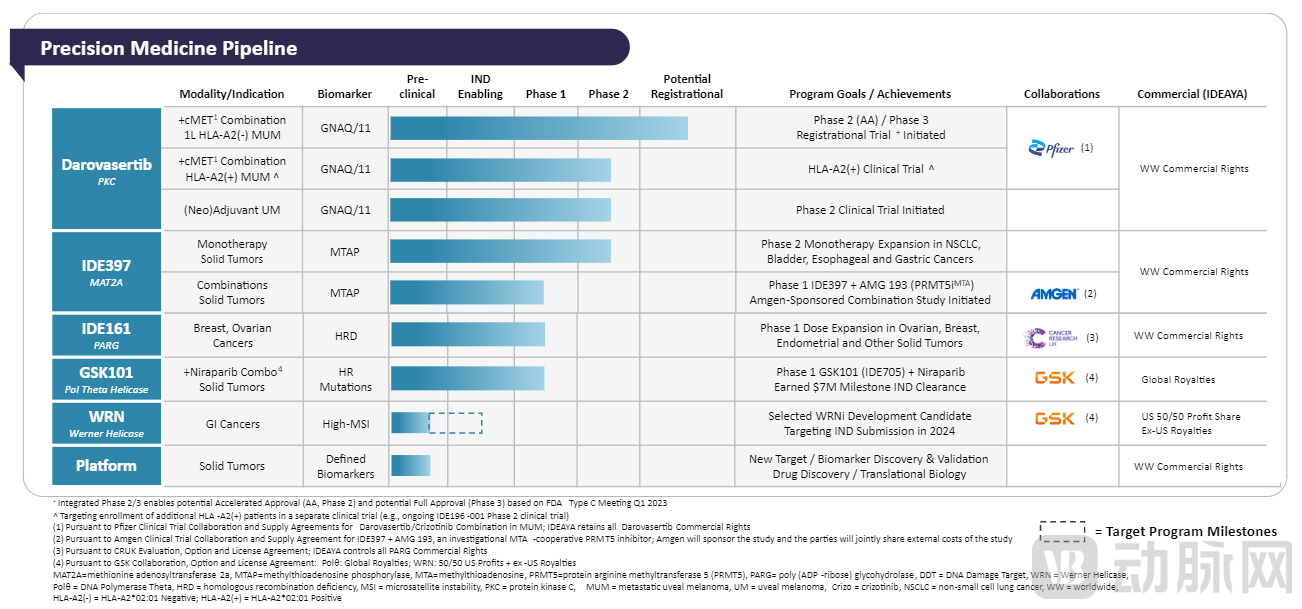
IDEAYA's Pipeline
IDE196 (Darovasertib): PKC Inhibitor
Uveal Melanoma (UM) is a common malignant and invasive intraocular tumor in adults. Unlike other eye diseases, it not only causes blindness but is also highly lethal. Current local treatment methods for UM include transpupillary thermotherapy, brachytherapy, and proton beam radiotherapy, which can save the patient's life while preserving partial vision. However, the survival rate of patients has not improved.
In addition, the metastasis rate of UM patients is high. Studies have shown that approximately 50% of UM patients will still develop metastases after treatment, with 90% of these patients experiencing liver metastases. Moreover, 90% of patients with liver metastases have a survival period of less than one year.3。
IDE196 is a potent selective small-molecule protein kinase C (PKC) inhibitor used to treat UM patients carrying G protein subunit Q/11 (GNAQ/GNA11) mutations. GNAQ/GNA11 mutations are a significant cause of UM, and studies have found that over 90% of UM patients carry GNAQ or GNA11 mutations.4。
Previously, IDEAYA had reached a clinical trial collaboration and supply agreement with Pfizer. According to the agreement, Pfizer provided Crizotinib (an investigational cMET inhibitor) to IDEAYA free of charge for conducting clinical trials. IDEAYA initiated a clinical study on IDE196 in combination with Crizotinib, enrolling 20 patients with metastatic uveal melanoma (MUM) as first-line treatment and 63 MUM patients receiving treatment at any line.
The results showed that, as a first-line treatment, the overall response rate (ORR) was 45% and the disease control rate (DCR) was 90% in 20 patients with MUM. As any-line treatment, the ORR was 30% and the DCR was 87% in 63 patients with MUM.
In addition, IDE196 as a neoadjuvant therapy for MUM may allow patients to avoid enucleation. IDEAYA Biosciences and Professor Anthony Joshua from Australia jointly initiated a trial named "Study of Darovasertib as an Adjuvant Therapy in UM". In June this year, the first UM patient who did not require eye removal was reported in the trial group. The patient was treated with IDE196 in combination with Crizotinib, resulting in approximately 80% tumor shrinkage after four months, successfully avoiding enucleation.
Currently, IDEAYA has expanded its previous collaboration with Pfizer to support the company’s MUM Phase 2/3 registrational clinical trial, continuing to evaluate the efficacy and safety of the combination therapy of IDE196 and Crizotinib.
IDE397: MAT2A Inhibitor
Methylthioadenosine phosphorylase (MTAP) is a tumor suppressor gene that exhibits abnormal expression in various tumor tissues. Studies have shown that MTAP deletion occurs in approximately 15% of solid tumors.5。
MTAP is involved in the metabolism of methylthioadenosine (MTA) and the regeneration of methionine required for the synthesis of S-adenosylmethionine (SAM). In the absence of MTAP, MTA accumulates and acts as an endogenous selective competitive inhibitor, inhibiting the binding of SAM to protein arginine methyltransferase 5 (PRMT5) and limiting PRMT5 activity. This partial inhibition makes MTAP-deficient cells more dependent on the activity of methionine adenosyltransferase IIα (MAT2A, an enzyme responsible for SAM synthesis).
Due to this dependency, when MAT2A is pharmacologically inhibited, the loss of MTAP leads to synthetic lethality. These effects result in the obstruction of PRMT5-catalyzed protein substrate methylation, causing defects in gene expression, DNA replication, and genomic integrity, ultimately leading to cancer cell death.
IDE397 is a selective small molecule inhibitor targeting MAT2A for the treatment of patients with MTAP-deleted solid tumors.
In July last year, IDEAYA Biosciences entered into a clinical trial collaboration and supply agreement with Amgen to evaluate the combination efficacy and safety of IDE397 and Amgen's AMG 193 (a PRMT5 small molecule inhibitor) as a combination therapy for treating patients with MTAP-deleted solid tumors. Under the agreement, IDEAYA will supply IDE397 to Amgen, and Amgen will be responsible for conducting the Phase 1 clinical combination trial.
Currently, IDE397 is in Phase 1/2 clinical trials, and the first patient has received combination dosing of IDE397 and AMG 193.
IDE161: PARG Inhibitor
Poly (ADP-ribose) glycohydrolase (PARG) is an enzyme with endo- and exoglycosidase activity against poly (ADP-ribose) (PARP), which can rapidly degrade PARP to release a large amount of free ADP-ribose. PARG reverses the action of PARP enzymes by hydrolyzing PAR glycosidic bonds after DNA damage, leading to increased sensitivity of PARG-deficient cells to DNA-damaging agents. Therefore, pharmacological inhibition of PARG will disrupt the DNA damage repair cycle, ultimately resulting in cancer cell death.
Based on this, IDEAYA launched the pipeline IDE161. IDE161 is a selective PARG inhibitor for treating adult patients with advanced or metastatic hormone receptor-positive (HR+) cancer.
Preclinical studies have shown that monotherapy with IDE161 can lead to tumor regression in PARP inhibitor-resistant HRD models. In September this year, IDEAYA Biosciences announced Phase 1 clinical trial data for "IDE161 as a single agent for the treatment of patients with HRD tumors." The data showed that the tumors of multiple patients with HRD solid tumors had initially shrunk. Notably, the first imaging assessment of a patient with endometrial cancer revealed an 87% reduction in the CA-125 tumor marker.
With its good efficacy, IDEAYA has been granted Fast Track designation by the FDA. The FDA has also designated IDEAYA for the treatment of breast and ovarian cancer patients with BRCA1/2 mutations.
In addition, IDEAYA Biosciences has reached a strategic partnership with GlaxoSmithKline (GSK) to jointly advance the research and development programs for Pol Theta and Werner Helicase pipelines.
DNA Polymerase Theta (Pol-Theta) is a synthetic lethal target with homologous recombination deficiency and plays an important role in the DNA damage response pathway for double-strand breaks. Currently, IDEAYA Biosciences and GSK have advanced the Pol Theta pipeline to Phase I clinical trials.
Microsatellite Instability (MSI) refers to the alteration in the length of microsatellite alleles. Compared with normal cells, the length of microsatellites in tumor cells changes due to the insertion or deletion of repeat units. A large number of studies have shown that the Werner Helicase in high MSI tumors exists in a variety of solid tumors, such as colorectal cancer, endometrial cancer, gastric cancer, etc.
IDEAYA Biosciences and GSK Enter into Collaboration to Advance Werner Helicase Program; Under the Agreement, GSK to Lead Clinical Development for Werner Helicase Program and Fund 80% of Development Costs, with IDEAYA Funding 20%
References:
1. Bridges, C.B., he origin of variations in sexual andsex-limited characters. Am.Nat., 1922. 56: p. 51-63.
2. Dobzhansky, T., Genetics of natural populations;recombination and variability in populations of Drosophila pseudoobscura.Genetics, 1946. 31: p. 269-90.
3. Krantz BA,Dave N,Komatsubara KM,et al. Uveal melanoma:epidemiology,etiology,and treatment of primary disease[J].Clin Ophthalmol,2017,11:279-289.DOI:10.2147/OPTH.S89591 .
4. Yu FX,Luo J,Mo JS,et al. Mutant Gq/11 promote uveal melanoma tumorigenesis by activating YAP[J].Cancer Cell,2014,25(6):822-830.DOI:10.1016/j.ccr.2014.04.017 .
5. Mavrakis K J, McDonald III E R, Schlabach M R, et al. Disordered methionine metabolism in MTAP/CDKN2A-deleted cancers leads to dependence on PRMT5[J]. Science, 2016, 351(6278): 1208-1213.