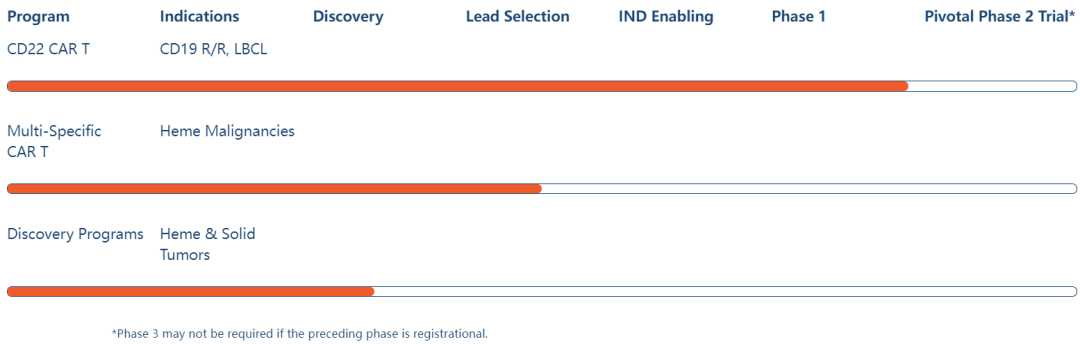
In recent months, the overall performance of biotech stocks has not been good, and the trading of several newly listed companies has also been unsatisfactory. Nevertheless, a biotech company focused on CAR-T therapy has still chosen to enter the secondary market. On October 20, CARGO Therapeutics submitted its IPO plan to the SEC for listing on Nasdaq. This is not only a test of the sluggish market, but it is also worth mentioning that,CARGO is also the first CAR-T company to make a bid for Nasdaq this year. Behind CARGO is an impressive operational team. In 2021, scientists including Professor Crystal Mackall from Stanford University, a pioneer in CAR-T therapy, officially founded CARGO. Mackall once worked at the National Cancer Institute in the United States.(NCI)With 27 years of work experience as the Director of Pediatric Oncology, joined Stanford University School of Medicine in 2016 as the Founding Director of the Stanford Cancer Cell Therapy Center, Deputy Director of the Stanford Cancer Institute, and Director of the Stanford Parker Cancer Immunotherapy Research Institute. "The establishment of CARGO aims to bring meaningful changes to patients' lives. The differentiated CD22 clinical data studied in patients shows impressive activity and very good safety. Combined with CARGO's proprietary platform, we are able to develop and deliver the next generation of CAR-T therapies," said Mackall. CRG-022 is the core pipeline of CARGO, consisting of a lentiviral vector expressing CD22-targeting CAR.(m971-BBZ)Composed of transduced autologous T cells.As a transmembrane protein, CD22 is expressed on normal B cells and B-cell malignancies. CARGO Therapeutics believes that CRG-022 has the potential to treat large B-cell lymphoma that has failed prior CD19 CAR-T cell therapy.(LBCL)Patient.Preliminary results from the Phase I clinical trial published in Blood in April 2021 showed that the therapy is effective for relapsed/refractory large B-cell lymphoma after CD19 CAR-T cell treatment.(R/R LBCL)More than 50% of patients achieved long-term complete remission after treatment.(CR)。 In the interim analysis updated this February, only one out of 20 patients who achieved CR relapsed, with a median overall survival of 22.5 months. This indicates that the toxicity of CRG-022 is controllable. The latest data disclosed in May showed that 20 out of 38 patients achieved complete response. Based on the Phase I clinical trial data, CRG-022 has been granted Breakthrough Therapy designation by the FDA. In August this year, the trial of CRG-022 for treating LBCL patients entered Phase II. According to the documents disclosed by CARGO Therapeutics, it hopes to directly push CRG-022 into the middle and late stages of development as soon as possible, and eventually use it for other blood cancers. The "underlying CAR" in CRG-022 is licensed from the NCI, and as part of the agreement, CARGO will make milestone payments of approximately $18 million to the NCI for the research of CRG-022 and CRG-025, respectively. Gina Chapman, CEO and President of CARGO, stated that the company aims to gain FDA approval following the Phase II trial for R/R LBCL. According to the IPO filing submitted by CARGO, the related interim results are expected to be released in 2025. Following CRG-022, CARGO has another project called CRG-023, which will target CD19, CD20, and CD22. CARGO is expected to be listed under the name CRGX, with the proceeds mainly used for Phase II research of CRG-022. However, Cargo did not provide an expected scale for its IPO or a price range. In March this year, CARGO announced the successful completion of its Series A financing, raising $200 million. Prior to this, CARGO had already secured $11 million in seed financing and $32 million in bridge financing.(bridge financing)。 But at this stage, CARGO's desire for funding is indeed very urgent. As of the end of June, CARGO's assets were $42.4 million, and it incurred a loss of $30.6 million in the first half of this year.
Reference Article:
1、CARGO Therapeutics heads to Nasdaq in first CAR-T cell therapy IPO pitch of 2023
$200 million Series A financing: What makes this CAR-T cell therapy startup unique?; BioWorld