Transfer Learning-Enhanced Graph Neural Network AOMP for Aldehyde Oxidase Metabolism Prediction Powered by NMR Data

AlphaMa
AI-Powered Innovative Drug Developer
Shanghai Institute of Materia Medica, Chinese Academy of SciencesZheng MingyueThe research team developed a novel AOX metabolic reaction prediction model based on neural networks, named AOMP. AOMP unifies the metabolic substrate/non-substrate classification task and the metabolic site prediction task, avoiding error accumulation and result inconsistency issues associated with staged predictions. Currently, the lack of training data is a key bottleneck in building high-accuracy AOX metabolic prediction models, as publicly available AOX drug metabolism data includes only hundreds of compounds. To address this challenge, the research team adopted a "large model + small sample fine-tuning" transfer learning strategy. Based on the correlation between the 13C-NMR chemical shifts of aromatic carbon atoms and the occurrence of metabolic oxidation at these sites found in earlier studies, they first pre-trained the model using a large amount of NMR shift data, then fine-tuned it with a small amount of AOX drug metabolism data, constructing the AOMP model, which significantly outperforms previous methods. Using AOMP, the research team systematically evaluated the propensity of common nitrogen-containing scaffolds in kinase inhibitors to undergo AOX metabolism, successfully identifying four new scaffolds prone to AOX metabolic reactions, which were validated through in vitro experiments. Additionally, the research team built a web server for predicting drug AOX metabolic reactions (https://aomp.alphama.com.cn) to facilitate its use by researchers in the field of drug discovery.
The relevant research article was published online inActa Pharmaceutica Sinica B (《药学学报》英文刊)Ph.D. candidate, Shanghai Institute of Materia MedicaXiong Jiacheng,Rongrong CuiPh.D., Suzhou AlphaMa Biotechnology Co., Ltd.Li ZhaojunDr. is the co-first author of the article. Shanghai Institute of Materia MedicaZheng MingyueThe corresponding author of the article is a researcher. This research was supported by the National Natural Science Foundation of China, Lingang Laboratory, the National Key R&D Program of China, and the Open Fund of the State Key Laboratory of Pharmaceutical Biotechnology at Nanjing University.
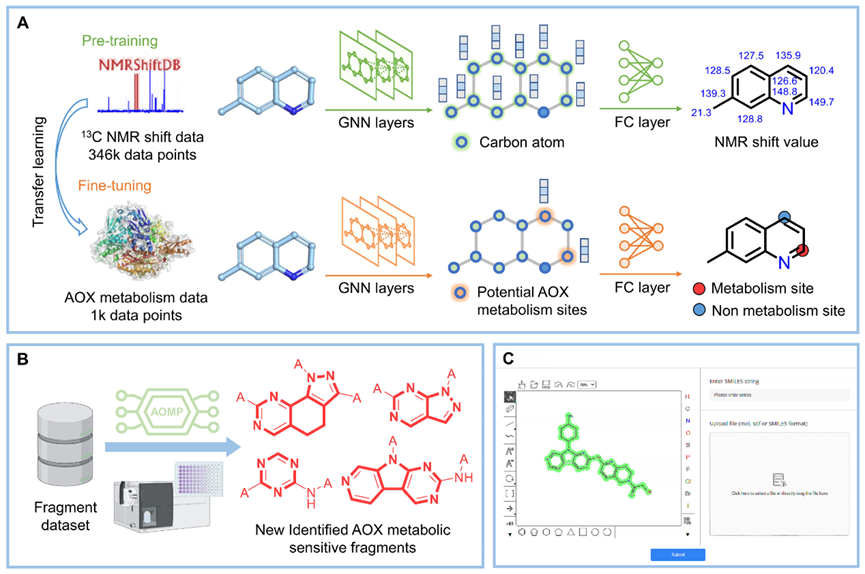
Transfer learning enhanced graph neural network for aldehyde oxidase metabolism prediction and its experimental application
Author Biography

Researcher at the Shanghai Institute of Materia Medica, Chinese Academy of Sciences, recipient of the National Outstanding Youth Fund, Executive Committee Member of the Digital Medicine Branch of the China Computer Federation, member of the Computer Chemistry Professional Committee of the Chinese Chemical Society, and member of the Drug Discovery Professional Committee of the Chinese Society for Bioinformatics. Research focuses on the development of precision drug design technologies based on artificial intelligence and big data, advancing machine learning algorithms and models for elucidating the mechanisms of action and target discovery of active compounds, as well as the discovery of novel target-active compounds and optimization of their drug-like properties.