

Roche Acquires Telavant and TL1A Antibody RVT-3101 from Roivant for $7.1 Billion, Originally Developed by Pfizer

Roche
Oncology Drug Research, Development, and Manufacturing
Roivant Sciences
Biopharmaceutical Company
Telavant
Innovative Therapy Developer
October 23,Roche announced that it has reached an agreement withRoivant HoldingsReach a final agreement,Acquisition of Roivant Subsidiary TelavantAnd its drug pipelineRVT-3101According to the terms of the agreement, Roche will pay an upfront acquisition price of $7.1 billion and $150 million in near-term milestone payments. Upon completion of the transaction, Roche will obtain the rights to develop, manufacture, and commercialize the RVT-3101 antibody in the United States and Japan.
In addition, upon completion of the transaction, Roche will also have the option to collaborate globally with Pfizer on the next-generation p40/TL1A-targeted bispecific antibody, which is currently in Phase I.
Three months ago, rumors swirled that Roivant Sciences might sell its重磅 ulcerative colitis (IBD) candidate treatment drug RVT-3101 to Roche for over $7 billion. Until today, this major BD deal has finally been confirmed, with the transaction amount roughly matching the previously rumored figure. The reason this deal has drawn significant attention is not only due to the staggering $7.1 billion price tag but also because it marks another update from the strongest "bargain hunter" Roivant Sciences. Moreover, it even involves a strategic choice by the "universal pharmaceutical giant," Pfizer.
The key drug involved in this transaction, RVT-3101, was abandoned by Pfizer at the end of last year.
RVT-3101 is an original drug developed by Pfizer. In December 2022, Pfizer announced the establishment of a joint venture, Vant, with Roivant Sciences, through which RVT-3101 was successfully transferred to Roivant. According to the agreement, the subsequent development of RVT-3101 will be fully managed by Roivant/Vant, and Vant will obtain commercial rights for the drug in the United States and Japan. Pfizer holds a 25% stake in Vant, retains commercial rights outside the U.S. and Japan, and has representation on the company's board.
Public information shows that RVT-3101 is a fully human monoclonal antibody targeting TL1A. By inhibiting TL1A, it targets inflammatory and fibrotic pathways and is a potential first-in-class drug. Currently, RVT-3101 has been studied in patients with moderate to severe ulcerative colitis (UC) in the TUSCANY Phase 2b study. Trial data from the 245 UC patients showed that 36% of subjects receiving the optimal dose of RVT-3101 achieved clinical remission after 56 weeks of treatment, up from 29% at week 14; 50% of subjects on the optimal dose showed endoscopic improvement at week 56, up from 36% at week 14; 21% of subjects on the optimal dose demonstrated endoscopic remission at week 56, up from 11% at week 14. In terms of safety, all doses were well tolerated within 56 weeks.
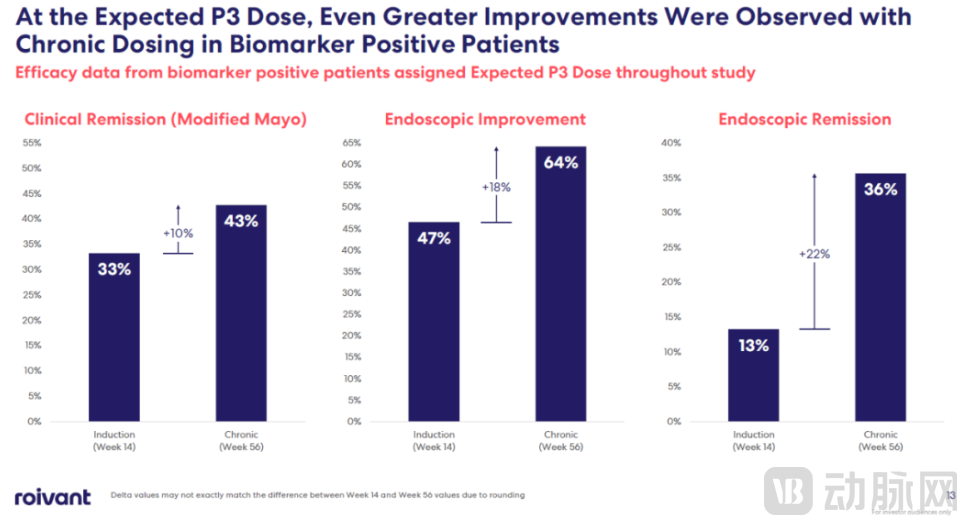 Source: Telavant Official Website
According to Roivant's website, RVT-3101 is currently undergoing a Phase 2 clinical trial for Crohn's disease. After the agreement is completed, Roche will be committed to initiating the global Phase 3 trial of RVT-3101 for the treatment of ulcerative colitis (IBD) as soon as possible. Additionally, outside the United States and Japan, Pfizer holds the commercial rights.
An SVB securities analyst once indicated that Roivant’s acquisition of RVT-3101 could represent a potential commercial opportunity worth nearly $15 billion in the U.S. when Pfizer announced its joint venture with Roivant to establish Vant.
In a report released this July, Citi analysts referred to RVT-3101 as a "highly collateralized asset," estimating that Roivant's stake in Telavant is worth approximately $4.5 billion due to its partnership with Pfizer.
Roivant Sciences was founded by Vivek Ramaswamy in 2014. Since its establishment, Roivant has incubated 21 subsidiaries, four of which have successfully gone public, and five were acquired by Sumitomo Pharma for $3 billion as early as 2019. In 2022, Sumitomo Pharma further invested $1.7 billion to acquire the remaining shares of Roivant's subsidiaries. Meanwhile, over the span of nine years, six drugs developed by Roivant have received FDA approval for market launch.
Since all the company names created by Roivant end with "vant," they have built their own "Vant Empire." Each biotech under Roivant operates as an independent entity to retain the agility and innovative spirit of a startup. At the same time, these biotechs can share resources from Roivant and other data-driven biotechs to support the development and commercialization of relevant drugs.
Talking about "finding bargains," Vivek Ramaswamy, when he was an investor, discovered that many large pharmaceutical companies abandon drugs under research for various reasons. These "failed drugs" actually have broad prospects. "Why not take over the drugs abandoned by big companies and continue their development?"
Since its establishment in 2014, Roivant Sciences has been "rescuing" failed drugs. For instance, in 2015, Roivant obtained the Alzheimer's drug Intepirdine (RVT-101) from GSK for a $5 million upfront payment, which once brought Ramaswamy over a 20,000% paper return on investment, pushing Axovant's market value close to $3 billion on its first day of trading.
In 2016, Myovant, a subsidiary of Roivant, reached an agreement with Takeda to obtain the global development and sales rights for Relugolix. In this deal, Myovant achieved zero upfront payment, only paying 5.1 million shares of company stock and less than 10% of sales royalties. Four years later, Relugolix successfully received FDA approval for market launch. Last year, Relugolix generated a combined revenue of $182 million in the U.S. and Chinese markets.
In addition, Roivant has also performed remarkably in the capital market, securing investments from multiple institutions such as SoftBank, South Korea's SK Holdings, and RTW Investments. Its subsidiaries, Axovant and Myovant, respectively set the records for the largest biopharmaceutical IPOs in the U.S. market in 2015 and 2016.
As a chronic disease that is difficult to cure, inflammatory bowel disease (IBD) includes ulcerative colitis (UC) and Crohn's disease (CD). In North America and Europe, more than 1.5 million and 2 million people, respectively, are affected by it. The broad market brings the possibility of strong revenue.According to Huachuang Securities dataIn the United States alone, the commercial market for advanced therapies targeting IBD is nearly $15 billion annually and continues to grow.
The IBD field features many blockbuster products and has always been favored by MNCs. Due to the limitations in remission rates and durability of classic anti-TNF biologics, scientists continue to explore new targets and therapies—evidence suggests that anti-TL1A (TNF Ligand-Related Molecule 1A) antibodies may become the next "breakthrough" in the IBD market.
TL1A belongs to the TNF superfamily and can independently mediate inflammation and fibrosis. It is associated with immune and fibrotic diseases such as RA, atopic dermatitis, SLE, asthma, and psoriasis. The TL1A blocking mechanism shows broad application potential in inflammatory and fibrotic diseases and has been clinically validated for the treatment of IBD.
Despite TL1A not yet being market-tested, many pharmaceutical companies have placed significant bets on it—In June 2023, Merck successfully acquired Prometheus for $10.8 billion, outbidding competitors AbbVie and BMS, to obtain the TL1A monoclonal antibody PRA-023; In October 2023, Sanofi and Teva Pharmaceuticals reached a collaboration, with a $500 million upfront payment and up to $1 billion in development and milestone payments, to jointly develop the novel anti-TL1A therapy TEV'574.
In China, according to data from the prospectus of Quanxin Biotech, the number of IBD patients in China is less than that in the United States, with 449,300 patients in 2017, increasing to 626,300 in 2021. It is estimated that by 2030, the number of patients will reach 1.2 million. The drug market size has grown slightly, increasing from US$480 million in 2017 to US$885 million in 2021. As a typical industrialized disease, the prevalence in developing countries is approaching that of developed countries.