

SKB264 (TROP2-ADC) Shows Promising Activity in Heavily Pretreated HR+/HER2- Metastatic Breast Cancer at ESMO 2023, with Multi-Tumor Development Underway
Kelun-Biotech
Innovative Drug Developer

MSD
Pharmaceutical R&D and Manufacturer
ChengduOctober 23, 2023PR Newswire -- Trophoblast cell surface antigen 2 (TROP2) is highly expressed in a variety of solid tumors and has become a popular target in the field of oncology in recent years. The research and development progress of antibody-drug conjugates (ADC) targeting TROP2 has drawn significant attention. At the 2023 European Society for Medical Oncology (ESMO) Congress held from October 20 to 24 in Madrid, Spain, the innovative TROP2-ADC (SKB264, MK-2870), jointly developed by Kelun-Biotech and MSD, was presented in an oral report for the treatment of previously treated hormone receptor-positive (HR+)/human epidermal growth factor receptor 2-negative (HER2-) metastatic breast cancer (mBC). The results from a Phase I/II single-arm basket trial (Abstract No.: 380MO) confirmed that SKB264 demonstrated manageable safety and favorable anti-tumor activity in patients with HR+/HER2- metastatic breast cancer. Professor Yin Yongmei presented the study and its key findings on behalf of the research team at the conference.
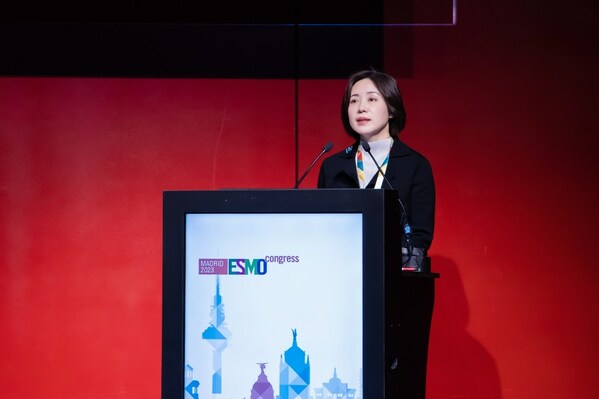
Professor Yin Yongmei from Jiangsu Provincial People's Hospital
Research Background
TROP2 is overexpressed in HR+/HER2- metastatic breast cancer and has been confirmed to be associated with poor prognosis in patients.SKB264Is a sophisticatedly designed targetedTROP2TheADC, by humanized anti-TROP2Monoclonal antibody, optimized for stabilityCL2AConnexin(The antibody end of the linker uses mesylpyrimidine to achieve irreversible conjugation with the antibody.), with toxin small moleculesT030(TopoisomeraseⅠInhibitor)Combined to form, Drug-Antibody Ratio(DAR)Average up to7.4。This study is the first public report of the Phase II cohort study of this innovative drug in HR+/HER2- metastatic breast cancer patients.
Research Methods
Patients with HR+/HER2- (including HER2-low and HER2-zero) metastatic breast cancer received SKB264 5mg/kg Q2W treatment until disease progression or intolerable toxicity occurred. Patients included in the study had previously failed endocrine therapy and received at least one chemotherapy regimen. Tumor assessments were conducted by investigators every 8 weeks according to RECIST v1.1.
Research Results
As of April 12, 2023, the study enrolled a total of 41 patients with a median age of 50 years, of whom 61% had an ECOG PS score of 1. The median follow-up time for the study was 8.2 months.
The main adverse reactions were hematological toxicities. The most common ≥3 grade treatment-related adverse events (TRAEs) were decreased neutrophil count (36.6%), decreased white blood cell count (22%), anemia (14.6%), and decreased platelet count (9.8%). Most hematological toxicities occurred within the first two months of treatment and recovered after treatment with G-CSF or erythropoietin, without the need for transfusion. Dose reduction due to TRAEs occurred in 17.1% (7/41) of patients, with no discontinuations or deaths caused by TRAEs. The incidence of gastrointestinal TRAEs was low, and no drug-related neuropathy or interstitial lung disease/pneumonia was observed.
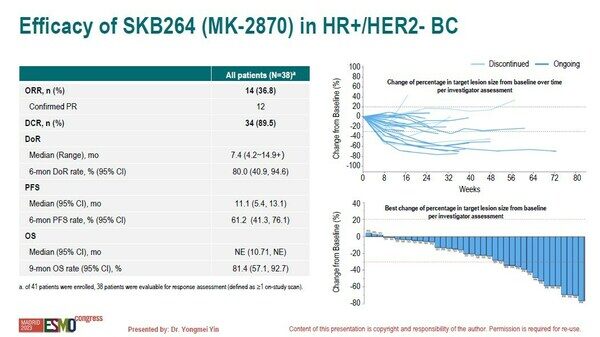
Among the 38 evaluable patients, 71% had HER2-low expression, 47% had primary endocrine resistance, and 79% had received ≥2 lines of chemotherapy for metastatic breast cancer. All patients had been treated with taxane drugs, and 65.8% had previously received CDK4/6 inhibitor therapy. The objective response rate (ORR) was 36.8%, the disease control rate (DCR) was 89.5%, the 6-month duration of response (DoR) rate was 80%, and the median progression-free survival (PFS) was 11.1 months. All subgroups benefited, including patients with HER2-low or zero expression, primary or secondary endocrine resistance, and those who had or had not previously used CDK4/6 inhibitors.
Research Conclusion
SKB264 Demonstrates Manageable Safety and Encouraging Antitumor Activity in HR+/HER2- Metastatic Breast Cancer Patients. Two Phase III clinical studies are currently being planned for HR+/HER2- metastatic breast cancer patients: one study in China targets patients who have received at least one line of chemotherapy in the metastatic setting, while another global study focuses on patients who have not received chemotherapy in the metastatic setting.
Summary
Previously, SKB264 demonstrated promising efficacy and manageable safety in heavily pretreated patients with metastatic triple-negative breast cancer (TNBC) and non-small cell lung cancer (NSCLC). At this year's ESMO, it once again showed significant therapeutic potential in HR+/HER2- metastatic breast cancer patients, undoubtedly boosting confidence for further research in the field.
2022 SABCSAnnual Meeting,SKB264ReleaseReleaseUsedFor locally advanced or metastatic triple-negative breast cancer (TNBC) Phase II expansion study data for patients. In55In patients whose efficacy can be evaluated,ORRFor 43.6% ,DCRFor 80% , among whichTROP2High-expression patientsORRFor 55.2%。mDoRFor11.5Months,mPFSFor5.7months, median overall survival (mOS) for14.6Months,12MonthsOSRate is66.4%。
At the 2023 ASCO Annual Meeting, SKB264 presented Phase II expansion study data for previously treated patients with locally advanced or metastatic non-small cell lung cancer (NSCLC). Among 39 evaluable patients, the ORR was 43.6%, the DCR was 94.9%, the mDoR was 9.3 months, the 6-month DoR rate was 77%, and the 12-month OS rate was 70.6%.EGFRMutation Subgroup PopulationORRFor60%,DCRFor100%,mDoRFor9.3Months,mPFSFor11.1Months,12MonthsOSRate of80.7%。
Published study data indicate that SKB264 has best-in-class potential among ADC drugs for treating advanced triple-negative breast cancer, advanced HR+HER2- breast cancer, and EGFR-mutated NSCLC that has failed TKI treatment.
Based onBreast CancerAnd Lung CancerThe eye-catching research data,SKB264AlreadyObtainCDEGrantedThreeA breakthrough therapy designation, respectively, for monotherapy in the treatment of locally advanced or metastatic triple-negative breast cancer (TNBC)、EGFR-TKI Treatment failure in locally advanced or metastaticEGFR Mutant Non-Small Cell Lung Cancer (EGFRm NSCLC) and have previously received at least two lines of systemic chemotherapy for locally advanced or metastatic hormone receptor (HR) Positive, Human Epidermal Growth Factor Receptor2Negative (HER2-) Breast cancer.
In the field of breast cancer,The Phase III registrational study of SKB264 monotherapy for locally advanced or metastatic triple-negative breast cancer patients previously treated with at least two lines of systemic therapy has met its primary endpoint, with plans to file for marketing authorization by the end of the year. The Phase III registrational study of SKB264 monotherapy for locally advanced or metastatic HR+HER2- breast cancer patients who have failed at least one line of prior chemotherapy has been approved to proceed. The Phase II study of SKB264 in combination with KL-A167 (anti-PD-L1 monoclonal antibody) for first-line treatment of HER2-negative breast cancer patients is currently ongoing.AnotherIn addition, several lung cancer registration studies are progressing rapidly, with active exploration of combination therapies and applications in other solid tumors. We look forward to the publication of more research results, bringing good news to cancer patients worldwide!