

Datopotamab Deruxtecan Shows Breakthrough Potential Across Multiple Advanced Solid Tumors

AstraZeneca
Biopharmaceutical Manufacturer

Daiichi-Sankyo
Pharmaceutical R&D Developer
▎WuXi
Edited by Kant Content Team
Recently, multiple clinical trial results of datopotamab deruxtecan (Dato-DXd), a potential blockbuster Trop2-targeted investigational antibody-drug conjugate (ADC) jointly developed by AstraZeneca and Daiichi Sankyo, were announced at the European Society for Medical Oncology (ESMO) Congress. A series of positive data fully demonstrates the potential of Dato-DXd to become a blockbuster drug.
Datopotamab deruxtecan is an ADC composed of a humanized, Trop2-targeting monoclonal antibody linked to an innovative DNA topoisomerase I inhibitor (DXd).DXd has a unique mechanism of action, with 10 times higher activity compared to the common chemotherapy drug irinotecan. Moreover, this drug has a strong ability to penetrate cell membranes, allowing it to kill neighboring cancer cells after killing cancer cells that have ingested the ADC, producing a "bystander effect." Trop2 is a protein widely expressed in various solid tumors, including HR-positive, HER2-low or negative breast cancer. AstraZeneca and Daiichi Sankyo reached an agreement in July 2020 to collaborate on the development of datopotamab deruxtecan.
Reduce the Risk of Disease Progression or Death in Advanced Non-Small Cell Lung Cancer (NSCLC)
TROPION-Lung01 is an ongoing global, multicenter, open-label, randomized pivotal Phase 3 trial evaluating the efficacy and safety of Dato-DXd (6.0 mg/kg) compared to docetaxel in patients with locally advanced or metastatic NSCLC who have previously received at least one prior therapy and have no actionable genomic alterations. The dual primary endpoints of the trial include progression-free survival (PFS) assessed by blinded independent central review (BICR) and overall survival (OS). Docetaxel is the current standard second-line treatment for patients with advanced NSCLC.
According to the assessment results of BICR,Compared with docetaxel, Dato-DXd reduced the risk of disease progression or death by 25% (HR=0.75; 95% CI: 0.62-0.91, p=0.004).The median PFS for patients treated with Dato-DXd and docetaxel was 4.4 months and 3.7 months, respectively. Additionally,The confirmed objective response rate (ORR) was 26.4% in the Dato-DXd group and 12.8% in the docetaxel group.
According to BICR assessment,In patients with non-squamous NSCLC, Dato-DXd demonstrated clinically meaningful benefit, reducing the risk of disease progression or death by 37% compared to docetaxel (HR=0.63; 95% CI: 0.51-0.78).The median PFS for patients treated with Dato-DXd and docetaxel were 5.6 months and 3.7 months, respectively. The confirmed ORR in the Dato-DXd group was 31.2%, including 4 complete responses (CR), compared to 12.8% in the docetaxel group, with no CR observed. However, Dato-DXd did not demonstrate a PFS benefit in patients with squamous NSCLC.
In terms of overall survival, the interim results for the overall population (HR=0.90; 95% CI: 0.72-1.13) and patients with non-squamous cell tumors (HR=0.77; 95% CI: 0.59-1.01) numerically supported Dato-DXd over docetaxel.However, the results did not reach statistical significance at the data cutoff date. The trial is still ongoing, and OS will be assessed at the final analysis.
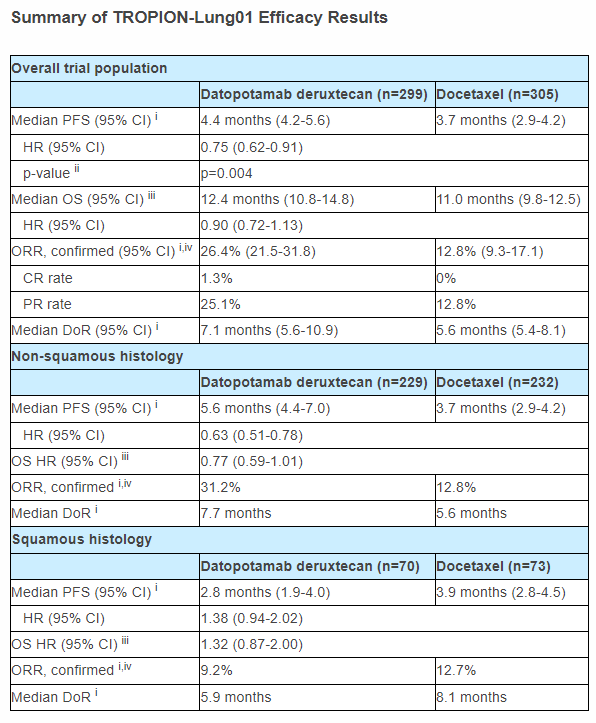
▲TROPION-Lung01 Trial Efficacy Results (Image Source: Reference [3])
Reduce the Risk of Disease Progression or Death in Patients with HR-Positive, HER2-Negative or Low-Expressing Breast Cancer
TROPION-Breast01 is a global, multicenter, open-label randomized Phase 3 trial,Aiming to evaluate the safety and efficacy of Dato-DXd (6.0mg/kg) compared with investigator-selected single-agent chemotherapy (eribulin, capecitabine, vinorelbine, or gemcitabine) in patients with surgically unresectable or metastatic HR-positive, HER2-low or negative (IHC 0, IHC 1+, or IHC 2+/ISH-) breast cancer.These patients were assessed by the investigators as having experienced disease progression during prior endocrine therapy or being unsuitable for endocrine therapy, and had received at least one systemic treatment. The dual primary endpoints of the trial include PFS and OS as evaluated by BICR.
According to BICR assessment,Compared with chemotherapy chosen by researchers, Dato-DXd reduced the risk of disease progression or death by 37% (HR=0.63; 95% CI: 0.52-0.76, p
The median PFS for patients treated with Dato-DXd and chemotherapy were 6.9 months and 4.9 months, respectively, with consistent PFS benefits observed across all subgroups of the trial. The results also showed a confirmed ORR of 36.4% in the Dato-DXd group, compared to an ORR of 22.9% in the chemotherapy group.
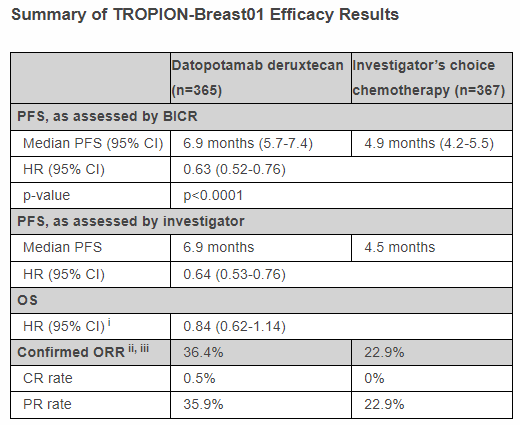
▲Efficacy results of the TROPION-Breast01 trial (Image source: Reference [2])
The analysis of OS shows that the interim results numerically support Dato-DXd over chemotherapy (HR=0.84; 95% CI: 0.62-1.14), but the results did not reach statistical significance at the data cutoff date. The trial is ongoing to evaluate OS.
Confirmed Objective Response Rate Nearly 80% in Metastatic Triple-Negative Breast Cancer (TNBC)
BEGONIA is an open-label, two-part, multi-center Phase Ib/2 trial designed to evaluate the efficacy and safety of the PD-L1 inhibitor Imfinzi (durvalumab) in combination with cancer therapies (with or without paclitaxel) as a first-line treatment for metastatic TNBC.Group 7 of the trial evaluates the safety, tolerability, and preliminary efficacy of Dato-DXd (6.0 mg/kg) in combination with Imfinzi in previously untreated patients with unresectable locally advanced or metastatic TNBC.The primary endpoint was safety and tolerability. Secondary endpoints were investigator-assessed ORR, PFS, and median duration of response (DoR).
Analysis shows that TNBC patients treated with Dato-DXd and Imfinzi exhibited sustained tumor response without new safety signals. The results indicate,The confirmed ORR in patients receiving the combination therapy was 79% (n=49/62), including 6 complete responses (CR) and 43 partial responses (PR). Responses were observed regardless of PD-L1 expression levels in patients' tumors.The patient's PFS was 13.8 months (95% CI: 11 - unable to calculate), DoR was 15.5 months (95% CI: 9.9 - unable to calculate), with a follow-up period of 11.7 months.
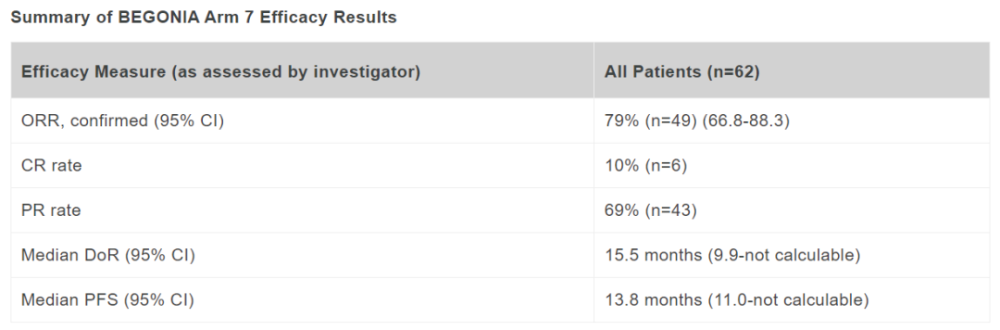
▲Efficacy results of Group 7 in the BEGONIA trial (Image source: Reference [1])
Currently, there are two ongoing Phase 3 trials evaluating Dato-DXd for the treatment of TNBC patients.