

J&J and AstraZeneca Report Positive Phase 3 Trial Results That May Reshape Treatment Paradigm for EGFR-Mutated NSCLC

Johnson & Johnson Innovative Medicine
Pharmaceutical R&D Developer

AstraZeneca
Biopharmaceutical Manufacturer
▎WuXi
Edited by Kant Content Team
At the recent European Society for Medical Oncology (ESMO) Congress, Johnson & Johnson Innovative Medicine and AstraZeneca respectively announced the efficacy results of the bispecific antibody Rybrevant (amivantamab) and the epidermal growth factor receptor (EGFR) tyrosine kinase inhibitor (TKI) Tagrisso (osimertinib) when each was combined with chemotherapy in treating patients with EGFR-mutated non-small cell lung cancer (NSCLC). The positive data indicate that these patients may have a new treatment option in the future.
Image Source: 123RF
It is estimated that approximately 2.2 million people worldwide are diagnosed with lung cancer each year, of which 80-85% are diagnosed with NSCLC. The most common mutation in NSCLC is EGFR mutation.According to statistics, 10-15% of NSCLC patients in Europe and the United States have EGFR mutations, while in Asian countries and regions this figure is 30-40%.The five-year survival rate for patients with advanced NSCLC and EGFR mutations who receive EGFR-TKI treatment is less than 20%. Therefore, these patients have significant unmet medical needs.
Rybrevant Combined with Chemotherapy Significantly Improves Progression-Free Survival and Reduces Risk of Intracranial Progression or Death in EGFR-Mutated NSCLC Patients
Rybrevant is an EGFR/MET bispecific antibody.Johnson & Johnson Innovative Medicine announced the Phase 3 clinical trial, MARIPOSA-2, at ESMO.Efficacy and Safety of Rybrevant in Combination with Chemotherapy (Carboplatin and Pemetrexed), with or without the Third-Generation EGFR-TKI Oral Drug Lazertinib, for the Treatment of Patients with Locally Advanced or Metastatic NSCLC.These patients have tumors with EGFR mutations and experienced disease progression during or after treatment with Tagrisso. The trial enrolled a total of 657 patients, who were randomly assigned to receive either Rybrevant and chemotherapy (with or without lazertinib) or chemotherapy alone. The dual primary endpoints are progression-free survival (PFS), as assessed by blinded independent central review (BICR), comparing the two Rybrevant combination therapies with chemotherapy alone. Key secondary endpoints include overall survival (OS), objective response rate (ORR), intracranial PFS, and more.
The analysis shows,Rybrevant + chemotherapy reduced the risk of disease progression or death by 52% compared to chemotherapy alone (HR=0.48; 95% CI: 0.36–0.64, P
Improvement in PFS was consistent across all predefined patient subgroups, including age, gender, ethnicity, history of brain metastases, smoking history, and prior lines of Tagrisso treatment. Additionally, Rybrevant + chemotherapy showed an ORR of 64%, Rybrevant + chemotherapy and lazertinib demonstrated an ORR of 63%, while the response rate for chemotherapy alone was 36%.
Data from MARIPOSA-2 also showed for the first time that the Rybrevant combination therapy regimen can provide intracranial activity. Specifically, compared with chemotherapy alone,Rybrevant + chemotherapy, Rybrevant + chemotherapy and lazertinib reduced the risk of intracranial progression or death by 45% and 42%, respectively (HR=0.55; 95% CI: 0.38-0.79, P=0.001 and HR=0.58; 95% CI: 0.44-0.78, P).
According to the press release, this finding is crucial for patients as nearly 30% of patients with this type of disease may experience brain metastasis of cancer cells.
Early OS data showed a trend favoring Rybrevant + chemotherapy (HR=0.77; 95% CI: 0.49-1.21).At the interim analysis, no OS difference was observed with Rybrevant + chemotherapy and lazertinib versus chemotherapy alone (HR=0.96; 95% CI: 0.67–1.35).
According to the press release, this is the first trial in which the Rybrevant regimen showed improved PFS compared to chemotherapy in patients with EGFR-mutated advanced NSCLC previously treated with Tagrisso. These results suggest that a Rybrevant-based treatment regimen could be a potential treatment option for patients with EGFR-mutated NSCLC.
Tagrisso Combined with Chemotherapy Significantly Improves CNS Progression-Free Survival in EGFR-Mutated NSCLC Patients
Tagrisso, developed by AstraZeneca, is a third-generation, irreversible EGFR-TKI., which has been clinically proven to be effective for NSCLC. The approved indications for Tagrisso include the treatment of locally advanced or metastatic EGFR-mutated NSCLC, first-line treatment for patients with locally advanced or metastatic EGFR T790M mutation-positive NSCLC, and adjuvant treatment for early-stage (IB, II, and IIIA) EGFR-mutated NSCLC. In August 2023, the combination of Tagrisso and chemotherapy received Breakthrough Therapy Designation from the U.S. FDA for the first-line treatment of adult patients with locally advanced or metastatic EGFR-mutated NSCLC. The supplemental New Drug Application (sNDA) for this combination therapy was accepted by the U.S. FDA this month and granted Priority Review status.
AstraZeneca's pre-specified exploratory analysis results of the FLAURA2 Phase III clinical trial announced at ESMO showed BICR assessmentTagrisso in combination with chemotherapy improved central nervous system PFS by 42% (HR=0.58; 95% CI: 0.33-1.01) compared to Tagrisso monotherapy in patients with locally advanced or metastatic NSCLC who had brain metastases and EGFR mutations at baseline.This patient group accounts for 40% of the total patients in the trial. Additionally, during the two-year follow-up, 74% of the patients receiving Tagrisso combined with chemotherapy did not experience CNS disease progression or death, compared to 54% for those treated with Tagrisso alone.Compared with Tagrisso monotherapy (43%), the combination of Tagrisso and chemotherapy (59%) showed a higher proportion of patients achieving complete response (CR) in the central nervous system (CNS).The detailed data results are as follows:
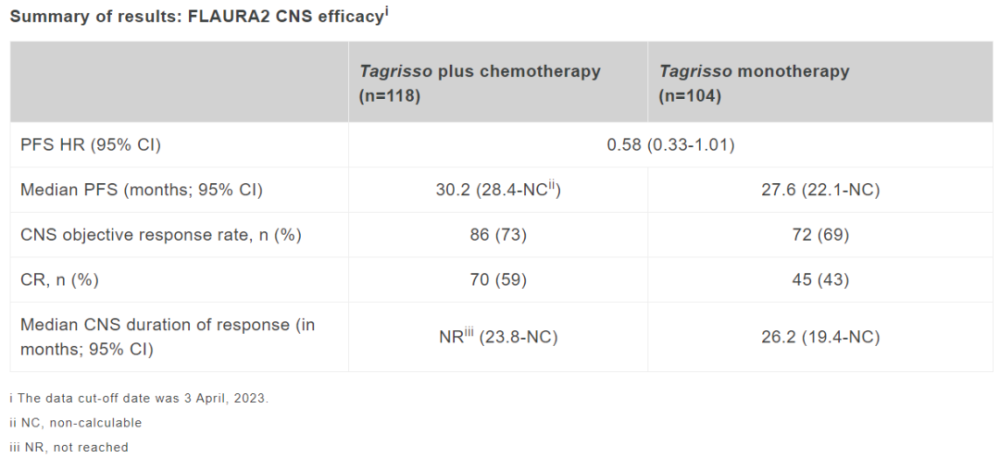
▲CNS efficacy results of Tagrisso in the FLAURA2 trial (Image source: Reference [2])