Daiichi Sankyo and AstraZeneca Announce Positive Topline Results from Phase III TROPION-Lung01 Trial of Datopotamab Deruxtecan in Previously Treated Advanced NSCLC

Daiichi-Sankyo
Pharmaceutical R&D Developer
On October 23, Daiichi Sankyo announced positive results from the pivotal Phase III clinical trial TROPION-Lung01. The results showed that, compared to the current standard treatment docetaxel, datopotamab deruxtecan (Dato-DXd) demonstrated a statistically significant improvement in progression-free survival (PFS) in patients with locally advanced or metastatic non-small cell lung cancer (NSCLC) who had received at least one prior therapy. Two updated study result reports (LBA12) from the Dato-DXd clinical development program will be presented at the ESMO 2023 (#ESMO23) Presidential Symposium 3.
Dato-DXd is a TROP2-targeted DXd antibody-drug conjugate (ADC) jointly developed by Daiichi Sankyo and AstraZeneca, designed based on proprietary technology.
As assessed by blinded independent central review (BICR), compared with docetaxel, Dato-DXd reduced the risk of disease progression or death by 25% (hazard ratio [HR]=0.75; 95% confidence interval [CI]: 0.62-0.91; p=0.004). The median PFS was 4.4 months in patients treated with Dato-DXd and 3.7 months in those treated with docetaxel. The confirmed objective response rate (ORR) was 26.4% in patients receiving Dato-DXd and 12.8% in patients receiving docetaxel. The median duration of response (DoR) was 7.1 months (95% CI: 5.6-10.9) in the Dato-DXd group and 5.6 months (95% CI: 5.4-8.1) in the docetaxel group.
According to BICR assessment, in patients with non-squamous NSCLC, Dato-DXd demonstrated clinically meaningful benefit. Compared with docetaxel, Dato-DXd reduced the risk of disease progression or death by 37% (HR=0.63; 95% CI: 0.51-0.78). The median PFS was 5.6 months for patients treated with Dato-DXd and 3.7 months for those treated with docetaxel. The confirmed ORR in the Dato-DXd group was 31.2%, including 4 complete responses (CRs), while the ORR in the docetaxel group was 12.8% with no complete responses observed. The median DoR was 7.7 months in the Dato-DXd group and 5.6 months in the docetaxel group. In patients with squamous cell carcinoma histology, Dato-DXd did not show a PFS benefit.
In the interim analysis for the dual primary endpoint of overall survival (OS), Dato-DXd demonstrated a numerical trend of benefit compared to chemotherapy in both the overall trial population and non-squamous patients (Overall population HR=0.90; 95% CI: 0.72-1.13, Non-squamous population HR=0.77; 95% CI: 0.59-1.01). As of the data cutoff date, OS has not reached statistical significance. The study is ongoing, and OS will be further evaluated in subsequent analyses.
In the TROPION-Lung01 study, no new safety issues were identified compared to previously reported data. The median treatment duration was 4.2 months in the Dato-DXd group, compared to 2.8 months in the docetaxel group. The incidence of treatment-related adverse events (TRAEs) of grade 3 or higher was 25% in the Dato-DXd group and 41% in the docetaxel group. The most common grade 3 or higher TRAEs included neutropenia (1% vs. 23%), stomatitis (6% vs. 1%), anemia (4% vs. 4%), asthenia (3% vs. 2%), nausea (2% vs. 1%), and fatigue (1% vs. 2%). In the Dato-DXd and docetaxel groups, 3% and 1% of patients, respectively, experienced adjudicated drug-related interstitial lung disease (ILD) events of grade 3 or higher. The investigator preliminarily determined that disease progression was the primary cause of death in this case. Among the seven grade 5 ILD events, four (1.7%) occurred in non-squamous patients and three (4.6%) in squamous NSCLC patients. One grade 5 ILD event (0.3%) occurred in the docetaxel group.
Patient enrollment in each treatment group, divided by tumor histological characteristics, was consistent with the actual data. Non-squamous cell carcinoma patients accounted for 78% and 77% in the Dato-DXd treatment group and docetaxel treatment group, respectively1. In the Dato-DXd treatment group, patients had previously received platinum-based therapy (99%), anti-PD1/anti-PDL1 therapy (88%), or targeted therapy (15%). In the docetaxel treatment group, patients had previously undergone platinum-based chemotherapy (100%), anti-PD1/anti-PDL1 therapy (88%), or targeted therapy (16%). Among patients in both groups, 17% had targetable genetic mutations, including EGFR mutations. As of the data cutoff date on March 29, 2023, 52 patients were still receiving Dato-DXd treatment, while 17 patients were still undergoing docetaxel treatment.
Summary of Efficacy Results from TROPION-Lung01:
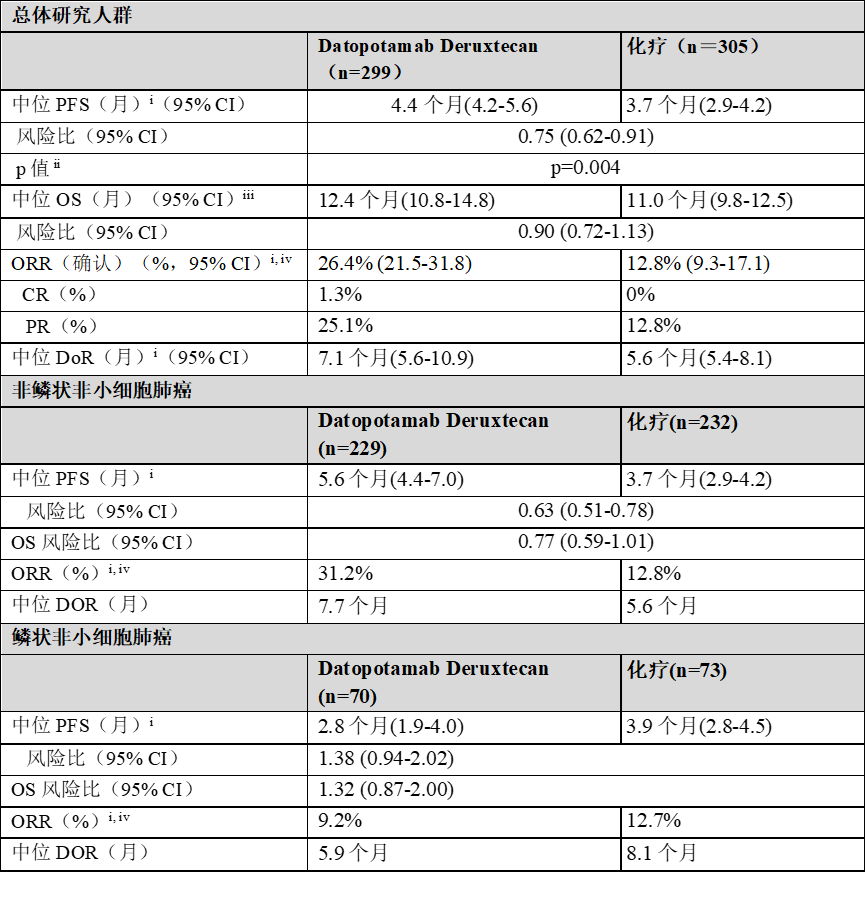
Source of the image: Daiichi Sankyo Official WeChat
CI, Confidence Interval; CR, Complete Response; DoR, Duration of Response; HR, Hazard Ratio; OS, Overall Survival; ORR, Overall Response Rate; PFS, Progression-Free Survival; PR, Partial Response
As assessed by BICR
The IIP value boundary is 0.008.
After a median follow-up of 11.8 months in the iiiDato-DXd group and 11.7 months in the docetaxel group, the overall survival data is not yet mature.
ivORR is (Complete Response + Partial Response)
TROPION-Lung05 Study Results
Preliminary results from the Phase II study TROPION-Lung05 showed that Dato-DXd demonstrated encouraging antitumor activity in heavily pretreated patients with advanced or metastatic NSCLC harboring targetable genomic alterations, including EGFR mutations and ALK rearrangements. These data were presented as a mini oral session (1314MO) at the ESMO Congress on Saturday, October 21, 2023.
In the overall population (n=137), the ORR in the Dato-DXd group was 35.8% (95% CI: 27.8-44.4), including 4 CRs and 45 PRs, with a disease control rate (DCR) of 78.8%. The median PFS was 5.4 months (95% CI: 4.7-7.0). In patients harboring EGFR mutations (n=78, the most common genomic mutation), the ORR for Dato-DXd was 43.6%, and the DCR was 82.1%.
In the TROPION-Lung05 study, the most common Grade 3 or higher TRAEs included stomatitis (10%), anemia (6%), decreased appetite (4%), and fatigue (4%). According to independent committee assessment, five cases of interstitial lung disease (ILD) were determined to be drug-related, including four Grade 1 or 2 events and one Grade 5 event.
About the TROPION-Lung01 Study
TROPION-Lung01 is an ongoing global, randomized, multi-center, open-label, Phase III study designed to evaluate the efficacy and safety of Dato-DXd compared to docetaxel in patients with locally advanced or metastatic NSCLC who have previously received at least one prior treatment, with or without actionable genomic mutations. Patients with actionable genomic mutations had previously received platinum-based chemotherapy and approved targeted therapies. Patients without known actionable genomic mutations had previously received platinum-based chemotherapy and PD-1 or PD-L1 inhibitor therapy either concurrently or sequentially.
The dual primary endpoints of TROPION-Lung01 are PFS assessed by BICR and OS. Key secondary endpoints include PFS assessed by investigators, ORR, DOR, time to response, DCR assessed by BICR and investigators, and safety.
TROPION-Lung01 recruited approximately 600 patients across research centers in Asia, Europe, North America, and South America. For more information, please visit ClinicalTrials.gov.
About TROPION-Lung05
TROPION-Lung05 is an ongoing global, multicenter, single-arm, open-label, Phase II study designed to evaluate the efficacy and safety of Dato-DXd in patients with advanced or metastatic NSCLC who have actionable gene mutations and experienced disease progression during or after receiving at least one tyrosine kinase inhibitor and at least one platinum-based chemotherapy regimen (with or without other systemic therapies). Patients with one or more gene mutations, including EGFR, ALK, ROS1, NTRK, BRAF, RET, or MET exon 14 skipping mutations, and who have received no more than four prior lines of therapy are eligible for this study.
The primary endpoint was ORR assessed by BICR. Secondary efficacy endpoints included DOR, best percentage change in the sum of diameters of measurable tumors, DCR, clinical benefit rate, PFS, time to response, and OS. Safety endpoints included treatment-emergent adverse events and other safety parameters. TROPION-Lung05 enrolled approximately 137 patients globally. For more information, please visit ClinicalTrials.gov.
About Datopotamab Deruxtecan
Datopotamabderuxtecan (Dato-DXd) is an investigational ADC targeting TROP2. Dato-DXd is designed using Daiichi Sankyo's proprietary DXd-ADC technology and is one of six ADCs in Daiichi Sankyo's oncology pipeline, as well as one of the most advanced projects in AstraZeneca’s ADC scientific platform. Dato-DXd consists of a humanized anti-TROP2 IgG1 monoclonal antibody (developed in collaboration with Sapporo Medical University) linked to multiple topoisomerase I inhibitor payloads (a derivative of exatecan, DXd) via a cleavable tetrapeptide linker.
The comprehensive development project TROPION is being conducted globally, with more than 12 studies evaluating the efficacy and safety of Dato-DXd in various tumors, including NSCLC, triple-negative breast cancer (TNBC), and HR-positive, HER2 low-expression or negative breast cancer. In addition to the TROPION project, Dato-DXd is also being assessed as a novel combination therapy in several ongoing studies.