

AstraZeneca and Daiichi Sankyo Present Updated Clinical Data from Three Trials of TROP2 ADC Datopotamab Deruxtecan at ESMO 2023

AstraZeneca
Biopharmaceutical Manufacturer

Welcome to follow Asymchem Pharma News
Recently, AstraZeneca shared three latest clinical data updates on datopotamab deruxtecan (Dato-DXd) at the 2023 European Society for Medical Oncology (ESMO) held in Madrid, Spain.
Dato-DXd (Datopotamab deruxtecan, DS-1062a) is a Trop2-targeted ADC drug, consisting of a humanized anti-TROP2 IgG1 monoclonal antibody conjugated with a potent topoisomerase I inhibitor payload via a stable tetrapeptide cleavable linker, with a drug-to-antibody ratio (DAR) of 4. TROP2 is a transmembrane glycoprotein widely expressed in various solid tumors, including adenocarcinoma (64%) and squamous cell carcinoma (75%), among others; currently, no TROP2-targeted ADC has been approved for the treatment of lung cancer patients.
At this year's ESMO, the company disclosed the Phase III trial data of TROPION-Lung01 for lung cancer, as well as the Phase III trial data of TROPION-Breast01 and the Phase Ib/II trial data of BEGONIA for breast cancer.
One
About TROPION-Lung01
TROPION-Lung01 is an ongoing global, randomized, multicenter, open-label Phase III trial evaluating the efficacy and safety of Dato-DXd (6.0 mg/kg) compared to docetaxel in patients with locally advanced or metastatic NSCLC who have previously received at least one prior treatment and have no actionable genomic alterations.
The dual primary endpoints are progression-free survival (PFS) and overall survival (OS) as assessed by blinded independent central review (BICR); key secondary endpoints include investigator-assessed PFS, objective response rate (ORR), duration of response (DoR), time to response, BICR, and disease control rate (DCR).
Results:
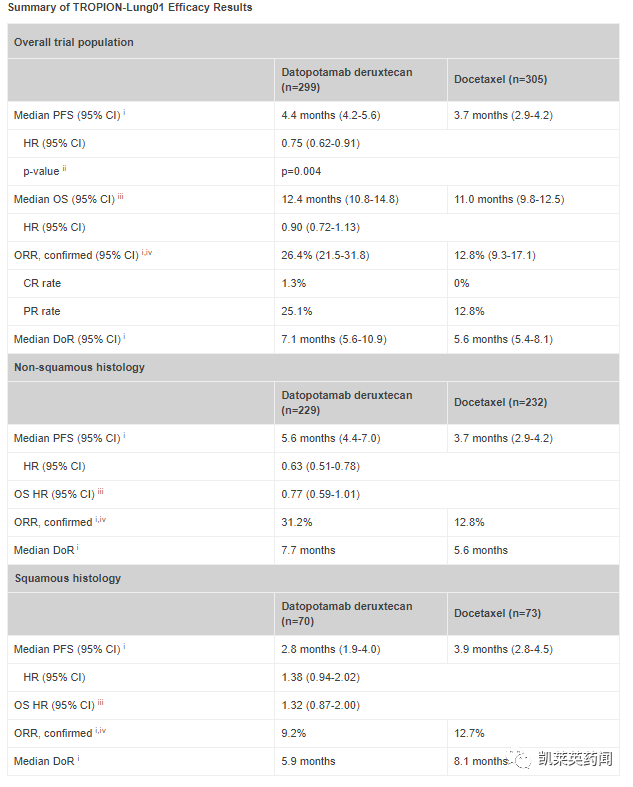
According to the data assessed by BICR, Datopotamab deruxtecan reduced the risk of disease progression or death by 25% compared to docetaxel; the median PFS for patients treated with datopotamab deruxtecan was 4.4 months, while for those treated with docetaxel, it was 3.7 months.
The ORR was 26.4% in patients treated with datopotamab deruxtecan and 12.8% in those treated with docetaxel.
According to BICR assessment, in patients with non-squamous NSCLC, the risk of disease progression or death was reduced by 37% compared to docetaxel; the median PFS for patients treated with datopotamab deruxtecan was 5.6 months, compared to 3.7 months for those treated with docetaxel; the confirmed ORR observed with datopotamab deruxtecan was 31.2%, including 4 complete responses (CR), while the ORR for docetaxel was 12.8%, with no CRs reported.
In the overall population and in patients with non-squamous tumors, overall survival (OS) had not reached statistical significance at the data cutoff.
In terms of safety, no new safety issues were identified; the median treatment duration was 4.2 months for datopotamab deruxtecan and 2.8 months for docetaxel. In the datopotamab deruxtecan arm and docetaxel arm, 25% and 41% of patients experienced Grade 3 or higher treatment-related adverse events (TRAEs), respectively. The most common Grade 3 or higher TRAEs were neutropenia (1%, 23%), stomatitis (6%, 1%), anemia (4%, 4%), asthenia (3%, 2%), nausea (2%, 1%), and fatigue (1%, 2%).
Two
About TROPION-Breast01
TROPION-Breast01 is a global, randomized, multi-center, open-label Phase III trial evaluating the safety and efficacy of datopotamab deruxtecan (6.0 mg/kg) versus investigator’s choice of single-agent chemotherapy (eribulin, capecitabine, vinorelbine, or gemcitabine) in patients with inoperable or metastatic HR-positive, HER2-low or negative (IHC 0, IHC 1+, or IHC 2+/ISH-) breast cancer. More than 700 patients were enrolled at sites in Asia, Europe, North America, South America, and Africa.
The dual primary endpoints were PFS and OS assessed by BICR. Key secondary endpoints included ORR, duration of response, investigator-assessed PFS, disease control rate, and time to first subsequent treatment.
Results show:
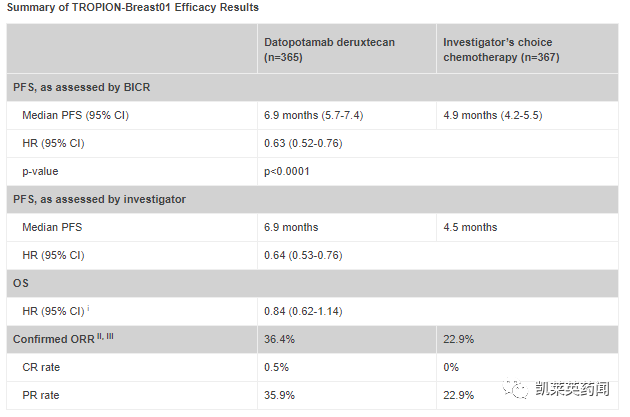
As assessed by blinded independent central review (BICR), datopotamab deruxtecan reduced the risk of disease progression or death by 37% compared to investigator’s choice of chemotherapy;
The median PFS for patients treated with datopotamab deruxtecan was 6.9 months, compared to 4.9 months for those receiving chemotherapy.
Consistent PFS benefit was observed across all subgroups.
The objective response rate (ORR) was 36.4% in patients treated with datopotamab deruxtecan, compared to 22.9% for chemotherapy.
At the data cutoff, OS had not reached statistical significance.
In terms of safety, no new safety issues were identified; Grade 3 or higher treatment-related adverse events (TRAEs) occurred in 21% and 45% of patients in the datopotamab deruxtecan arm and chemotherapy arm, respectively. The most common Grade 3 or higher TRAEs were neutropenia (1%, 31%), stomatitis (6%, 3%), fatigue (2%, 2%), and anemia (1%, 2%).
In the datopotamab deruxtecan group, the incidence of interstitial lung disease (ILD) of all grades was low (3%), and most events were low-grade. One grade 5 ILD event, adjudicated by an independent committee as drug-related, was determined by the investigator to be caused by disease progression.
Three
About BEGONIA
BEGONIA is an open-label, two-part, multi-center Ib/II trial evaluating datopotamab deruxtecan in combination with Imfinzi and tumor therapy regimens with or without paclitaxel for the first-line treatment of metastatic triple-negative breast cancer (TNBC).
Among them, Arm 7 of the trial is evaluating the safety, tolerability, and preliminary efficacy of datopotamab deruxtecan (6.0 mg/kg) in combination with Imfinzi (1120 mg) for previously untreated patients with unresectable locally advanced or metastatic TNBC. The primary endpoints are safety and tolerability. Secondary endpoints include investigator-assessed ORR, PFS, and DOR.
The results of Group 7 show:
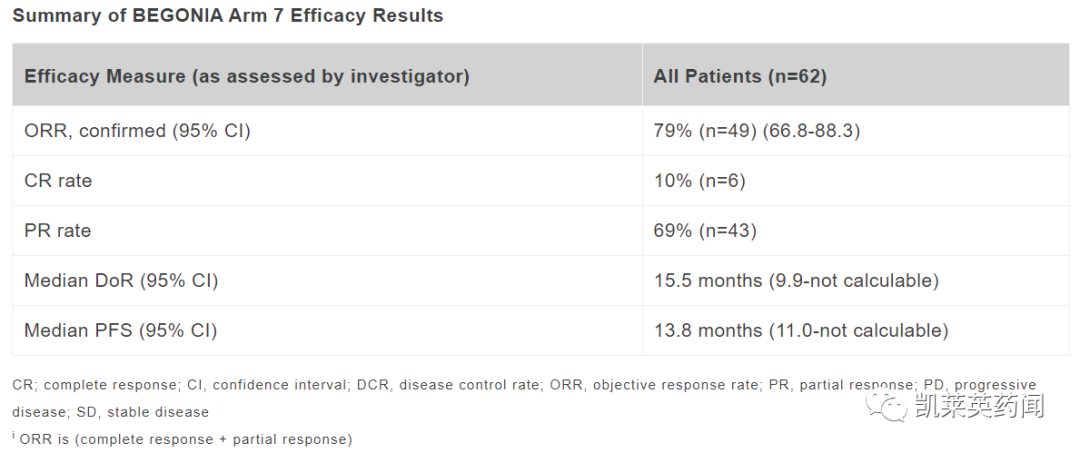
Regardless of PD-L1 expression levels, the ORR of datopotamab deruxtecan combined with Imfinzi (an anti-PD-L1 therapy) was 79%, including 6 complete responses (CR) and 43 partial responses (PR); the median progression-free survival (PFS) was 13.8 months; the median duration of response (DoR) was 15.5 months.
In terms of safety, the combination of datopotamab deruxtecan and Imfinzi is consistent with the known safety profiles of the two drugs. Treatment-emergent adverse events (TEAEs) of grade 3 or higher occurred in 57% of patients. The most common grade 3 or higher TEAEs were increased amylase (18%), stomatitis (11%), constipation (2%), fatigue (2%), vomiting (2%), and decreased appetite (2%). An independent committee determined that three cases of interstitial lung disease (ILD) were drug-related, including two grade 2 events and one grade 1 event.
In addition, enrollment is currently underway for Arm 8 of the BEGONIA trial, which is evaluating the efficacy of datopotamab deruxtecan in combination with Imfinzi in TNBC patients with high levels of PD-L1 expression.




"Views"Click once