

AstraZeneca's 'Lung Cancer Blockbuster' Osimertinib Faces Mounting Competition as Johnson & Johnson's Amivantamab-Lazertinib Combo Outperforms in Head-to-Head Trial

Johnson & Johnson
Healthcare Product Manufacturers, Health Service Providers

AstraZeneca
Biopharmaceutical Manufacturer

Unexpected Outcomes at ESMO Conference: Even AstraZeneca's Star Drug Osimertinib Faces Challenges.
On October 23, Johnson & Johnson announced a head-to-head Phase III clinical trial targeting Osimertinib,The results showed that the clinical effect of Johnson & Johnson's amivantamab combined with lazertinib was better than that of osimertinib.
Osimertinib is the benchmark for global third-generation EGFR drugs, and its status has remained unshaken for many years.In 2022, the global sales of Osimertinib reached $5.4 billion.
The more popular it is, the more likely it is to be targeted.
AstraZeneca, of course, will not sit idly by. On October 16, AstraZeneca announced:FDA Grants Priority Review to Osimertinib Combination Chemotherapy Regimen, used for the treatment of non-small cell lung cancer. Clinical data shows that this combination regimen is superior to osimertinib alone.Increased the median progression-free survival period by 8.8 months for patients.
The official race between the two sides has begun.

Besiege the Throne
Amivantamab is an EGFR x MET bispecific antibody developed by Johnson & Johnson, and Lazertinib is a third-generation EGFR inhibitor introduced by Johnson & Johnson. Johnson & Johnson disclosed that through the latest clinical trials,First-line treatment regimens will be established for adult patients with locally advanced or metastatic NSCLC harboring EGFR exon 19 deletions or exon 21 (L858R) substitution mutations.
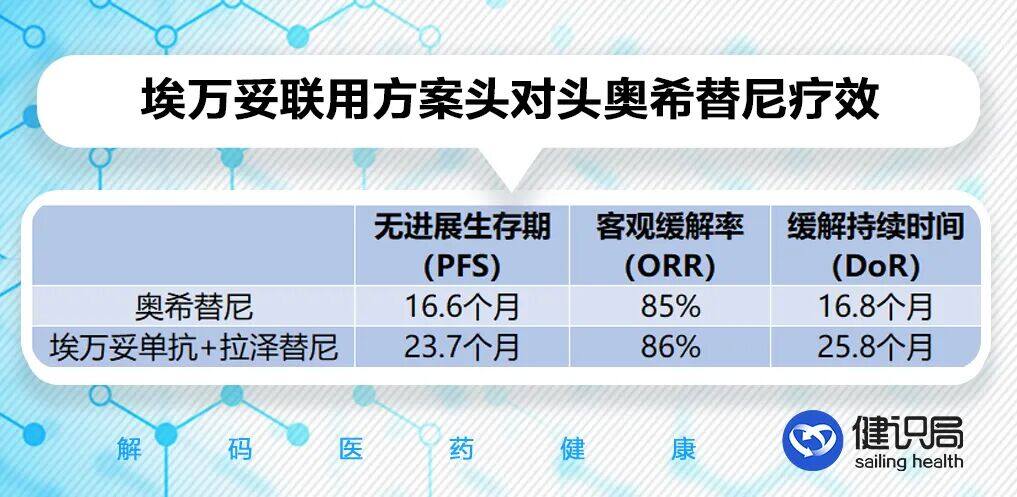
In fact, at the end of September this year, Johnson & Johnson had already obtained the clinical results, but waited until the ESMO conference to disclose them. The data shows that the combination of Johnson & Johnson's two drugs can reduce the risk of disease progression or death by 30% compared to Osimertinib.Median PFS reached 23.7 months, 7.1 months longer than Osimertinib.. The OS data for overall survival has not yet matured, but it currently shows a positive trend.
Data Source: ESMO Official Website
The EGFR field is highly competitive, with Almonertinib, Furmonertinib, and Befotertinib already vying for market share in China. The positive results from Johnson & Johnson's combination therapy could pose the most direct challenge to Osimertinib.
Among non-small cell lung cancer patients with EGFR gene mutations, EGFR exon 19 deletions and exon 21 substitution mutations are the most common, which are also the mainstream indications for EGFR-TKIs currently.In 2018, Osimertinib entered a rapid growth phase after securing its position as a first-line treatment for this indication, doubling its sales that year and becoming AstraZeneca's leading anti-cancer drug.
Amivantamab has been approved for the treatment of locally advanced or metastatic non-small cell lung cancer with EGFR exon20 insertion mutations. Until now,Globally, only Amivantamab and Dizal's Sunvozertinib have been approved for this indication.
With almost no competitors and an urgent need to fill the treatment gap, Johnson & Johnson focused on exon 20 as the primary indication to advance in designing clinical trials. The result was very fortunate,In May 2021, Amivantamab received accelerated approval in the United States, significantly advancing the product's market launch schedule.
But this market is still too small after all. Perhaps for this reason, Johnson & Johnson has recently accelerated clinical trials of amivantamab combination therapy in the field of non-small cell lung cancer with EGFR exon 19 deletions and exon 21 substitution mutations. In 2021, Johnson & Johnson also initiated research following resistance to osimertinib. The results showed that amivantamab demonstrated good therapeutic effects, reducing the risk of disease progression or death by 52% when combined with chemotherapy, and achieving a 56% reduction when further combined with lazertinib.
What Osimertinib can treat or cannot treat, Amivantamab combination therapy can handle.Therefore, this time Johnson & Johnson directly conducted a head-to-head trial.

Challengers Gather
Head-to-head defeat of Osimertinib doesn't necessarily mean a bright future for Amivantamab.
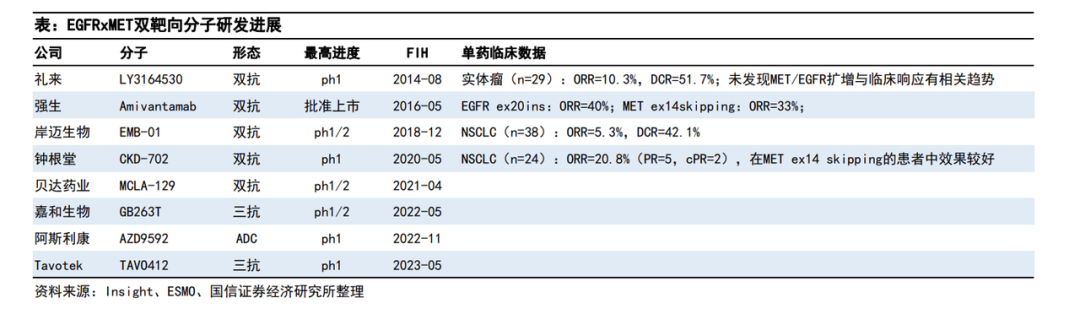
The advantage of the Amivantamab regimen currently lies in its speed. There are many drug developments targeting EGFR-TKI resistance mechanisms, including EFGR x MET dual-target drugs as well as TROP2 ADC and HER3 ADC, which are undergoing clinical trials. The combination regimen with Amivantamab is already one of the faster-progressing treatments and has been proven to have superior efficacy.
Source: Guoxin Securities Research Report
Lazertinib, combined with Amivantamab, is also a third-generation EGFR inhibitor. The combination of these two powerful drugs seems to have an efficacy superior to Osimertinib, as expected.Safety is the biggest concern with combination use.In clinical trials, Johnson & Johnson concluded that: The safety of amivantamab combined with lazertinib is consistent with previous reports. Its toxicity is largely controllable.
But it is worth noting that,Compared with Osimertinib, the incidence of hypoalbuminemia, peripheral edema, and venous thrombosis was also higher in patients treated with Amivantamab combination therapy.
To truly compete with Osimertinib, Johnson & Johnson's product may not have the capability yet. In China, there are also several promising varieties. Currently, Aumolertinib, Furmonertinib, and Befotertinib have been successively approved, and they are in a period of rapid growth. In terms of efficacy, they are no less effective than Osimertinib.But so far, no variety has conducted a head-to-head trial targeting Osimertinib.
The issue of drug resistance is also driving the development of a new generation of EGFR inhibitors. Since the approval of osimertinib in 2015, third-generation inhibitors have been around for nearly 8 years.Fourth-generation InhibitorAlthough it has not been launched, the competitive landscape is already very intense. Chinese companies such as Zhengda Tianqing, Beta Pharma, Qilu Pharmaceutical, Junshi Biosciences, Hansoh Pharmaceutical, and Zai Lab have already invested in research and development, among which...The US-based Blueprint Medicines' BLU-945, which is in Phase I/II trials, is being developed and commercialized by Zai Lab in Greater China.。Osimertinib will face considerable challenges.
This may be the pressure that comes with the "throne."
Jian Shi Ju learned that AstraZeneca is developing the EGFR/c-MET bispecific antibody-drug conjugate (ADC) AZD9592 to address the situation of resistance to osimertinib. In March this year, this ADC has already been submitted for clinical trials in China. If the development proceeds smoothly, it could potentially become another growth driver for osimertinib.
By | Yang Xixia
Editor | Jiang Yan, Jia Ting
Operation | Valley

Statement: Original content by Jian Shi Ju, please do not reprint without permission.
One Sad, One Happy: Reasons Found for China's ADC Going Overseas!
Scan to add me: Join the group for communication, informed tips, and authorized reprints.
If there are any issues with the content, please contact us by email:
jianshiju@boyamedia.com
For business cooperation, please contact: 13288688512