Recently, Daiichi Sankyo and AstraZeneca jointly announced multiple study results of datopotamab deruxtecan (Dato-DXd), including the Phase III TROPION-Breast01 study, Phase III TROPION-Lung01 study, Phase II TROPION-Lung05 study, and Phase Ib/II BEGONIA study. Among them, data from the TROPION-Breast01 and TROPION-Lung01 studies came from two latest positive result reports (LBA11 and LBA12) of the Dato-DXd clinical development program and were presented in special reports at the 2023 European Society for Medical Oncology (ESMO23) Congress.Dato-DXd is an investigational antibody-drug conjugate (ADC) targeting TROP2. Designed using Daiichi Sankyo's proprietary DXd ADC technology, Dato-DXd is one of the three core ADCs in Daiichi Sankyo's oncology pipeline and represents the most advanced program on AstraZeneca’s ADC scientific platform. Dato-DXd consists of a humanized anti-TROP2 IgG1 monoclonal antibody (developed in collaboration with Sapporo Medical University) linked to a topoisomerase I inhibitor payload (a camptothecin derivative) via a cleavable tetrapeptide linker.Dato-DXd First Phase III Breast Cancer Study,
Showcase Trop-2 ADC as the Best-in-Class (BIC) Treatment for Breast Cancer

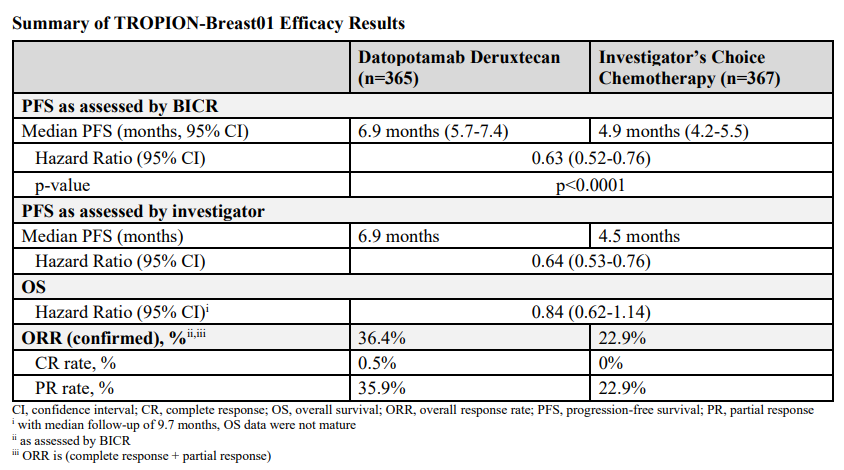
TROPION-Breast01It is a global, randomized, multi-center, open-label Phase III study aimed at evaluating the efficacy and safety of Dato-DXd versus investigator-selected chemotherapy regimens in patients with inoperable or metastatic HR-positive, HER2-low, or HER2-negative (IHC 0, IHC 1+, or IHC 2+/ISH-) breast cancer whose disease has progressed after prior endocrine therapy as assessed by the investigator or who are unsuitable for endocrine therapy and have received at least one prior systemic therapy.In the dual primary endpoint analysis, assessed by Blinded Independent Central Review (BICR), compared with investigator-selected chemotherapy,Dato-DXd Reduces Risk of Disease Progression or Death by 37% in HR-Positive, HER2-Low or Negative Metastatic Breast Cancer Patients(Hazard Ratio [HR] = 0.63; 95% Confidence Interval [CI]: 0.52-0.76; p<0.0001).The median progression-free survival (PFS) was 6.9 months in the Dato-DXd treatment group and 4.9 months in the chemotherapy group. Consistent PFS benefits were observed across different subgroups. Additionally, the analysis showed an objective response rate (ORR) of 36.4% in the Dato-DXd treatment group, compared to 22.9% in the chemotherapy group.In the interim analysis for the dual primary endpoint of overall survival (OS), as of the data release, Dato-DXd demonstrated a trend toward improved OS over chemotherapy (HR = 0.84; 95% CI: 0.62-1.14); however, at the data cutoff date, OS had not yet reached statistical significance. The study is ongoing, and OS will be further evaluated in subsequent analyses.Dato-DXd demonstrated superior safety compared to chemotherapy, with no new safety concerns identified. The incidence rates of treatment-related adverse events (TRAEs) of Grade 3 or higher were 21% in the Dato-DXd group and 45% in the chemotherapy group.
BEGONIAIt is an open-label, two-part, multicenter Phase Ib/II trial designed to evaluate the efficacy and safety of combining with other therapies (with or without paclitaxel) for first-line treatment of metastatic TNBC. Cohort 7 evaluates the safety, tolerability, and preliminary efficacy of Dato-DXd in combination with durvalumab in patients with previously untreated unresectable, locally advanced, or metastatic triple-negative breast cancer (TNBC).The results showed that the confirmed ORR of Dato-DXd combined with the immunotherapy drug durvalumab was 79% (95% CI: 67-88), including 6 cases.Complete Remission (CR)And 43 casesPartial Response (PR)Regardless of PD-L1 expression levels, relief was observed. The median PFS was 13.8 months (95% CI: 11-Not Calculable [NC]).First Positive Phase III Results for ADC in Lung Cancer Treatment,
Dato-DXd Pioneers as the First-in-Class (FIC) TROP2 ADC in Advanced Lung Cancer ADC Therapy

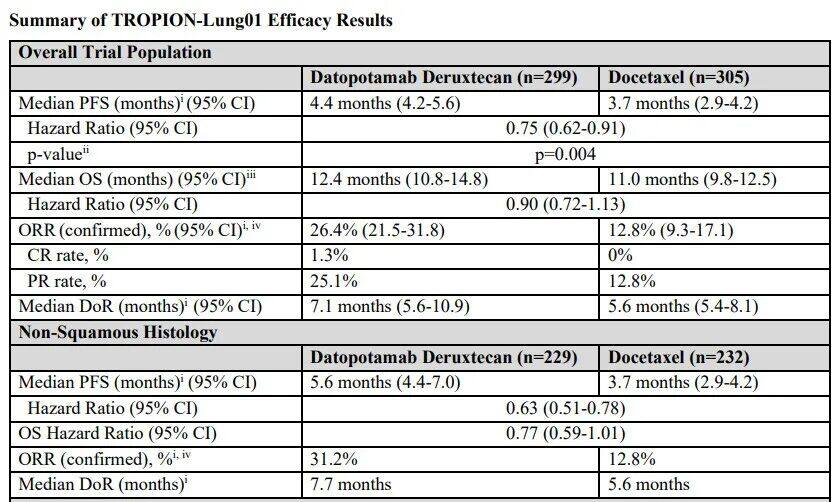
TROPION-Lung01It is an ongoing global, randomized, multicenter, open-label, Phase III study aimed at evaluating the efficacy and safety of Dato-DXd compared to docetaxel in patients with locally advanced or metastatic NSCLC who have previously received at least one prior therapy, with or without actionable genetic mutations.As assessed by BICR, compared with docetaxel, Dato-DXd reduced the risk of disease progression or death by 25% (HR=0.75; 95% CI: 0.62-0.91; p=0.004). The median PFS was 4.4 months for patients treated with Dato-DXd and 3.7 months for those treated with docetaxel. The confirmed ORR was 26.4% in patients receiving Dato-DXd and 12.8% in patients receiving docetaxel.As assessed by BICR,In patients with non-squamous NSCLC, Dato-DXd demonstrated clinically meaningful benefit, reducing the risk of disease progression or death by 37% compared to docetaxel (HR=0.63; 95% CI: 0.51-0.78).The median PFS for patients treated with Dato-DXd was 5.6 months, compared to 3.7 months for patients treated with docetaxel.
The interim analysis for the dual primary endpoint OS showed that, in both the overall trial population and non-squamous cell carcinoma patients, Dato-DXd demonstrated a numerical trend of benefit compared to chemotherapy (Overall population HR=0.90; 95% CI: 0.72-1.13,HR=0.77 in non-squamous cell carcinoma population; 95% CI: 0.59-1.01). As of the data cutoff date, OS has not reached statistical significance. The study is currently ongoing, and OS will be evaluated in further analyses.In the TROPION-Lung01 study, no new safety issues were identified compared to previously reported data. The incidence rates of treatment-related adverse events (TRAEs) of grade 3 or higher were 25% in the Dato-DXd treatment group and 41% in the docetaxel treatment group.TROPION-Lung05It is an ongoing global, multicenter, single-arm, open-label, Phase II study aimed at evaluating the efficacy and safety of Dato-DXd in treating patients with advanced or metastatic NSCLC who have actionable gene mutations and experienced disease progression during or after receiving at least one tyrosine kinase inhibitor and at least one platinum-based chemotherapy regimen (with or without other systemic therapies). Patients with one or more gene mutations, including EGFR, ALK, ROS1, NTRK, BRAF, RET, or MET exon 14 skipping mutations, and who have received no more than four prior lines of therapy are eligible for this study.
In the overall population (n=137), the ORR in the Dato-DXd group was 35.8% (95% CI: 27.8-44.4), including 4 cases of complete response (CR) and 45 cases of partial response (PR), with a disease control rate (DCR) of 78.8%. The median PFS was 5.4 months (95% CI: 4.7-7.0). In patients harboring EGFR mutations (n=78, the most common genomic mutation), the ORR for Dato-DXd was 43.6%, and the DCR was 82.1%.
Copyright © 2023 PHARMCUBE. All Rights Reserved.
Welcome to forward, share, and reasonably cite. When citing, please clearly indicate the source of the article.For reprint, please leave a message to the WeChat Official Account backend or send a message, and indicate the name and ID of the official account.
Disclaimer: The information in this WeChat article is for general reference only and should not be used directly as decision-making content. PharmaCube assumes no responsibility for any loss incurred by any party due to the use of the content herein.The tweet is used to convey knowledge. If you have any questions about copyright, etc., please contact PharmaExpress within 30 days of the publication of this article.Original content is prohibited from being reproduced on other platforms without authorization.Questions can be sent.Email to yong_wang@pku.edu.cn for more information.©2021 Medicine Express All rights reserved
Pharma ExpressSharing of literature, frontiers, popular science, and interesting stories in the fields of pharmacy and life sciences.