

Neuromodulation Sector Heats Up: Three IPOs Emerge as Boston Scientific Bets $6 Billion on Strategic Acquisitions

Boston Scientific
Medical Device Manufacturer

Axonics
Developer of Novel Implantable Neuromodulation Technologies

Medtronic
Chronic Disease Medical Device and Therapy Developer
Recently, the implantation of DBS (deep brain stimulation) electrodes as a "mood switch" to intervene in treatment-resistant depression has drawn public attention.
DBS Intervention for Refractory Depression Regulates Patients' Emotions and Also Stimulates the Neuromodulation Industry. This Means That Neuromodulation Is Expected to Open the Door to the Blue Ocean Market of Refractory Psychiatric Disorders.
After 2018, the field of neuromodulation experienced a boom, giving rise to several U.S.-listed companies. For example, in 2018, Axonics went public on Nasdaq with its innovative sacral nerve stimulation product for treating urinary incontinence and achieved nearly 2 billion yuan in revenue in 2022. In 2021, Neuropace, which developed a closed-loop stimulation product for refractory epilepsy, went public; in the same year, CVRx, which uses neuromodulation to treat heart failure, was listed on Nasdaq.
This field is still bursting with innovative vitality, and there have been multiple financings around neuromodulation globally.Among them, Saluda Medical, a pioneer in the global neuromodulation field, secured over 1 billion yuan in its Series C+ funding round in May this year. Chinese neuromodulation company Nurotron has also completed IPO tutoring and verification.
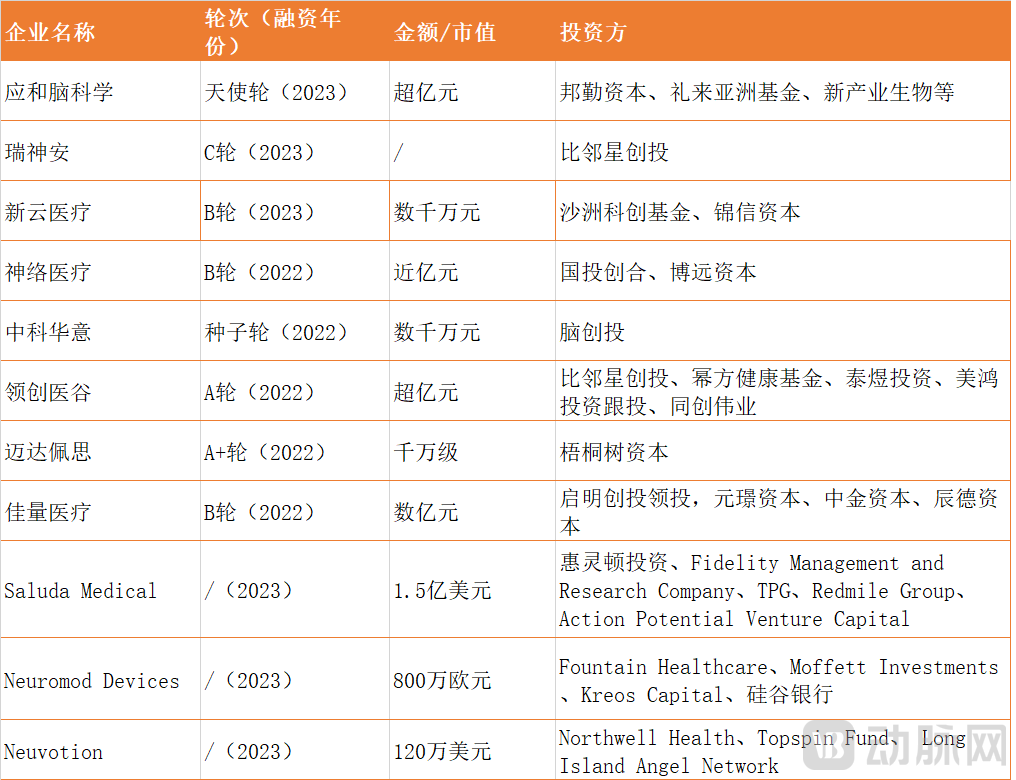
Global Financing Events in the Field of Neuromodulation
The giants have also focused on neuromodulation. In September 2023, Boston Scientific acquired Relievant Medsystems for $850 million (approximately RMB 6.2 billion) to expand its neuromodulation portfolio for treating chronic pain. Abbott is exploring the use of DBS to intervene in treatment-resistant depression. Meanwhile, Medtronic has launched closed-loop DBS and SCS products.
Under the dense changes, it is not difficult to find that neuromodulation is in the midst of an industrial transformation.
The neuromodulation market is mainly composed of three major segments: SCS (Spinal Cord Stimulation), DBS (Deep Brain Stimulation), and VNS (Vagus Nerve Stimulation). In the global market share, Spinal Cord Stimulators (SCS) account for the largest proportion, representing nearly 55% of the total market in 2018; Deep Brain Stimulators account for 16%, Vagus Nerve Stimulators account for 14%, and other categories account for approximately 15%.
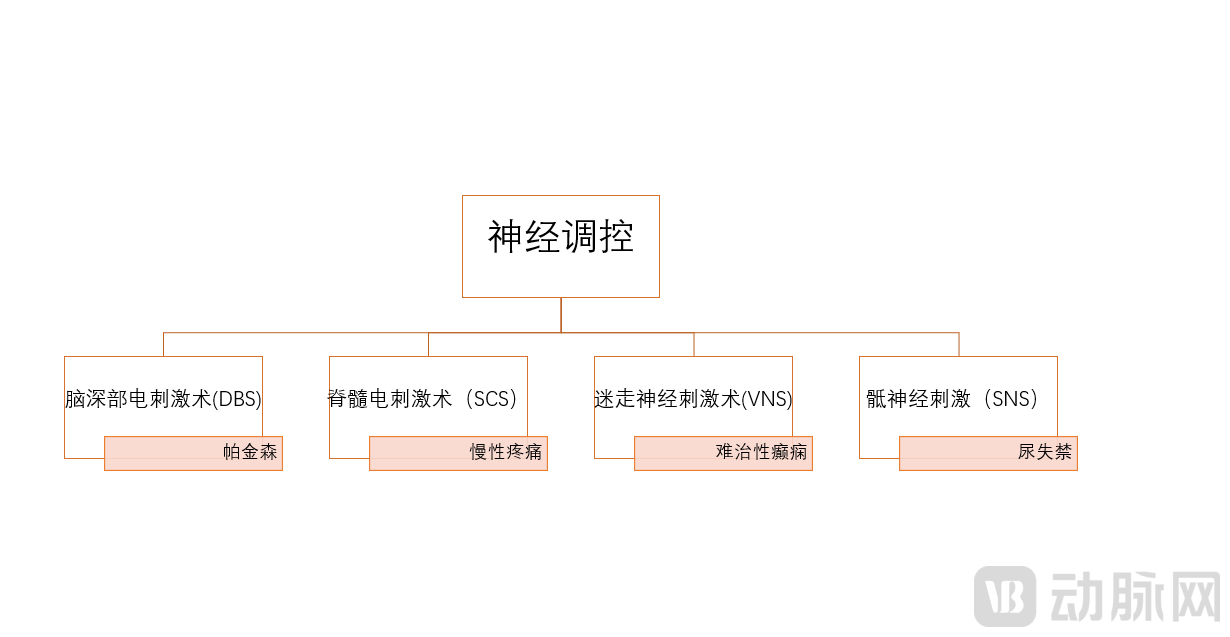
Neuromodulation Industry Map
The neuro-modulation track cannot avoid the four giants: Medtronic, Abbott, Boston Scientific, and LivaNova.In the SCS (Spinal Cord Stimulation) market segment, Medtronic, Abbott, and Boston Scientific each hold about one-third of the market share. In the DBS (Deep Brain Stimulation) market, Medtronic dominates with over 80% of the market share, while Abbott and Boston Scientific split the remaining market. In the VNS market, LivaNova holds more than 80% of the market.
From the financial reports of Medtronic, Abbott, and Boston Scientific, the neuromodulation market is experiencing rapid growth.According to the data disclosed in Medtronic's 2023 annual report, the revenue from neuromodulation in the 2023 fiscal year was $1.693 billion, a year-on-year increase of 2.4%, mainly driven by pain management products. Abbott’s Q2 2023 neuromodulation revenue was $423 million, a year-on-year increase of 13.2%. Neuromodulation is the fastest-growing medical device business outside of diabetes care. Boston Scientific's Q2 2023 financial report shows that the revenue from the neuromodulation business in the first half of 2023 was $244 million.
How Do the Three Giants Lay Out Neuromodulation Products Amid Industrial Changes?
Boston Scientific Expands SCS Portfolio Through Acquisitions. In 2023, Boston Scientific acquired Relievant Medsystems, a company specializing in neuroablation treatments for discogenic pain, for $850 million.
Relievant Medsystems' core product, the Intracept system, treats chronic vertebral-origin low back pain through vertebral nerve ablation and is currently the only FDA-approved method for treating this condition. The acquisition of Relievant Medsystems has helped Boston Scientific expand its chronic pain solutions to meet the needs of different patients.
Shenluo Medical founder Wang Shou dong said: "For the chronic pain market, neuromodulation, decompression, and radiofrequency ablation relieve chronic pain in different ways. Pain caused by compression needs decompression first. For example, some patients with lumbar disc herniation can have their pain greatly reduced after surgery. Radiofrequency ablation treats pain by destroying nerves. SCS relieves intractable pain by stimulating spinal nerves with pulse current to block pain signals from being transmitted to the brain via the spinal cord. All three methods meet certain clinical needs, and SCS, as a safe 'green therapy,' is increasingly gaining clinical attention."
Although this acquisition did not directly involve a neuromodulation company, it can enhance Boston Scientific's competitiveness in the chronic pain relief market. This forms a product portfolio of neuromodulation + Indirect Decompression System (IDS) + Radiofrequency Ablation (RFA), covering more patient needs and also driving the penetration of neuromodulation.
In the DBS field, Boston Scientific has introduced directional electrodes to achieve targeted stimulation, thereby addressing the shortcomings of traditional DBS ring electrodes. By adjusting the stimulation direction of the directional electrodes, precise stimulation of the target neural nucleus can be achieved, avoiding adverse reactions such as language disorders and visual impairments in patients.
Medtronic's strategy is to launch closed-loop products in the field of neuromodulation.In 2020, Medtronic launched the Percept PC DBS product, the first FDA-approved DBS product with the ability to "sense" deep brain neural activity.
In 2023, Medtronic launched the first closed-loop SCS product, Inceptiv. The highlight of Inceptiv's closed-loop stimulation is the use of ECAP as the feedback signal for stimulation, continuously sensing each individual's unique biological signals and adjusting the stimulation as needed.
Abbott is exploring the unknown territory of depression in the field of neuromodulation.Abbott's application of DBS in treating refractory depression received FDA Breakthrough Device Designation in 2022. Evidence suggests that implanting electrodes in parts of the brain responsible for mood regulation can help alleviate symptoms of refractory depression.
DBS Application in Intervention for Refractory Psychiatric Disorders Becomes a Key Exploration Area. Relevant experiments are being conducted in the fields of depression, Alzheimer's disease, tic disorders, addiction, anorexia nervosa, and schizophrenia.
Explorers are not limited to Abbott. In China, Jingyu Medical's DBS intervention for refractory depression has conducted clinical research at Ruijin Hospital, affiliated with Shanghai Jiao Tong University School of Medicine. Currently, 23 patients have completed the implantation, with an average improvement of 60% in depressive symptoms.
From the layout directions of the three giants, it is not difficult to see that neuromodulation is developing in two major directions: expanding indications and creating closed-loop products.
Neuromodulation technology, once limited to interrupting neural signals associated with chronic pain and movement disorders, is now expanding into new fields. Urinary incontinence, heart failure, stroke rehabilitation, treatment-resistant depression, and obsessive-compulsive disorder have all become areas of exploration for neuromodulation.
In terms of technological change, a significant trend in the field of neuromodulation is the move towards miniaturization and closed-loop stimulation.
Miniaturization reduces product volume, decreases power consumption, and brings a better implantation experience for patients.
Closed-loop stimulation is a revolutionary change to the open-loop stimulation model.The previous generation of neurostimulators (DBS, SCS, VNS) were primarily open-loop stimulation systems. Open-loop stimulation systems fix the stimulation intensity and interval, emitting electrical pulses at a fixed frequency.
Taking SCS implant surgery as an example, during the operation, effective stimulation parameters are selected based on the patient's paresthesia and pain relief level, and the parameters are fixed once determined. After a period post-operation, it is necessary to adjust the stimulation amplitude via remote control to reduce the possibility of over- or under-stimulation, but this carries the risk of diminished treatment effectiveness.
Closed-loop stimulation, on the other hand, adjusts the intensity and frequency of electrical stimulation by real-time sensing of neural signals.Representative products approved globally include the Responsive Neurostimulator (RNS) developed by NeuroPace for the treatment of refractory epilepsy and Medtronic's Percept™ PC, a brain stimulation device with sensing capabilities.
NeuroPace's RNS Stimulator and RNS System can collect EEG signals through electrode plates placed near the patient's epileptogenic focus, identify abnormal electrical patterns specific to the patient before a seizure, and the stimulator is equipped with multiple sets of stimulation parameters. When abnormal EEG activity is detected, the stimulator automatically activates and delivers the corresponding stimulation program through the electrodes to the cortex or target brain area. This suppresses the excessive synchronization of neuronal discharges, thereby achieving the goal of inhibiting epileptic seizures.
At the same time, the product design moves the pulse generator from the chest site of VNS and DBS implantation to the brain, reducing skin and flesh trauma and the risk of surgical complications. The RNS system provides personalized treatment for different patients, performs feedback stimulation, reduces power consumption, and offers better therapeutic effects.
Medtronic's Percept™ PC, a brain sensing stimulator, features 16 independently adjustable stimulation channels and 6 sensing channels. While delivering electrical stimulation therapy to the patient's brain, it senses specific brain signals associated with disease symptoms and analyzes them using intelligent algorithms, providing objective data for doctors to develop treatment strategies, thereby offering personalized and precise treatment to patients.
The difficulty in achieving a true closed-loop in neuromodulation lies in the interpretation of signals. The challenge of implementing sensing technology has been described by the scientific community as "hearing a whisper amidst the roar of a jet engine." The primary difficulty lies in identifying neural signals, with the further challenge being the ability to interpret these signals. Without precise signal judgment, many ineffective stimuli will be administered, failing to achieve targeted stimulation.
How Neuromodulation Achieves More Precise Signal Interpretation and Accurate Stimulation, Brain-Computer Interface Technology May Be the Answer.
In a broad sense, NeuroPace's RNS system has formed a brain-computer interface. However, the RNS system collects coarse local field potential (LFP) signals or electrocorticography (ECoG) signals and does not analyze these signals. The new high-throughput neural electrodes aim to collect spike signals, which are high-frequency pulse electrical signals released at the single-neuron level. These signals can be analyzed and encoded, with the potential to bring breakthroughs in understanding disease mechanisms.
Although neuromodulation has shown high growth globally, its market penetration rate in China has remained relatively low.
For example, using neuromodulation to alleviate refractory pain. Globally, more than 1.5 billion people suffer from various types of chronic pain, surpassing the total number of patients with cardiovascular diseases, diabetes, and cancer combined. Among them, over a quarter experience the most stubborn neuropathic pain, urgently requiring better treatment options.
In China, the number of pain patients exceeds 300 million and is increasing at a rate of 10 to 20 million per year. There are approximately 50 million patients with chronic intractable pain. SCS is mainly used to treat intractable pain, such as peripheral nerve injury pain, diabetic foot neuropathy, postherpetic neuralgia, phantom limb pain, and other painful conditions.
Although the patient base is large, the annual number of SCS implants in China is not high compared to the global annual volume of 100,000 SCS implants due to the high cost of SCS.
Cost is the main reason for patients in China to "bear the pain."
Shenluo Medical founder Wang Shoudong told VCBeat: "The total cost of SCS implantation in China is about 280,000 yuan, with domestically produced products costing between 150,000 and 200,000 yuan. In terms of medical insurance reimbursement, only three or four provinces in China support reimbursement for SCS implantation. For most people, the cost of implanting a matchbox-sized stimulator is equivalent to that of a mid-sized car. The high cost exceeds the affordability of many patients."
The gap between domestic and international markets and the many pain points in the clinical application of traditional implantable neuromodulation products have given Chinese companies an opportunity to enter the market, with multiple companies securing financing.
In the field of chronic pain, ShenLuo Medical aims to launch SCS products with higher accessibility, independently developing two major systems: the SCS system and Peripheral Nerve Stimulation (PNS). The SCS is used for long-term implantation to treat intractable pain, while the PNS is designed for short-term implantation as a temporary, short-term peripheral nerve modulation system that alleviates acute and chronic pain. This form of physical therapy has no drug-related side effects, filling the gap between opioid medications and expensive surgical neuromodulation.
In the field of closed-loop neuromodulation, Epilcure, a responsive neurostimulator for refractory epilepsy co-developed and produced by NovaMed, a subsidiary of JiLiang Medical, in collaboration with Zhejiang University, has officially launched its prospective, multi-center, controlled China registration clinical trial. This clinical trial is being implemented across eight top neurosurgical centers in China.
Exploring new fields is not easy, as even Axonics and Neuropace, the overseas benchmark startups in neuromodulation, remain in a loss-making state years after their IPOs.
Axonics has developed a sacral nerve stimulator to provide long-lasting and safe clinical treatment for patients with overactive bladder or fecal incontinence.
In 2019, Axonics' wireless-adjustable, rechargeable miniature r-SNM system was approved, with an expected service life of up to 15 years. In 2022, Axonics' total net revenue was approximately $273.6 million, representing a year-over-year increase of 52%.
Although its growth rate and scale are quite impressive, Axonics remains in a continuous loss, with a net loss of $47.1 million in 2022, compared to $36.1 million in 2021. Multiple analysts predict that Axonics is expected to break even by 2024.
Global closed-loop neuromodulation pioneer Neuropace is also in a loss-making state, with Neuropace's revenue for the first half of 2023 reaching $30.98 million, a year-on-year increase of 43%, and a net loss of $19.49 million.
Even with breakthrough and innovative products, it takes years to reach the break-even point. While expecting disruptive innovations from neuromodulation, sufficient preparation for the long commercialization cycle of products is also required.
References:
usher in a new era of personalized and precise DBS treatment! Medtronic's intelligent Percept™ PC neurostimulator is about to be clinically applied in China — Medtronic Neurostimulator
Huaxing Capital's Jia Yan: When Capital Meets the Slow-Running Track, Brain-Computer Interface Landing in Medical Scenarios Is No Longer Far Away | Huaxing Medical Perspective —— Huaxing Capital
Brain-Computer Interface: Close to Treating Depression and Paralysis, Far from Digital Immortality | 36Kr New Trends —— 36Kr