

Chongqing Launches $33 Billion Dual-Fund Initiative, Signaling a Major Push into Biopharma Investment
EVAHEART
Cardiovascular Medical Device Developer

SCGC
Investment Institutions in Innovative Fields

Vivo Capital
Global Healthcare Investment Company
Chongqing Welcomes Another Billion-Dollar Heavyweight Fund.
On October 26, the Western (Chongqing) Science City Industrial Development Mother Fund was officially established.Total Fund Size: 30 Billion, focusing on biomedicine, integrated circuits, new energy storage and other fields. Once the news came out, it quickly drew attention from the venture capital circle.
However, this is not the first time that the venture capital community has focused on Chongqing this year. As early as May this year,Chongqing Releases Major News – Announces Establishment of 200 Billion CNY Chongqing Industrial Investment Fund, and will also focus on the pharmaceuticals sector.
In fact, since the beginning of this year, local government-backed mega-funds, worth tens or even hundreds of billions of yuan, have been emerging one after another. According to VCBeat's observation, only in October, nearly 20 places, including Shenzhen, Chengdu, Nanjing, Dongguan, and Fuzhou, announced the establishment of industrial mega-funds. So why is Chongqing drawing so much attention?A very core point still lies in the "contrast" it brings to the entire venture capital industry.。
On the one hand, compared to Beijing, Guangzhou, Shenzhen, and the eastern coastal cities, Chongqing has fewer local market-oriented investment institutions, and the overall investment atmosphere is not very active. Coupled with a relatively weak industrial foundation in the pharmaceutical sector, Chongqing was often overlooked by many mainstream venture capital firms in the past. In previous discussions between VCBeat and several top-tier investors,Many people said that they have never been to Chongqing., even those who have already come mostly do so for tourism, and very few come to see the projects.
But on the other hand, Chongqing has successively established two major mother funds totaling 230 billion yuan in less than half a year, and has gathered includingCICC, Hillhouse, Sequoia, Fortune Venture Capital, Shenzhen Capital Group, IDG, Legend Capital, Qianhai Ark, Top AllianceNearly a hundred top-tier investment institutions, including [specific names], are determined to achieve great success.
And it is precisely within this strong sense of "contrast" that an investment opportunity hidden in Chongqing's pharmaceutical sector seems to have already begun.
Chongqing's pharmaceutical industry is not "nothing"
For many investors, when mentioning Chongqing, the first impression is that it is a tourist city. Those who know a little more would realize it as a heavyweight in manufacturing, boasting the world's largest electronic information industry cluster and China’s largest automotive industry cluster. However, few investors associate it with the pharmaceuticals industry.
Of course, there are objective factors that Chongqing's pharmaceutical industry development is relatively weak, but it is not without any achievements. In fact, in the past year or two, Chongqing's pharmaceutical industry has made some noise in the capital market.
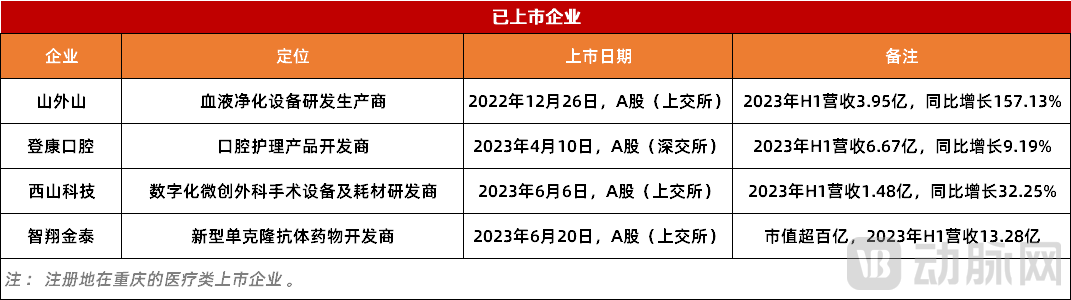 Figure 1. Listed enterprises in Chongqing pharmaceuticals sector over the past year (Data source: Public information)
Taking the secondary market as an example,In the past year, four pharmaceutical companies in Chongqing have successfully gone public, namely SWS, DenCare Oral, Xishan Technology, and ZhiXiang JinTai., among which the domestic blood purification leader, Shanchu Mountain, is also the first STAR Market IPO in Chongqing.
Of course, it's not just the secondary market that's bustling; the primary market also has its shining moments. According to incomplete statistics from the VCBeat database,In the past one and a half years, Chongqing's pharmaceutical sector has completed 24 financings, with a total financing amount exceeding 3 billion yuan.Among them, BMF Precision, a 3D printing service provider for disposable medical application devices, has completed three rounds of financing in a row, with a total financing amount exceeding 500 million yuan.
However, in terms of overall financing volume, Chongqing currently lags significantly behind Beijing, Shanghai, Guangzhou, Shenzhen, and Suzhou in the pharmaceutical field. Moreover, among the new first-tier cities represented by Chengdu, Nanjing, Wuhan, Changsha, and Hefei, Chongqing does not hold a significant advantage at present. However, when compared to its own past performance, Chongqing has shown clear progress in both the number of financing events and the amount of financing. Notably, this growth has occurred against the backdrop of a general downturn in the pharmaceutical market.
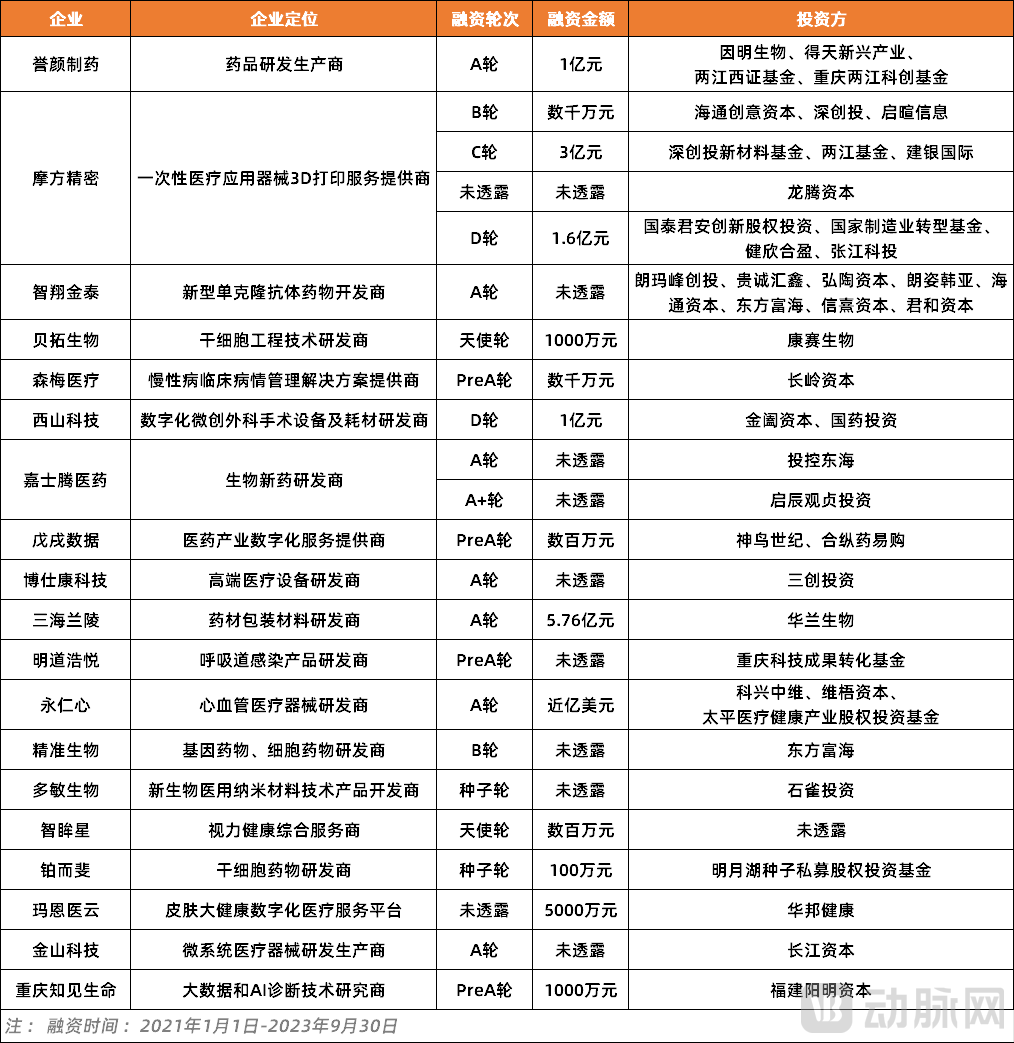 Figure 2. Investment in Chongqing's pharmaceutical sector over the past one and a half years (Data source: VCBeat)
Of course, the encouraging aspect is not just this. Further analysis of these financing events by VCBeat reveals that most of them are concentrated in the early stages. According to incomplete statistics,Among the 19 Chongqing-based pharmaceutical companies that have completed financing in the past year and a half, 16 are at or before Series A, accounting for a total of 84%.。
Besides, in this batch of early pharmaceutical enterprises, most of them focus on cutting-edge technology fields. For example,Chongqing Kingmed Pharma Co., Ltd.It is located in Chongqing Liangjiang New Area and has completed three rounds of financing. It focuses on the organoid field and currently has five major tumor organoid products: "Jia Jie Kang®" (digestive system), "Jia Tu Ning®" (respiratory and thoracic system), "Jia Yi An®" (gynecological system), "Jia Rui Ke®" (urinary system), and "Jia Wei NingTM" (rare tumors).
Another representative company isEVAHEARTIt is located in Beibei District, Chongqing, and completed a nearly 100-million-dollar Series A financing round in March this year. It focuses on the field of heart failure critical care, and its core product, the "Implantable Left Ventricular Assist Device EVAHEART," is the only artificial heart in China that has been approved for both short-term and long-term treatment indications.
In addition, includingGene Testing, High-end Ophthalmic Devices, Stem Cell Drugs, AI Diagnosis, Orthopedic Devices, Nuclear MedicineIncluding core technology sectors such as these, Chongqing pharmaceutical companies currently have coverage in all areas.
Through these, it is not difficult to find that although Chongqing's pharmaceutical industry started relatively late, in recent years it has been focusing on high-end technology fields and has already incubated a number of start-up projects. At the same time, in the secondary market, four listed companies have emerged in the past year, which also verifies the complete investment logic of Chongqing's pharmaceutical industry chain.
From 0 to 1, the Low-Key Layout Hidden Beneath the Surface
If the movements in the capital market are like the visible part above the water, which many investors can see, then the efforts made by Chongqing's pharmaceutical industry beneath the surface may rarely catch the attention of investors. However, in some hidden corners, Chongqing has been quietly making its moves.
For example, in R&D, in June 2022, with the core mission of "next-generation diagnosis of major diseases"Jinfeng LaboratoryOfficially inaugurated. It is reported that,The laboratory currently has nearly 20 PIs, mainly focusing on segments such as life sciences, pathology, brain science, biomedicine, and artificial intelligence.。
And in order to better promote basic research, in June this year, Jinfeng Laboratory also specifically established"The Technology Committee" has attracted 12 academicians from the "Two Academies," including Xue-min Zhang.At the same time, it has also introduced several academic experts in specialized fields, including 12 medical experts, 8 biology experts, and 3 experts in mathematics and artificial intelligence, which will strongly promote multidisciplinary integration based on the pharmaceutical field as well as multi-field scientific research collaboration.
At the same time, in the near future,National Health Strategy Resource Center (Preparatory)Also officially inaugurated at Jinfeng Lab. According to a relevant official from the Chongqing Science and Technology Bureau, the National Health Strategy Resource Center will cover a planned construction area of 6,000 square meters and focus on key developments."Three Databases, Two Platforms, and Two Bases", including the health resource library, human genetic germplasm resource library, and reserve cell resource library; the cell intelligent manufacturing technology platform and sample information resource sharing platform, as well as the clinical trial base for cell therapy products and the biopharmaceutical industrialization base.
And on the carrier side, Chongqing has focused on building in recent yearsChongqing International BioCityAndChongqing National Biomedical Industry BaseIt has also taken shape. Taking Chongqing International Bio City located in Banan District, Chongqing as an example,Currently, more than 100 biopharmaceutical industry chain enterprises have gathered.The previously mentioned listed company, ZhiXiang JinTai, is located here, and it has now become the largest and most complete biomedicine industry cluster in Chongqing with the most comprehensive industrial chain. It is reported that in the first half of this year, Chongqing International Bio-city achieved a scale industrial output value of 7.059 billion yuan, increasing by 2.13% year-on-year.
In this regard, having dealt with Chongqing for many years,Wang Yunhai, Managing Partner of Xianfeng Qiyun"It just mentioned this point, 'Chongqing has enough space to absorb high-quality enterprises and emerging industries, such as the two major biotechnology industrial parks, which are currently equipped with relatively complete software and hardware facilities.'"
There is fundamental research, practical platforms, and a crucial element—an active capital market.. As many people understand, the capital resources in Chongqing's market are not abundant, and local state-owned assets are also relatively limited. Moreover, most of them are still in the early stages of development, and there is still some misunderstanding about the biopharmaceutical industry at this stage.
However, Chongqing has been gradually changing this situation in the past year or two. Taking local state-owned assets as an example, according to the introduction by relevant responsible persons, "We have already established a special pharmaceutical investment team this year. At the same time, we have introduced many professionals in the pharmaceutical field, including frontline pharmaceutical investors, academic experts, and clinical experts. We are also actively cooperating with many frontline market-oriented institutions. The purpose is to be able to invest more focused and professionally in the pharmaceutical sector."
In addition, in terms of market-oriented institutions, with the support of two major industrial funds totaling 230 billion yuan, Chongqing has almost brought over half of the venture capital circle this year, includingCICC, Legend Capital, Hillhouse, Sequoia, Fortune Venture Capital, Shenzhen Capital Group, IDG, Vivo CapitalIncluding those mentioned above, the lineup is quite extensive, making this the liveliest scene in Chongqing's venture capital history.
In this regard, a front-line investor who recently came to Chongqing to evaluate projects told VCBeat, "The decision to come to Chongqing is driven by two factors. On one hand, it’s the general trend of the capital market, where everyone is moving closer to local state-owned capital. On the other hand, we’ve observed some positive changes in Chongqing's pharmaceutical industry in recent years, such as significant improvements in fundamental research and overall supporting infrastructure. Additionally, as the pharmaceutical industries in Beijing, Shanghai, Guangzhou, Shenzhen, and Suzhou are nearing saturation, there is a clear trend of rapid migration towards inland cities. Therefore, in the pharmaceutical sector, Chongqing still holds many investment opportunities for the future."
Of course, in addition to those mentioned earlier,In terms of policy, talent, geographical advantages, and the integration of related industrial chains, Chongqing also has some advantages and untapped potential.
Taking the reserve of key talents as an example, Chongqing is focusing on strengthening support for universities with certain advantages in related industrial fields, such as Chongqing University, Chongqing University of Technology, and Chongqing University of Posts and Telecommunications, to actively cultivate relevant talents; at the same time, it is also vigorously attracting talent.Currently, 50 top universities and research institutions from China and abroad have been introduced, along with more than 2,900 high-end scientific researchers. Additionally, 25 academician teams have been formed, 21 municipal high-end research and development institutions have been approved, and 19 post-doctoral research workstations at the municipal level or above have been established.。
In addition, with the integration of leading industrial chains, and relying on the deep accumulation in manufacturing and electronic information industries, there will be significant opportunities in medical devices and digital healthcare in the future. Coupled with lower land and labor costs, as well as the dual identity of being a municipality directly under the central government and part of the Chengdu-Chongqing economic circle, this advantage will be further amplified.
The Road to Transformation is Long and Arduous, What is Currently Lacking in Chongqing?
Looking at things should not be one-sided; in the development of the pharmaceuticals industry,Chongqing currently still has many limitations.。
At the "Chongqing Industrial Investment Fund Theme Roundtable Conference" held in May this year,Liu Bo, Vice President of Shenzhen Capital GroupIt succinctly pointed out the areas where Chongqing still falls short in industrial development, summarizing them into six points:The first shortage is the leading of leading enterprises., the leading enterprise in the industrial chain;The Second Ecology is Incomplete, The integration of industry, technology, and finance is about building an ecosystem. It's not enough to have just one or two large enterprises; a large number of small and medium-sized enterprises are also needed.The third shortage is sci-tech innovation enterprises; the fourth shortage is listed companies; the fifth shortage is funding and venture capital., venture capital is the primary capital that supports and matches innovation and entrepreneurship;The Sixth Deficiency MechanismChongqing needs to explore the introduction of market-oriented operating mechanisms under the state-owned system.
In fact, these concerns are not without reason, and the pain points in the development of the pharmaceutical industry do exist. As is well known, Chongqing is a major manufacturing hub with a complete range of industrial categories and a solid industrial foundation.However, emerging industries currently focus more on manufacturing implementation than on research and development leadership, with indicators related to overall scientific and technological innovation investment still relatively lagging behind.According to a set of data released by Xinhua News Agency, as of February 2023, Chongqing has a total of 7,000 high-tech enterprises, increasing by 24.3% year-on-year. However, compared with the numbers of 37,000, 22,000, 12,000, and 29,000 in Beijing, Shanghai, Guangzhou, and Shenzhen respectively, there is still a significant gap.
And zooming back into the pharmaceutical sector, against the backdrop of many new first-tier cities vigorously promoting the concentrated development of the pharmaceutical industry, Chongqing does not stand out in this regard, especially when compared to neighboring Chengdu, where gaps exist in various aspects. For instance, the number of listed companies in the pharmaceutical field, the activity level of the capital market, and the overall construction of the industrial chain, among others.
Therefore, for Chongqing,To make up for the shortcomings and find a path suitable for the development of the pharmaceuticals industry is particularly important at present.。
Specifically, the first priority is to focus on fundamental scientific research., starting to incubate innovative projects locally. In a previous interview with VCBeat, a Hefei state-owned enterprise representative mentioned, "Hefei's focus is still more on itself at present, mainly on nurturing its own pharmaceutical industry ecosystem, then cultivating promising candidates within this ecosystem and promoting them to become leading players in the industry chain, thereby connecting upstream and downstream industries." This approach is equally applicable to Chongqing.
Secondly, at the capital level, a dual-model of guiding funds and market-oriented mother funds operating in parallel is established.Chen Wei, Chairman and Founding Partner of Oriental Fortune, advised Chongqing in a conference this May, "In addition to developing government-guided funds, Chongqing should also develop market-oriented mother funds. Meanwhile, local governments need to support the coordinated development of the venture capital industry from the seed stage to angel, growth, and merger and acquisition stages."
This is not reasonable. Similar to the growth logic of medical projects, each stage has its specific needs, so funds from different stages are required. On this basis, these funds from different stages should form a complete chain to create a virtuous cycle.
Finally, in terms of overall policies and the ecosystem, there should be more inclusiveness and a more market-driven approach."A pharmaceutical founder who started a business in Chongqing told VCBeat, 'Beijing, Shanghai, Guangzhou, and Shenzhen are all heavily developed cities where the threshold for starting a business is currently very high. Startups need a more inclusive environment to survive and take root.'"
Following this industrial logic, Chongqing needs to be more open and inclusive, not only in terms of the selection of landing projects but also in supporting these projects, especially when they encounter difficulties. At such times, it is crucial to provide as much support as possible for start-up projects. Of course, the enthusiasm for project introduction and the professional capability for project support are equally important.
In terms of marketization, when Chongqing announced the 200 billion yuan industrial fund earlier, it explicitly mentioned that market-oriented operations should be emphasized. Management fees, excess profit distribution, as well as project pricing, valuation, and exit strategies will all operate according to market rules to ensure the safety and appreciation of the funds.
Not long ago, Chongqing, located in the southwestern corner of China, had a relatively weak presence in the venture capital circle, especially during the internet era when it was almost invisible. It was not until the recent explosion of hard technology that Chongqing, with its deep accumulation in manufacturing, began to attract waves of investors. Subsequently, one technological project after another started to take root and flourish.Therefore, Chongqing, which is currently not prominent on the map of China's entire pharmaceutical industry, may be a "potential stock" waiting to explode.。
1. "VC/PE Goes to Chongqing" — Investment Community;
2. "Just Moments Ago, Chongqing's 200 Billion Yuan Mother Fund Arrives" — VCBeat;
3. "Can Chongqing Sustain Its Lead Over Guangzhou?" — Lishi Business Review。