ESMO 2023: Multiple Breast Cancer ADCs Make Waves with Breakthrough Data

AstraZeneca
Biopharmaceutical Manufacturer

Daiichi-Sankyo
Pharmaceutical R&D Developer
According to the latest global cancer burden data for 2020 released by the International Agency for Research on Cancer (IARC) of the World Health Organization, there were 2.26 million new cases of breast cancer globally in 2020, surpassing lung cancer for the first time to become the most common cancer worldwide.
The treatment of breast cancer has gone through multiple eras, including surgery, radiotherapy, chemotherapy, endocrine therapy, and targeted therapy. Today, antibody-drug conjugates (ADCs) represented by Enhertu and Trodelvy are new options for breast cancer treatment.
Recently, the 2023 European Society for Medical Oncology (ESMO) Congress was held in Madrid, Spain. At the conference, several significant breast cancer studies were announced, particularly with Antibody-Drug Conjugates (ADCs) showing remarkable progress and achieving new breakthroughs.
Multi-Target Collaboration Achieves Excellent Results
1. HER2
HER2 is an epidermal growth factor receptor that is highly expressed in 20% of breast cancers, and anti-HER2 therapy is an important approach in breast cancer treatment.
Currently, the main three categories of targeted drugs approved by pharmaceutical regulatory authorities in and outside of China for HER2 are: small-molecule tyrosine kinase inhibitors, monoclonal antibodies, and antibody-drug conjugates (ADCs).
Among them, Trastuzumab Deruxtecan (T-DXd, trade name: Enhertu, formerly known as DS-8201) is a representative of ADC drugs and has epoch-making significance in the history of breast cancer treatment. The antibody part of this drug is Herceptin (Trastuzumab), and the toxin part is the DNA topoisomerase inhibitor Deruxtecan.
In 2019, the FDA approved Enhertu for use in HER2+ breast cancer patients who were resistant to previous HER2-targeted therapies. On June 5, 2022, the results of a clinical trial named DESTINY-Breast04 were presented at the American Society of Clinical Oncology Annual Meeting. The participants in this trial were all metastatic breast cancer patients with low HER2 expression, ineligible for prior HER2-targeted drugs. Compared to standard chemotherapy, Enhertu reduced the risk of death or tumor progression by 50%. Two months later, in August 2022, the FDA approved Enhertu for use in breast cancer patients with low HER2 expression, officially initiating a transformation in the classification and treatment of breast cancer. In July this year, Enhertu was also approved in China for the treatment of breast cancer patients with low HER2 expression.
At this year's ESMO conference, Daiichi Sankyo once again announced more research data on Enhertu.
DB04 Study Updates Survival Outcomes
DESTINY-Breast04 (DB04) evaluates the efficacy and safety of T-DXd versus physician's choice chemotherapy (TPC) in patients with HER2-low (IHC 1+ or IHC 2+/ISH-) metastatic breast cancer.
As of January 11, 2022, preliminary study data showed a median follow-up time of 18.4 months. In the overall population, the mOS was 23.4 months in the T-DXd group and 16.8 months in the TPC group (HR=0.64; P=0.001).
The longer follow-up results pre-specified in the DB04 study were reported at this ESMO Congress. As of the data cutoff on March 1, 2023, with a median follow-up of 32 months, in terms of mOS benefit, T-DXd group vs TPC group in the overall population: 22.9 months vs 16.8 months (HR=0.69); in HR+ patients, T-DXd group vs TPC group: 23.9 months vs 17.6 months (HR=0.69). In terms of mPFS benefit, T-DXd group vs TPC group in the overall population: 8.8 months vs 4.2 months (HR=0.36); in HR+ patients, T-DXd group vs TPC group: 9.6 months vs 4.2 months (HR=0.37).
In terms of safety, the incidence of ≥3 grade treatment-related adverse events (TEAEs) was lower in the T-DXd group compared to the TPC group (54.4% vs 67.4%).
DB01, 02, 03 Studies Show Enhertu's Potential in Treating HER2+ Breast Cancer with Brain Metastases
An exploratory pooled analysis reported the efficacy and safety of T-DXd and control drugs in patients with baseline treated/stable and untreated/active brain metastases from the DB01, 02, and 03 studies.
Results showed that among 148 patients with baseline brain metastases treated with T-DXd, 104 (70.3%) had previously treated brain metastases, and 44 (29.7%) had untreated brain metastases. The median number of treatment lines in the metastatic disease setting was 3. The median treatment duration was 12.7 months in the T-DXd group versus 5.6 months in the control group. Intracranial ORR: T-DXd vs TPC/T-DM1, stable brain metastases: 45.2% vs 27.6%; active brain metastases: 45.5% vs 12.0%. Intracranial PFS: stable brain metastases: 12.3 months vs 8.7 months; active brain metastases: 18.5 months vs 4.0 months.
In addition, the ESMO conference also released the brain metastasis subgroup of the DB04 study. Among 35 HER2-low advanced breast cancer patients with baseline brain metastases, the median intracranial PFS for the T-DXd group and the TPC group were 9.7 months and not evaluable (NE), respectively, while the intracranial ORR was 25% and 0%, respectively.
2. Trop2
Among all breast cancers, triple-negative breast cancer (HR-/HER2-) does not express estrogen receptor (ER) or progesterone receptor (PR), nor is it HER2-positive, making breakthrough breast cancer treatments of the past few decades, such as endocrine therapy and HER2-targeted drugs, inapplicable.
Although triple-negative breast cancer is HER2-negative, it does not lack any hallmark tumor proteins. In recent years, the breakthrough of novel ADCs represented by TROP2-ADC has brought new options for breast cancer treatment.
In 2020, the FDA granted accelerated approval to Gilead's Trop2 ADC drug sacituzumab govitecan (brand name Trodelvy) for the treatment of patients with second-line and above triple-negative breast cancer. In the subsequent Phase 3 clinical trial ASCENT, Trodelvy reduced the risk of death by 49% in patients with advanced triple-negative breast cancer compared to previous standard chemotherapy, increasing overall survival time from 6.9 months in the chemotherapy group to 11.8 months. Based on these results, Trodelvy received full FDA approval on April 7, 2021. In June 2022, Trodelvy was also approved in China for the treatment of triple-negative breast cancer.
At this year's ESMO conference, AstraZeneca and Daiichi Sankyo presented three latest clinical data sets for the TROP2-targeted ADC drug datopotamab deruxtecan (Dato-DXd, code name: DS-1062a): Phase 3 trial data from TROPION-Lung01 for lung cancer, and Phase 3 trial data from TROPION-Breast01 and Phase 1b/2 trial data from BEGONIA for breast cancer.
TROPION-Breast01 Study
The TROPION-Breast01 study is the first Phase 3 trial of Dato-DXd in the field of breast cancer. The study enrolled a total of 732 patients (365 in the Dato-DXd group and 367 in the ICC group), with dual primary endpoints of PFS and OS assessed by BICR.
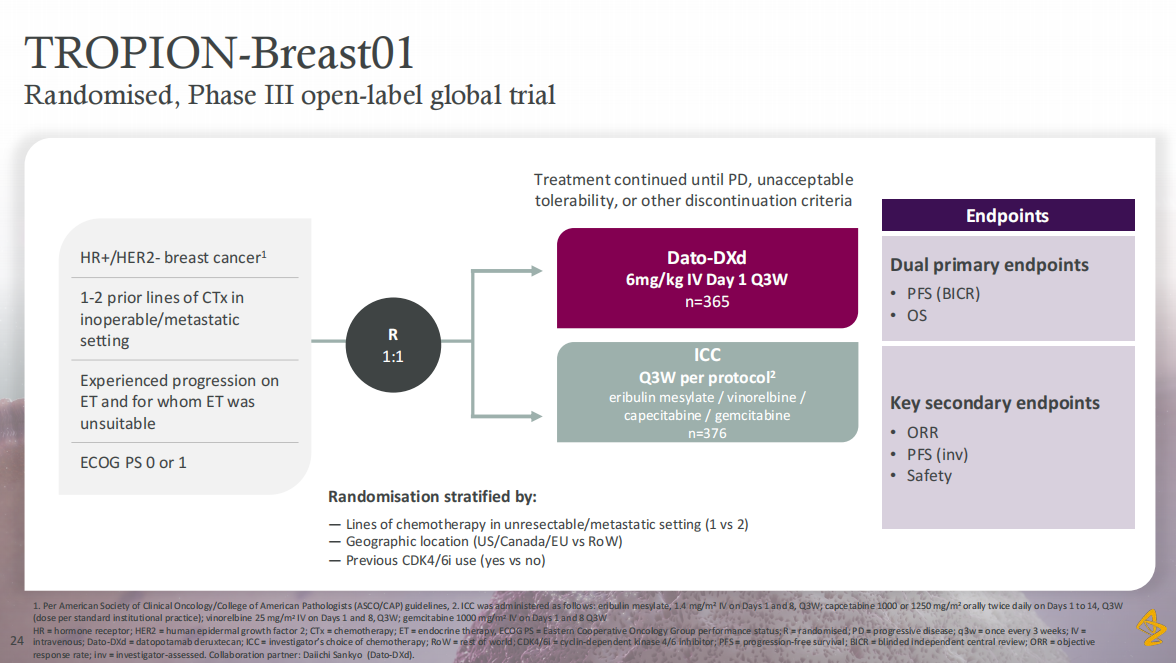
Image Source: AstraZeneca Official Website
As of July 17, 2023, the median PFS for patients in the Dato-DXd group and ICC group were 6.9 months and 4.9 months, respectively. The risk of disease progression or death in the Dato-DXd group was significantly reduced by 37% compared to the ICC group (HR 0.63, 95% CI: 0.52-0.76; P<0.0001). Consistent PFS benefits were observed across all subgroups. The ORR for the Dato-DXd group and ICC group were 36.4% and 22.9%, respectively. OS data are not yet mature, but a benefit trend in the Dato-DXd group has been observed (HR 0.84, 95% CI: 0.62-1.14).
Compared with the ICC group, the incidence of ≥3 grade TRAEs (21% vs 45%) and TRAEs leading to dose reduction (21% vs 30%) was lower in the Dato-DXd group.
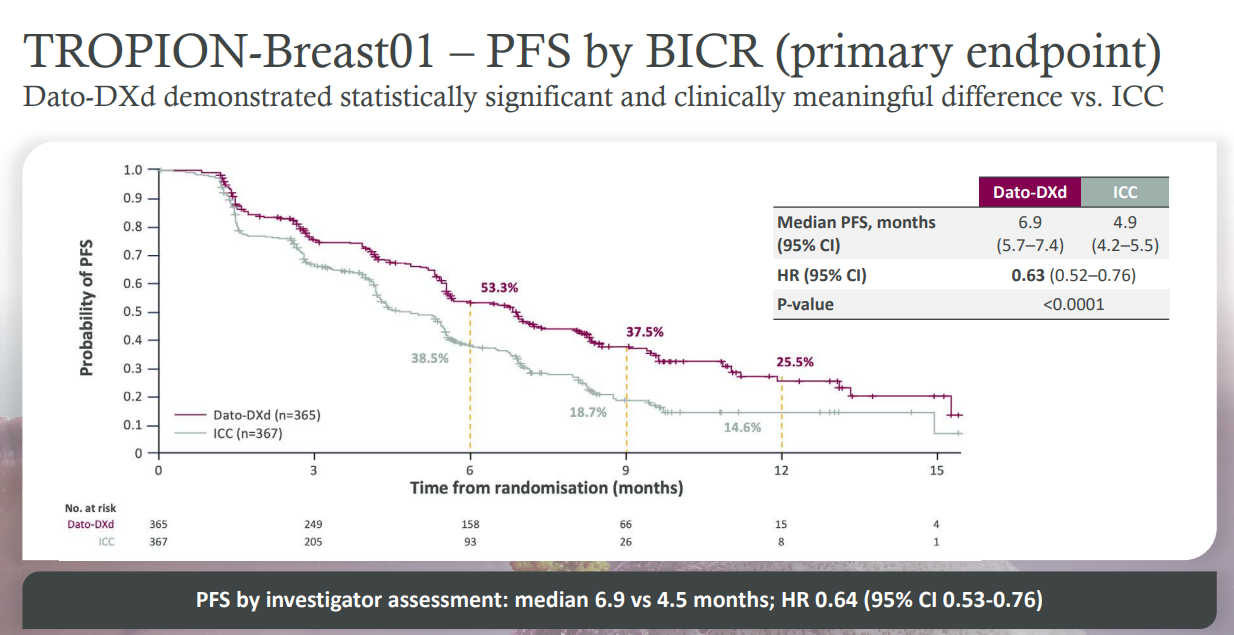
Image Source: AstraZeneca Official Website
In summary, compared with ICC, patients receiving Dato-DXd treatment showed statistically significant and clinically meaningful improvements in PFS. Meanwhile, Dato-DXd demonstrated better safety and tolerability. The study results highlight Dato-DXd's best-in-class therapeutic potential as a Trop-2 ADC in breast cancer treatment.
BEGONIA Study
The BEGONIA study (NCT03742102) is an open-label, two-part, multicenter Phase 1b/2 trial evaluating the safety, tolerability, and preliminary efficacy of novel ADCs (including Dato-DXd) in combination with durvalumab as a first-line treatment for patients with unresectable locally advanced/metastatic triple-negative breast cancer (a/mTNBC).
Among them, Arm 7 of the trial is evaluating the safety, tolerability, and preliminary efficacy of Dato-DXd in combination with Imfinzi (durvalumab) for previously untreated, unresectable locally advanced or metastatic TNBC patients. The primary endpoints are safety and tolerability. Secondary endpoints include investigator-assessed ORR, PFS, and DOR.
As of February 2, 2023, a total of 62 patients received Dato-DXd combination therapy (29 are still ongoing). The results showed: regardless of PD-L1 expression levels, the ORR of Dato-DXd combined with Imfinzi was 79%, including 6 complete responses (CR) and 43 partial responses (PR); PFS was 13.8 months, and DoR was 15.5 months.
In terms of safety, the combination of Dato-DXd and Imfinzi is consistent with the known safety profiles of the two drugs.
In addition, enrollment is currently underway for Arm 8 of the BEGONIA trial, which is evaluating the efficacy of datopotamab deruxtecan in combination with Imfinzi in TNBC patients with high levels of PD-L1 expression.
3. B7-H4
B7-H4 is a new target for cancer treatment, and Hansoh Pharma's HS-20089 is an ADC drug targeting B7-H4. At this ESMO conference, Hansoh Pharma announced the first-in-human trial results of HS-20089.
As of April 11, 2023, 44 patients with advanced solid tumors received HS-20089 treatment, including 41 cases of breast cancer, 2 cases of ovarian cancer, and 1 case of endometrial cancer. Among 33 evaluable patients, 8 PRs (24.2%) were observed, with a DCR of 63.6%. In the subgroup of 16 triple-negative breast cancer patients, 6 PRs (37.5%) were observed.
A few days ago, Hansoh Pharma reached a collaboration with GSK, granting the latter an exclusive global license (excluding mainland China, Hong Kong, Macao, and Taiwan) for HS-20089, with an upfront payment of 85 million USD and potential milestone payments of up to 1.485 billion USD.
Chinese pharmaceutical companies make joint efforts
The therapeutic potential of ADC drugs in the field of oncology has attracted the attention of pharmaceutical companies worldwide. Pharmaceutical companies in China have also quickly entered this field with strong technological innovation capabilities and achieved good results.
In addition to Hansoh Pharma mentioned above, several China-based pharmaceutical companies presented their ADC projects at this ESMO conference.
Kelun Botai: SKB264
SKB264 (MK-2870), a Trop2 ADC developed by Kelun Biotech, has been granted Breakthrough Therapy Designation by the Center for Drug Evaluation of the National Medical Products Administration for its monotherapy in locally advanced or metastatic HR+/HER2- breast cancer.
At this year's ESMO Congress, Kelun announced the latest research results of SKB264 in a Phase I/II, single-arm, basket trial for previously treated metastatic HR+/HER2- breast cancer.
As of April 12, 2023, among the 38 evaluable subjects, 47% had primary endocrine resistance, 79% had received ≥2 lines of chemotherapy, 100% had received taxane treatment, and 65.8% had received CDK4/6 inhibitor therapy. At a median follow-up of 8.2 months, the ORR was 36.8% (14/38, 12 confirmed PRs and 2 unconfirmed PRs), the DCR was 89.5%, the median DoR was 7.4 months (range, 4.2-14.9+), and the 6-month DoR rate was 80%. In terms of disease control rate survival data, the mPFS reached 11.1 months, with a 6-month PFS rate of 61.2%.
In terms of safety, the incidence of adverse events (AE) ≥G3 was low, with only 17.1% of patients experiencing dose reduction due to treatment-related AEs (TRAEs). No TRAEs led to discontinuation or death.
Based on the current data, SKB264 has shown promising efficacy in treating metastatic HR+/HER2- breast cancer, offering a potential new and effective treatment option for such patients.
Baili Tianheng: BL-M07D1
BL-M07D1 is a HER2 ADC. At this year's ESMO conference, Baili Tianheng announced the latest data on BL-M07D1 in HER2-positive breast cancer.
As of May 1, the dose of D-ESC has reached 5.0 mg/kg, with no dose-limiting toxicity (DLT) observed. In 15 patients with HER2-positive advanced breast cancer, the ORR and DCR of BL-M07D1 treatment were 60% and 100%, respectively.
CSPC: DP303c
DP303c is composed of a humanized anti-HER2 antibody, a cleavable linker, and the cytotoxic agent MMAE. At this year's ESMO Congress, CSPC Pharmaceutical Group announced the Phase I clinical trial results of DP303c in treating HER2-expressing advanced solid tumors.
In the breast cancer cohort (n=68), the minimum effective dose was 1.0 mg/kg, with mPFS and mDoR being 6.44 months and 10.97 months, respectively. Among the 66 evaluable breast cancer patients, ORR and DCR were 51.5% and 77.3%, respectively.
Conclusion
In recent years, the means of breast cancer treatment have been continuously advancing, from chemotherapy, endocrine therapy, and targeted therapy, to ADC drugs ushering in a new chapter in breast cancer treatment with their unique design and excellent clinical data.
As China makes efforts in researching and developing new drugs and conducting clinical studies, we are gradually gaining recognition from international peers. Kelun Pharmaceuticals and Hansoh Pharma’s ADC projects have successively secured cooperation orders from multinational pharmaceutical giants and made their voices heard at international conferences such as ESMO.
References
1. Chinese Society of Clinical Oncology
2. ESMO Official Website
3. Public Information of Each Company

Editor: Liuli
Disclaimer: This article is a reprint from Yaozhi.com. The images and text are the original property of their respective owners. The purpose of the reprint is to convey more information and does not represent the views of this platform. If there are any issues regarding content, copyright, or other matters, please leave a message on this platform, and we will address it promptly.
Disclaimer: This article is content uploaded by the PharmEasy conference user. The images and text are owned by the organizer or publisher, and the publication aims to convey more information, not representing the viewpoint of this platform. If there are any issues regarding the content, copyright, or other problems, please leave a message on this platform, and we will delete it promptly.