

Expert Interview
Chongqing Precision Bio Announces MC-1-50 CAR-T Therapy IND Approval and Highlights PRIMCAR® Platform Advancements
Oct 30, 2023 21:02
CST Updated
21:02

Precision Biotech
Gene and Cell Therapy Developer

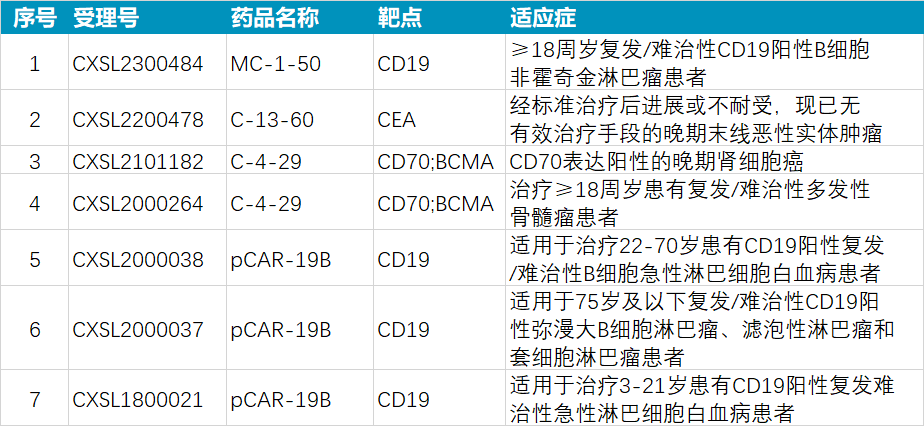
On October 18, MC-1-50, a CD19 CAR-T cell therapy independently developed by Chongqing Precision Biotech Co., Ltd. based on its proprietary PRIMCAR® platform, officially received the clinical trial implied permission from the National Medical Products Administration (NMPA) to conduct clinical research in patients aged ≥18 years with relapsed/refractory CD19-positive B-cell non-Hodgkin lymphoma (r/r B-NHL). It is reported that, to date, Precision Biotech has obtained CDE registration for clinical implied permission for seven indications across four CAR-T products.
Overcoming Two Major Pain Points of Traditional CAR-T Cell Therapy

Traditional CD19 CAR-T cell therapy has shown significant efficacy in patients with relapsed/refractory acute B lymphoblastic leukemia (r/r B-ALL). However, the side effects of this cell therapy, particularly life-threatening high-grade cytokine release syndrome (CRS) and immune effector cell-associated neurotoxicity syndrome (ICANS), greatly limit its widespread application. Additionally, the relatively long preparation waiting time (approximately 15 days), high costs (treatment costs for approved products in China exceed one million yuan), and a certain probability of post-treatment relapse are critical issues that need to be urgently addressed within the industry.
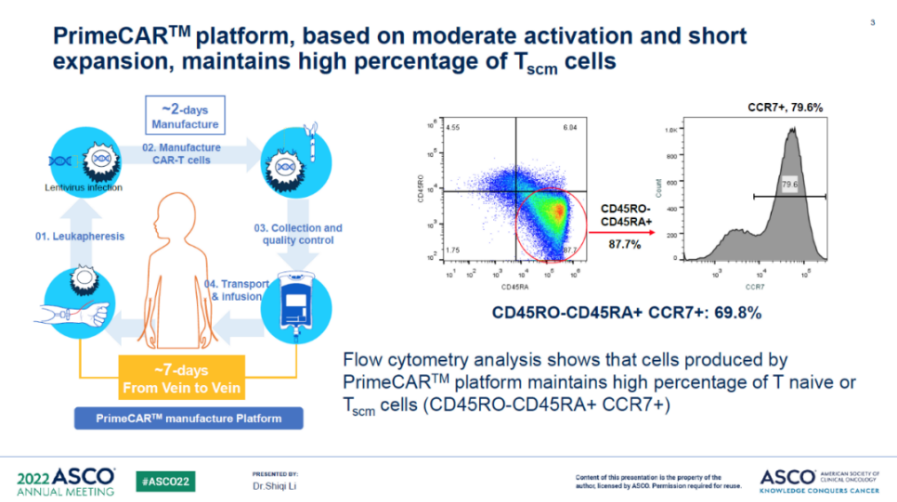
PRIMCAR® Platform Has a Short Production Cycle and a High Proportion of Naive Cells (Source: ASCO)
To address industry pain points and common challenges such as long patient waiting times and high costs, Precision Biotech has developed the next-generation cell preparation platform, PRIMCAR®. This platform can generate CAR-T cells within 48 hours and, combined with a rigorous quality control system, enables patients to receive cell infusion within seven days. The PRIMCAR® platform significantly improves production efficiency and reduces manufacturing costs. Additionally, the cells produced using this platform have a high proportion of T naive cells, which can exert therapeutic effects at very low infusion doses while demonstrating excellent safety.
More Timely, Safer, and More Effective CAR-T Therapy

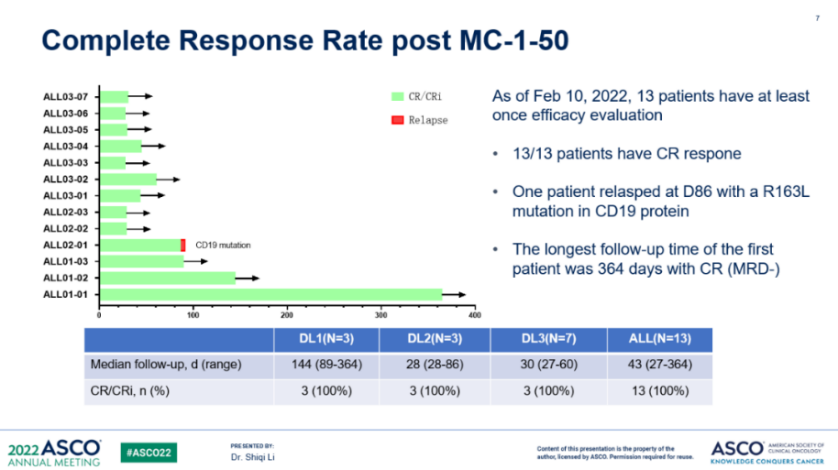
At the 2022 American Society of Clinical Oncology (ASCO) Annual Meeting, Precision Biotech publicly disclosed clinical research data on MC-1-50, which was developed based on PRIMCAR® (see figure below). The report summarized the safety and efficacy outcomes of 13 patients with r/r B-ALL who were treated with MC-1-50. The enrolled patients had an average tumor burden of 58.4%. The results showed an ORR of 100%; in terms of safety, CRS occurred in 84% of the patients, including grade 1 CRS in 7 cases (54%) and grade 2 CRS in 4 cases (30%). No CRS of grade 3 or higher was observed. Only one patient (7%) experienced grade 1 ICANS, with no ICANS of grade 2 or higher reported. No dose-limiting toxicity occurred during the treatment process.
One year later, at the 2023 ASCO Annual Meeting, Chongqing Precision Biotech Co., Ltd. further updated the clinical data of MC-1-50 for the r/r B-ALL indication. A total of 19 patients with r/r B-ALL received MC-1-50 treatment, and more than half of the patients had a tumor burden ≥50% (11/19). The cell preparation time for all subjects was approximately 2 days. In terms of safety, the majority of patients (18/19, 95%) experienced Grade 2 or lower CRS, with only one patient (5%) experiencing Grade 3 CRS; no CRS of Grade 4 or higher was observed. Only two patients (11%) developed Grade 1 ICANS, and one patient (5%) developed Grade 2 ICANS, with no occurrence of ICANS of Grade 3 or higher. No dose-limiting toxicity was found during the treatment. In terms of efficacy, the ORR reached 100%, with over 50% of patients achieving sustained CR without undergoing transplantation. The main cause of relapse in patients was CD19-negative relapse or CD19 mutation.
Source: ASCO
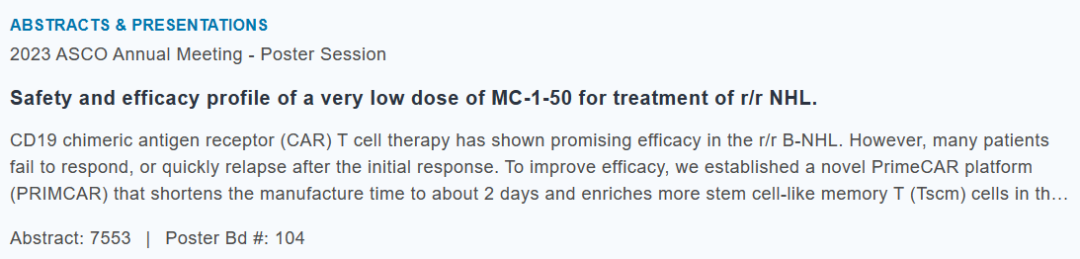
In addition, at the 2023 ASCO Annual Meeting, Precision Biotech also disclosed Phase I clinical research data for MC-1-50 in treating r/r B-NHL. The study enrolled 13 patients with r/r B-NHL, including DLBCL, CLL, FL, MCL, and HGBL. The cell preparation time for all subjects was approximately two days. In terms of safety, CRS occurred in only 23% of patients, with two patients (15%) experiencing Grade 1 CRS and one patient (8%) experiencing Grade 2 CRS. No CRS ≥ Grade 3 was observed. No ICANS were reported in any of the patients. No dose-limiting toxicity was identified during the treatment process. Regarding efficacy, all patients in the 5*10^5 CAR+/kg dose group achieved CR, and those who achieved CR experienced prolonged sustained remission, suggesting greater patient benefit at this dose level.
In summary, the MC-1-50 product developed based on the PRIMCAR® platform has demonstrated characteristics of high production efficiency, low reinfusion dosage, and minimal toxic side effects. The treatment data from patients with r/r B-ALL and r/r B-NHL have shown significant advantages in both therapeutic efficacy and safety. The PRIMCAR® platform has officially reduced the Vein-To-Vein manufacturing time of CAR-T to within one week, offering patients a more timely, safe, and effective new option, and providing the possibility for future outpatient CAR-T treatments.
Chief Scientist of Chongqing Precision Biotech Co., Ltd.
Professor Qian Cheng

MedCube Pro: How does the PRIMCAR® platform generate CAR-T cells within 48 hours?
Professor Qian Cheng:Shortening the preparation duration typically requires overcoming several issues: 1)How to quickly complete cell activation and gene modification in a short period of time;2)How to overcome cell death caused by cell activation;3)How to control the immune response of cells in the body, so that it neither fails to suppress tumor growth in a short time due to insufficient function, nor causes severe toxic side effects due to excessive function.
To address these issues, our team has optimized the lentivirus production process to enhance viral infection efficiency, achieving gene modification with a minimal amount of virus. We have also refined the cell activation process to prevent massive cell death post-activation and effectively balanced the functionality and side effects of CAR-T cells in vivo. For the PRIMCAR® technology platform, Chongqing Precision Biotech Co., Ltd. has filed seven related invention patents covering core cultivation protocols, CAR gene transduction, quality control testing, and more.
PharmaCube Pro: Apart from MC-1-50, what are the R&D plans of Chongqing Precision Biotech Co., Ltd. based on the PRIMCAR® platform?
Professor Qian Cheng:PRIMCAR® is a rapid production platform developed to address the core issues of long patient waiting times and high production costs associated with existing autologous CAR-T products. It also reduces immunotoxic side effects and enhances the persistence advantage of CAR-T cells in the body. Therefore, this platformIn the future, it can be widely used for the development of autologous CAR-T cell products.
MC-1-50 is a product targeting the CD19 antigen. In addition to this target, other targets for hematological tumors such as BCMA, CD70, and CD123 can also be used to develop corresponding products on this platform. Moreover, the current rapid preparation technology has only been applied in hematological system tumors. Moving forward, we will explore application strategies for this platform in solid tumors, further expanding the application scope of the PRIMCAR® platform.
PharmaCube Pro: To reduce the cost of autologous CAR-T therapy and patient waiting time, in recent years, there has also been exploration into in-situ (in vivo) CAR-T therapies based on mRNA or circular RNA. Some refer to in vivo CAR-T as the 2.0 era of cell therapy. What is your view on this development strategy?
Professor Qian Cheng:The in vivo preparation technology of RNA-based CAR-T is undoubtedly an important development direction in the CAR-T field.This technology can theoretically fundamentally change the current production model of CAR-T products, break through the capacity bottleneck of CAR-T cell therapy, and is also closer to traditional pharmaceuticals in form. However, it must be pointed out that this technology currently faces significant challenges, such asTarget Specificity Issues Within the Body, safety issues caused by transduction of other non-target cells; another issue is efficiency, on the one hand, whether a sufficient number of effective CAR-T cells can be obtained to exert the drug's efficacy, and on the other hand, whether it is mRNA or circular RNA, it still belongs toTransient ExpressionTechnology, which can only inevitably serve a short-term function, thus, willFacing the problem of multiple infusions and repeated dosing, which in turn increases the likelihood of triggering ADA, further weakening its efficacy. These technical issues currently lack an ideal solution within the industry, but with advancements in technology, it is believed that they will be gradually resolved. Chongqing Precision Biotech Co., Ltd. highly recognizes the promising application prospects of this technology and has conducted extensive research on combining mRNA and circular RNA with CAR-T, leveraging its own strengths. It has also laid out multiple core patents both internationally and domestically in China.
PharmaCube Pro: Tackling solid tumors is the current collective focus in the CAR-T field. What is Precision Biotech's technological layout in the development of solid tumor treatments? Could you share some of the latest advancements?
Professor Qian Cheng:The main challenge currently facing solid tumors is still the lack of efficacy, especially in ensuring treatment safety while improving efficacy as much as possible and finding the right balance. Unlike hematological tumors, CAR-T faces an unfavorable situation when treating solid tumors. Therefore, to comprehensively enhance the function of CAR-T in solid tumor treatment, multi-dimensional optimization is required, including technological innovations in research and design, production and manufacturing, and clinical application. This demands high comprehensive R&D capabilities from institutions, which must not be one-sided but also require a profound understanding and recognition of the basic research capabilities of tumors. Because if we do not understand the opponent, the tumor, it is difficult to discuss how to defeat it.
Our team began developing gene therapy products for tumors more than 30 years ago and has conducted a series of fundamental and applied research on tumors, gaining profound insights into them. As one of the earliest teams in China to develop CAR-T therapies for solid tumors, Chongqing Precision Biotech Co., Ltd. has also implemented technological innovations in recent years across multiple areas such as target screening, CAR frameworks, cell preparation processes, and clinical dosing pathways, introducingMulti-target HyeCAR® Platform, PhiCAR® Platform Targeting the Physical Microenvironment of TumorsAndResCAR™ Platform Technology Targeting the Tumor Immune Microenvironment, andPRIMCAR® Technology in Process ManufacturingIn terms of clinical application, we have proposed an innovative treatment model to address various challenges faced by solid tumors from multiple dimensions, and applied for more than 120 invention patents.
In terms of products, weSuccessively launched the first CAR-T for solid tumors targeting CD70 and CEA in China., and successfully obtained two CDE tacit approvals. Recently, the tumor microenvironment-induced CAR-T we developed was also published in the top oncology journal "Cancer Research." Our product integrates multiple technologies, and the related clinical results are eagerly anticipated.
PharmaCube Pro: Regarding CAR-T therapy for solid tumors, a strategy recently explored in the field seems to be "installing" antigens onto solid tumors. For example,A study published in the journal Science on October 12Scientists from Columbia University have designed tumor-colonizing bacteria that produce synthetic antigens in tumors, directing CAR-T cells to destroy cancer cells forced to "reveal" themselves. Could you comment on this research progress? What do you think of this strategy of "installing antigens" on tumors?
Professor Qian Cheng:The study has recently attracted considerable attention, focusing on a probiotic-guided CAR-T cell (ProCAR) platform. Through this platform, T cells are engineered to sense and respond to synthetic CAR targets delivered by probiotics colonizing solid tumors, achieving a powerful combination for therapeutic effects. Due to the lack of specific treatment targets for solid tumors, there is currently a prevalent "On-Target-Off-Tumor" safety issue with solid tumors, which also exhibit heterogeneity in antigen expression.ToThe strategy of tumor "loading antigens" is indeed an important research direction in the current solid tumor CAR-T field.
In fact, the main conclusions of this article were published as early as 2021 in the preprint online journal *BioRxiv*. Around the same time, there were also studies that "coated" Her2-expressing tumor cells to express CD19 molecules by using adaptor proteins such as CD19-Her2. Even earlier, there had been various attempts to use viral vectors to express CD19 on the surface of tumor cells. It can be said that scientists have been exploring the strategy of "antigen coating" for tumors. One obvious advantage of this strategy is that CAR-T targeting a single antigen can address multiple different tumor issues, achieving a sort of "universal" effect to some extent. Moreover, safer targets can be selected, thus enhancing clinical safety. However,Relatively speaking, this approach actually shifts the difficulty of the problem to the aspect of how to develop efficient and specific tumor-labeling technologies.For instance, this study utilized probiotics as a vehicle to achieve the effect of labeling tumors, not only realizing the guidance for CAR-T to identify and kill tumors but also ingeniously leveraging the potential of bacteria to activate the body's immune system, further amplifying the therapeutic effect. However, it must be pointed out that the types of probiotics that meet the requirements are actually very limited, and the safety of the probiotics themselves is also worth noting. The immunogenicity caused by repeated administration cannot be ignored either. Additionally, the local administration method adopted in this study practically limits the wider application of this technology.Thus, the future of CAR-T technology lies in whether to modify T cells or to modify other vectors such as viruses or bacteria, which is a question worth our consideration.
PharmaCube Pro: Looking ahead 3-5 years, in which areas do you think the CAR-T field will achieve breakthroughs?
Professor Qian Cheng:First, in terms of product production models: 1) For autologous cell products, the goals of multi-targeting, short preparation cycles, high efficacy, and long persistence will be achieved, addressing the application issues of CAR-T products for the majority of patients; 2) For universal cell products, in the next 3-5 years, various universal product strategies will experience a boom, with diverse approaches such as αβT, γδT, DNT, and NK cells from multiple sources flourishing. This will significantly increase the persistence of allogeneic cells in the body and enhance the functionality of universal products in vivo; 3) For in vivo production technology, optimization of targeted gene vectors is expected to enable precise in situ modification of effector cells. Through the development of function-enhancing elements, high anti-tumor effects can be achieved without pre-treatment.
Secondly, in terms of indication developmentIn the future, the indications for CAR-T will gradually extend from cancer treatment to applications such as autoimmune diseases, viral infections, maintaining vital organ function (treating cardiac fibrosis, liver fibrosis, etc.), and preventing aging.
- Scroll up and down to view references -

PharmaCube Pro
New Targets, New Technologies, New Therapies