Novartis to Acquire FDA Priority Review Voucher from bluebird bio for $103 Million

Novartis
Drug Development and Manufacturing

BlueBird Bio
Gene Therapy Developer
According to FIERCEPharma, Novartis has reached a transfer agreement with bluebird bio to purchase a U.S. FDA Priority Review Voucher (PRV) from bluebird bio for $103 million.
But whether this $103 million transfer agreement can be reached depends on whether the FDA approves Bluebird Bio's gene therapy Lovo-cel for the treatment of sickle cell disease (SCD). Bluebird Bio expects the FDA to make a decision on its Lovo-cel application by December 20.
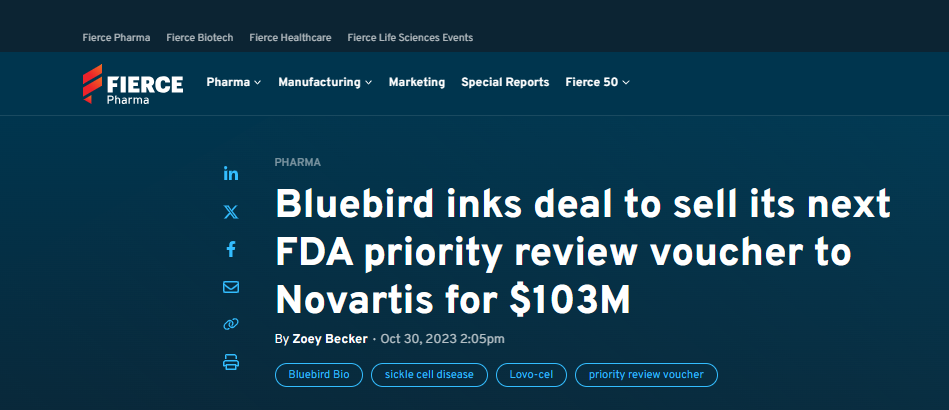
Image Source: FIERCEPharma website
The Priority Review Voucher (PRV) system is a benefit program implemented by the U.S. FDA to encourage pharmaceutical companies to develop drugs targeting certain tropical diseases, rare diseases, and material threat medical countermeasures. Pharmaceutical manufacturers who successfully develop relevant drugs according to the disease list are eligible to receive a PRV. This priority review voucher can be used by the pharmaceutical company itself or sold to other pharmaceutical companies, allowing its recipient to expedite the review of a new drug application, reducing the standard review time from 10 months to 6 months.
Following argenx and BMS
Novartis Becomes the Third Buyer
According to a document from Bluebird Bio, Novartis is the other company in the PRV transfer agreement. If the deal is ultimately reached, this will be Bluebird Bio's third sale of PRV in nearly a year.
Bluebird Bio Receives Two Priority Review Vouchers in 2022 Following U.S. FDA Approval of ZYNTEGLO (betibeglogene autotemcel) for Adult and Pediatric Patients with β-Thalassemia Requiring Regular Red Blood Cell Transfusions, and SKYSONA (elivaldogene autotemcle) for Early Active Cerebral Adrenoleukodystrophy.
Subsequently, in November 2022 and January 2023, Bluebird Bio completed the sale of its Priority Review Voucher (PRV) for $102 million and $95 million, respectively — selling it to Dutch immunology company argenx and multinational giant BMS. The PRV acquired by argenx is expected to be used for the future marketing application of its first-in-class neonatal Fc receptor (FcRn) blocker efgartigimod.
Funding in Critical Condition, Insufficient to Last a Year
Transferring PRV Could Bring in Cash Flow Revenue
Bluebird Bio Reveals Financial Challenges in Q2 Earnings Report: Cash Position at $291 Million Including Restricted Funds as of June 30, 2023
Bluebird bio Inc. CFO Chris Krawtschuk said in a statement that the sale of lovo-cel PRV "will provide bluebird bio with significant non-dilutive funding ahead of the anticipated launch."
At the same time, with the launch of Zynteglo and Skysona, Bluebird Bio stated that it expects its cash flow to last until the middle of 2024. However, the road to market for these two products has been fraught with difficulties.
Zynteglo is the first product that Bluebird Bio has developed after 27 years of dedication to gene therapy. In August 2022, it became the first FDA-approved ex vivo lentiviral gene therapy, with the potential to transform the treatment paradigm for β-thalassemia, which currently requires lifelong care. Adult and pediatric patients with this condition need regular red blood cell transfusions.
Due to the stringent control by European regulatory authorities over drug specifications and manufacturing processes, the commercialization of Zynteglo, which was introduced in 2019, faced multiple delays and was postponed until 2020. This coincided with the global outbreak of the COVID-19 pandemic, forcing the first commercial treatment to be pushed back to the second half of the year.
Fortunately, in September 2022, Bluebird Bio brought good news. The gene therapy Skysona was granted accelerated approval by the U.S. FDA for marketing following its approval in the EU. It is used to slow the progression of neurological dysfunction in boys aged 4-17 with early active cerebral adrenoleukodystrophy (CALD). Skysona uses a lentiviral vector to introduce functional copies of the ABCD1 gene into the patient's own hematopoietic stem cells ex vivo, which are then reinfused into the patient. By expressing the ALD protein, it halts the progression of CALD and preserves neurological function as much as possible. The price of this therapy is $3 million.
Source:
1.https://www.fiercepharma.com/premium/webinar/unleashing-ai-opportunities-strong-data-foundation
2.https://mp.weixin.qq.com/s/aBNsmmPg2WXRyLEF2Gm2vQ

Editor: Pea Shooter
Disclaimer: This article is an integrated content and does not represent the views of this platform. If it involves issues related to the content, copyright, or other problems, please leave a message on this platform, and we will handle it promptly.