

Novo Nordisk Secures Exclusive Global License to Vect-Horus’ VECTrans® Platform in $327 Million Deal
Vect-Horus
Developer of carriers for targeted therapy molecules and imaging agents
Novo Nordisk
Insulin Developer and Manufacturer
Welcome to follow Asymchem Pharma News
On October 30, 2023, Vect-Horus announced that it had signed a global licensing agreement with Novo Nordisk A/S.This agreement grants Novo Nordisk A/S the global exclusive license to use Vect-Horus's platform technology "VECTrans" for carrier delivery targeting specific objectives, with the option for Novo Nordisk A/S to add other targets to the license.
According to the terms of the agreement,Vect-Horus to Receive Upfront Payment and Up to $327 Million in Additional Potential Development, Regulatory, and Commercial Milestones Across 3 ProgramsMoreover, Vect-Horus is also entitled to receive a share of the product sales.
"Being able to precisely target the delivery of therapeutic agents is crucial to our ambition to address unmet needs in serious chronic diseases," said Brian Vandahl, Senior Vice President of Global Research Technology at Novo Nordisk. "We are excited to collaborate with Vect-Horus and leverage their platform to discover optimal delivery methods for specific targets. This is an example of how we utilize external collaborations to further advance our innovation process."
One
Vect-Horus Company -- VECTrans® Technology Platform
VECT-HORUS, founded in 2005 as a spin-off from the Institute of NeuroPhysiopathology (INP, UMR7051, CNRS, and Aix Marseille University), is led by co-founder Dr. Michel Khrestchatisky. The company designs and develops carriers that facilitate the targeted delivery of therapeutic or imaging agents to organs, including the brain and tumors. VECT-HORUS currently has 38 employees and has secured 40 million euros in equity and grants.
VECTrans® Technology Platform
One of the major challenges in the field of drug delivery is how to enhance the delivery of (bio)therapeutics across biological barriers. The blood-brain barrier (BBB), composed of a unique and highly selective vascular/endothelial system, remains a primary obstacle in the development of central nervous system (CNS) drugs, as it prevents the vast majority of (bio)therapeutics from accessing neural tissue. This results in low efficacy and high attrition rates for CNS drug developers.
Another challenge is how to maximize the reduction of dose levels and off-target effects of newly developed molecules while enhancing therapeutic or diagnostic efficacy. For the pharmaceutical industry, growth-driven molecules (such as therapeutics and ASOs) may become trapped in the liver and kidneys, hindering their distribution to target cells and tissues. Targeted drug delivery to relevant tissues should achieve maximum therapeutic efficacy with minimal drug dosage.
Vect-Horus has developed the "VECTrans®" breakthrough technology platform, aimed at making the "undruggable" "druggable" by overcoming the challenges posed by biological blood-brain barriers (BBB) and broader biological barriers.
VECTrans® is specifically designed and optimized based on "molecular carriers," which, once linked to a payload, can deliver it to target cells in the body, thereby altering the pharmacokinetics (PK) and distribution profile of therapeutic or imaging candidate drugs.
Specifically, the carrier developed by the company targets endogenous cell surface receptors that naturally participate in "receptor-mediated transport" (RMT) and leverages their advantages to achieve drug delivery. This targeted delivery method has the advantage of not relying on invasive administration routes and is considered the most effective and safest physiological pathway for the transcellular barrier delivery of macromolecules.
VECTrans® technology utilizes the high uptake/endocytosis and recycling capabilities of specific receptors, thereby enabling substantial intracellular transport and accumulation of therapeutic or imaging agents. Once the carrier molecule in the carrier-payload complex is locked onto the appropriate receptor on the surface of BBB endothelial cells, cancer cells, or any target cells expressing such receptors, the carrier-payload complex is rapidly internalized, followed by intracellular/transcellular transport. This ultimately results in the payload being delivered into the cells and across the BBB into the brain via transcytosis.
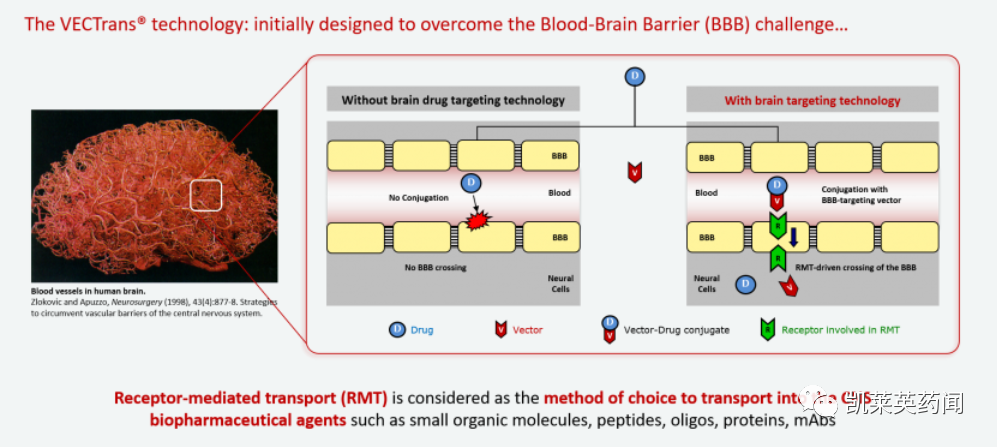
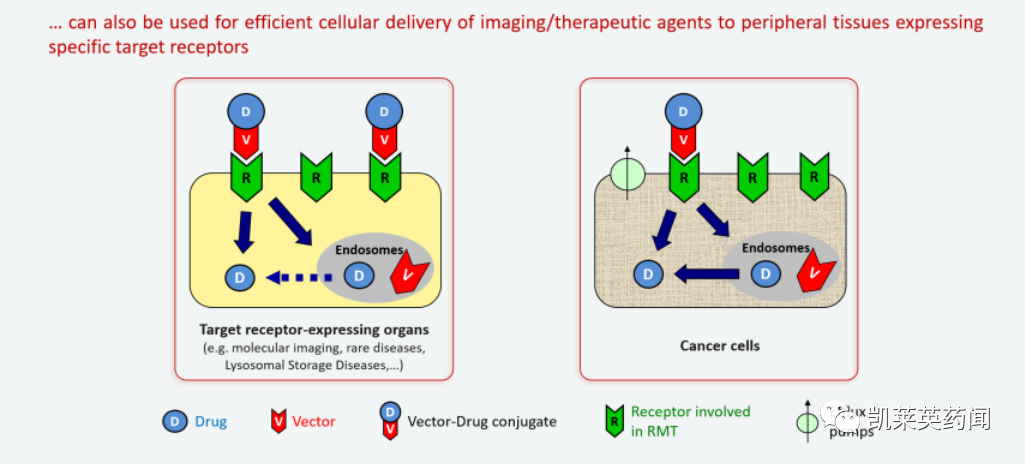
Therefore, Vect-Horus's VECTrans® technology can develop carrier-therapeutic or imaging agent complexes for the diagnosis or treatment of central nervous system diseases (including neurodegenerative diseases) or pathological conditions (including genetic diseases or cancer).
Two
Novo Nordisk's Layout in Delivery Technology
Delivery technology is considered the last mile in drug development, and Novo Nordisk places great importance on delivery technology. The oral GLP-1 peptide drug Rybelsus (semaglutide), launched by Novo Nordisk in 2019, utilized the absorption enhancer SNAC developed by Emisphere and implemented layered patent protection. In the following years, Novo Nordisk collaborated with or acquired new delivery technologies annually.
1. On November 6, 2020, Novo Nordisk invested $1.8 billion to acquire Emisphere Technologies Inc. (EMIS) and the royalty obligations of its Eligen oral drug delivery platform. Emisphere Technologies is a drug delivery company that owns proprietary technologies such as Eligen SNAC. The Eligen SNAC technology enables drug therapies to be delivered in tablet form.
2. On November 18, 2021, Novo Nordisk announced the acquisition of Dicerna Pharmaceuticals for $3.3 billion. Prior to the acquisition, Dicerna had collaborated with Novo Nordisk for over two years, exploring more than 30 hepatocyte targets, including indications such as non-alcoholic steatohepatitis, type 2 diabetes, and obesity. Dicerna possesses the liver-targeted GalXC™ delivery platform and is exploring new applications of the non-liver-targeted GalXC-Plus technology to develop next-generation RNAi therapies.
3. On March 9, 2022, Novo Nordisk expanded its existing research collaboration with MIT and Brigham and Women's Hospital (BWH) in oral drug delivery technology, extending the cooperation period to 2026 and broadening the scope to include the creation and integration of bioelectronics, biosensors, and stimuli-responsive delivery devices.
4. On June 19, 2023, Novo Nordisk announced the acquisition of BIOCORP, a company specializing in the design, development, and manufacture of delivery systems and innovative medical devices, including Bluetooth-enabled smart pen injectors.
5. On July 17, 2023, Novo Nordisk signed a research agreement with RNA startup Eleven Therapeutics to explore new avenues for delivering nucleic acid drugs. The two parties will utilize Eleven's platform, "DELiveri," to identify potential molecules capable of delivering nucleic acid therapeutics for an undisclosed cardiometabolic condition. Novo Nordisk has provided exclusive rights related to certain cell types and applications associated with the platform.
……


"Views"Click once