Chinese 'Weight-Loss Wonder Drug' Mazdutide Shows 17.8kg Average Weight Loss in 48 Weeks, Outperforming Semaglutide

Innovent
High-end Biologics Developer

Eli Lilly
Global Pharmaceutical R&D and Production Company
48-week treatment resulted in an 18.6% (17.8kg) greater reduction compared to the placebo group, outperforming semaglutide.
1. Weight loss effect better than semaglutide?
On October 30, Innovent Bio announced the latest Phase II clinical data of GLP-1R/GCGR dual agonist Mastytide in Chinese obese subjects, which was jointly promoted by Innovent Bio and Eli Lilly and Company.
The results showed that, after 48 weeks of treatment, the mean percentage change in body weight from baseline in the 9 mg madusotide group compared to placebo was −18.6%, with an absolute mean difference of −17.8 kg. Additionally, 51.2% of subjects experienced a body weight reduction of more than 15% from baseline, and 34.9% achieved a reduction of more than 20%.
In terms of weight loss effects, MASHIDU peptide outperforms the performance of semaglutide injection in the STEP1 trial.
STEP1 results showed that after 68 weeks of treatment, the weight loss in the semaglutide 2.4mg group was approximately 14.9%, compared to 2.4% in the placebo group, with a treatment difference of -12.5% between the two groups.
Compared with Eli Lilly's tirzepatide injection, the weight loss effect of mazdutide is close to the performance of tirzepatide in SURMOUNT-1.
SURMOUNT-1 Results Showed That After 72 Weeks of Treatment, the Mean Body Weight Decreased by Approximately 22.5% (23.6 kg) in the Tirzepatide 15 mg Group and Approximately 2.4% (2.4 kg) in the Placebo Group, with a Treatment Difference of -20.1% (-21.2 kg) Between the Two Groups.
In terms of safety, no serious adverse events or adverse events leading to discontinuation occurred in the 9mg Maduotide group during the 48-week treatment period. Additionally, its two-step titration dosing regimen is comparatively simpler and more tolerable.
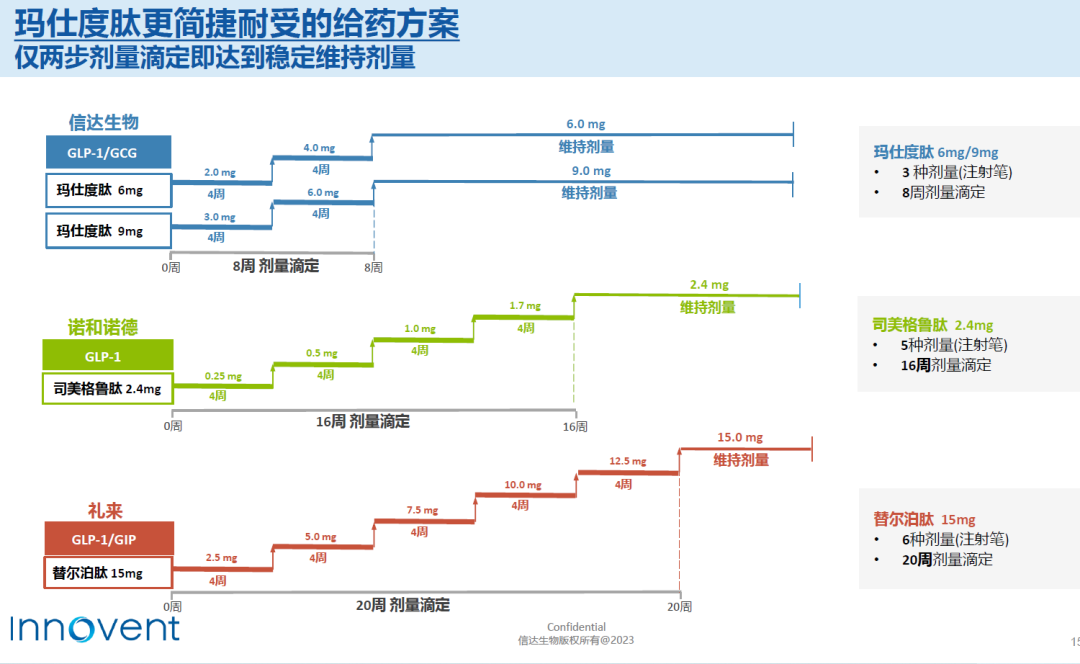
More detailed data from this clinical study will be disclosed at future academic conferences or in academic journals.
Innovent Bio is expected toSubmit the 6mg dose version of the weight loss indication for market approval by the end of this year to early next year., submit the marketing application for type 2 diabetes in 2024.
Currently, three Phase III registration studies of Mastytide 4mg and 6mg are ongoing in Chinese subjects with overweight or obesity (GLORY-1) and type 2 diabetes (DREAMS-1 and DREAMS-2);The Phase III clinical trial plan for MASHIDU peptide 9mg in Chinese obese subjects is scheduled to start by the end of this year.
2. Multi-target drugs may become even more popular
Apart from Innovent Bio,Boehringer Ingelheim/Zealand Pharma's GLP-1R/GCGR dual agonist BI456906 has also initiated three Phase III clinical trials, covering weight loss, diabetes, and cardiovascular safety.
Compared with the first-generation liraglutide, semaglutide, as the second-generation GLP-1 weight-loss drug, enhances GLP-1 receptor affinity and albumin binding ability. It offers advantages such as improved weight-loss effects and reduced dosing frequency, gradually replacing the first-generation drugs and being regarded as the "king of weight-loss drugs."
Now,Innovent Bio and Boehringer Ingelheim's announced two GLP-1R/GCGR dual-target agonists both exhibit better clinical performance than single-target drugs.
In contrast, multi-target agonists can simultaneously activate multiple signaling pathways, resulting in superior therapeutic effects.
Taking Innovent Bio's MASHIDU peptide as an example, as a mammalian oxyntomodulin (OXM) analog, MASHIDU peptide not only promotes insulin secretion, reduces blood glucose, and aids in weight loss by activating GLP-1R, but also enhances weight loss efficacy by increasing energy expenditure through GCGR activation, while improving liver fat metabolism.
The results also showed that in subjects with baseline liver fat content exceeding 5% (i.e., patients with fatty liver), the liver fat content in the 9mg group of Mastytide decreased by an average of 73.3% from baseline after 24 weeks of treatment; the reduction in alanine aminotransferase levels at 24 weeks relative to placebo was 45.5%. The above benefits were maintained during the extended treatment period up to 48 weeks.
At the 24-week primary endpoint, the reductions in triglycerides, total cholesterol, low-density lipoprotein cholesterol, and blood uric acid levels in the 9mg Mastyde peptide group were significantly greater than those in the placebo group, and these reductions were maintained throughout the 48-week extended treatment period; high-density lipoprotein cholesterol levels remained stable over the entire 48-week treatment period.
The administration methods and clinical research of combination therapies with various hypoglycemic and weight-loss drugs are relatively complex. Single-molecule multi-receptor agonists have become a significant direction in this field's development. In the crowded GLP-1赛道 (GLP-1 track), dual-target/multi-target drugs based on GLP-1R, such as GLP-1R/GIPR, GLP-1R/GCGR, GIPR/GLP-1R/GCGR, are expected to gain even more attention.

Editor: Bai Ji
Disclaimer: This article is a reprint from Pharmacist Network. All images and text are owned by the original author. The purpose of the reprint is to convey more information and does not represent the views of this platform. If there are any issues regarding content, copyright, or other problems, please leave a message on this platform, and we will address it promptly.