

Pfizer's mRNA Influenza Vaccine modFlu Meets Dual Primary Endpoints in Phase 3 Trial

Pfizer
Pharmaceutical R&D Developer
▎WuXi
Edited by Kant Content Team
Today, Pfizer announced in its third-quarter reportIts modFlu influenza mRNA vaccine candidate therapy, currently in an ongoing Phase 3 trial, successfully achieved two primary endpoints in the cohort aged 18 to 64.Preliminary analysis shows that the mRNA candidate vaccine achieves non-inferiority and superiority compared to the marketed influenza vaccine.

In the cohort, the mRNA candidate vaccine demonstrated non-inferiority and superiority relative to the marketed influenza vaccine at the time of primary analysis.Through the end-of-season analysis, the efficacy of the 18-64 cohort was maintained, and the candidate vaccine retained non-inferiority compared to the control vaccine.The primary and end-of-season efficacy analyses considered both influenza A and B cases, although the vast majority of cases recorded in this cohort, as well as during the overall 2022/2023 influenza season, were influenza A cases.
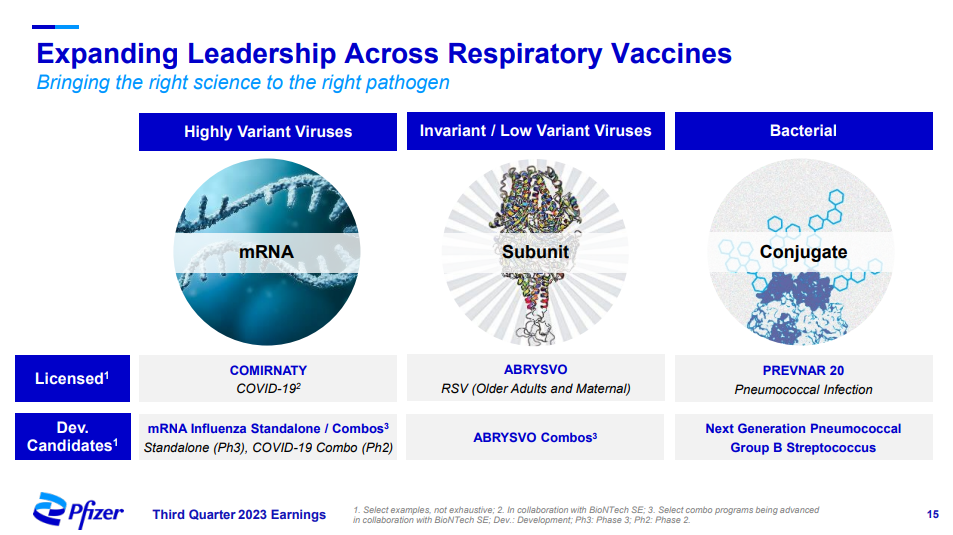
▲Pfizer's Layout in the Respiratory Vaccine Field (Image Source: Reference [2])
However, in terms of secondary immunogenicity efficacy endpoints, the vaccine only reached the secondary endpoint for the influenza A virus strain (but not for the influenza B virus strain).
In terms of safety, the safety profile of this influenza mRNA candidate vaccine in the 18-64 age group is similar to that of standard influenza vaccines. Pfizer is expected to release Phase 3 trial cohort data for adults aged 65 and older later this year.
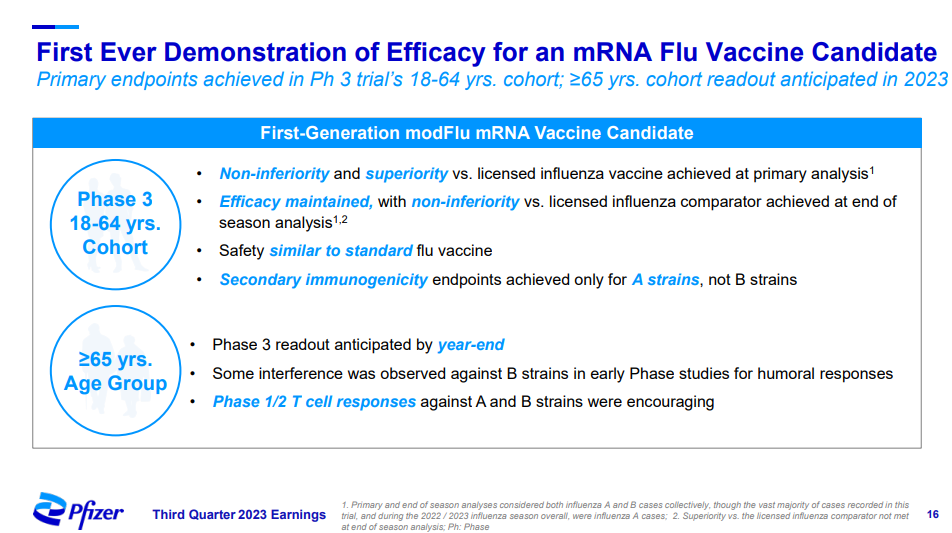
▲Pfizer mRNA Flu Vaccine Phase 3 Trial Results Summary (Image Source: Reference [2])
It is worth mentioning that, similar to Pfizer, Moderna's flu mRNA vaccine mRNA-1010 showed superiority over existing vaccines in seroconversion rates (the rate at which neutralizing antibodies reach positive standards) for the H1N1 and H3N2 strains of influenza A virus when the initial clinical trial results were announced. However, mRNA-1010 did not achieve non-inferiority against the Yamagata and Victoria strains of influenza B virus. After Moderna improved its vaccine formulation, updated results were announced in September this year.Clinical OutcomesResults showed that mRNA-1010 met all co-primary endpoints across all four strains (H1N1, H3N2, Yamagata, and Victoria). Compared to the approved control vaccine, higher geometric mean ratios of antibody titers and seroconversion rates were observed for all four virus strains.
modFlu (PF-07252220) is the first-generation mRNA vaccine developed by Pfizer and BioNTech for the prevention of influenza.