DeepMind Unveils AlphaFold 3: A Breakthrough AI Model Predicting Nearly All Biomolecular Structures with Atomic Accuracy

Isomorphic Labs
AI Drug Developer

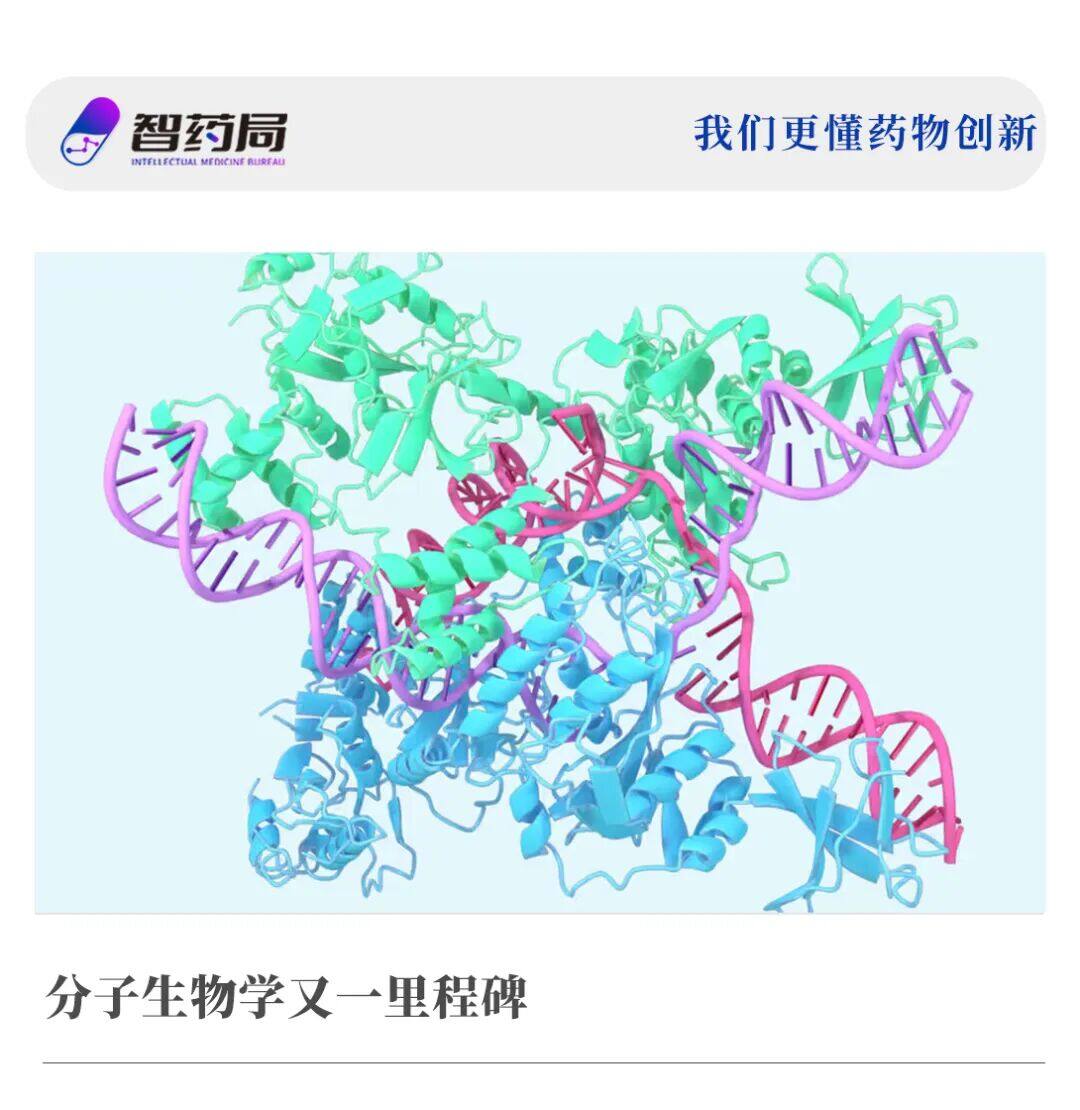
In 2020, DeepMind launched AlphaFold2, which shocked the industry and changed the way people understand proteins and their interactions.
Based on the significant achievements of AlphaFold, on November 4, 2021, Alphabet, the parent company of Google, established a new drug research and development company named Isomorphic Labs in the UK.
October 31,Google DeepmindJointly released with Isomorphic Labs the next-generation AlphaFold model, which is expected to change the game rules of drug discovery.
New Generation AlphaFoldCan predict the structure of almost any molecule in the Protein Data Bank (PDB), typically with atomic precision.,Including ligands (small molecules), proteins, nucleic acids (DNA and RNA), and biomolecules containing post-translational modifications (PTM)。
The model's extended functionalities and performance help accelerate breakthroughs in biomedicine and usher in the next era of "digital biology," offering new insights into disease pathways, genomics, potential therapeutic targets, mechanisms of drug design, and the functionality of new platforms for protein engineering and synthetic biology.
Isomorphic Labs is applying the next-generation AlphaFold model to therapeutic drug design.
 Beyond Protein Folding
AlphaFold is a fundamental breakthrough in single-chain protein prediction. Subsequently, AlphaFold-Multimer expanded to complexes with multiple protein chains, followed by AlphaFold2.3, which improved performance and extended coverage to larger complexes.
In 2022, AlphaFold collaborated with EMBL's European Bioinformatics Institute to freely provide structural predictions for nearly all catalogued proteins known to science through the AlphaFold Protein Structure Database.
To date, more than 40,000 users from over 190 countries have accessed the AlphaFold database, and scientists around the world have used AlphaFold's predictions to help advance various research projects.
DeepMind DemonstratesAlphaFold's卓越能力在于预测蛋白质折叠之外的准确结构,从而在配体、蛋白质、核酸和翻译后修饰方面生成高度准确的结构预测。
For protein-nucleic acid interfaces, the new version of AlphaFold outperforms similar models like RoseTTAFold2NA, and for RNA structure prediction, it surpasses other AI methods but slightly lags behind human experts.
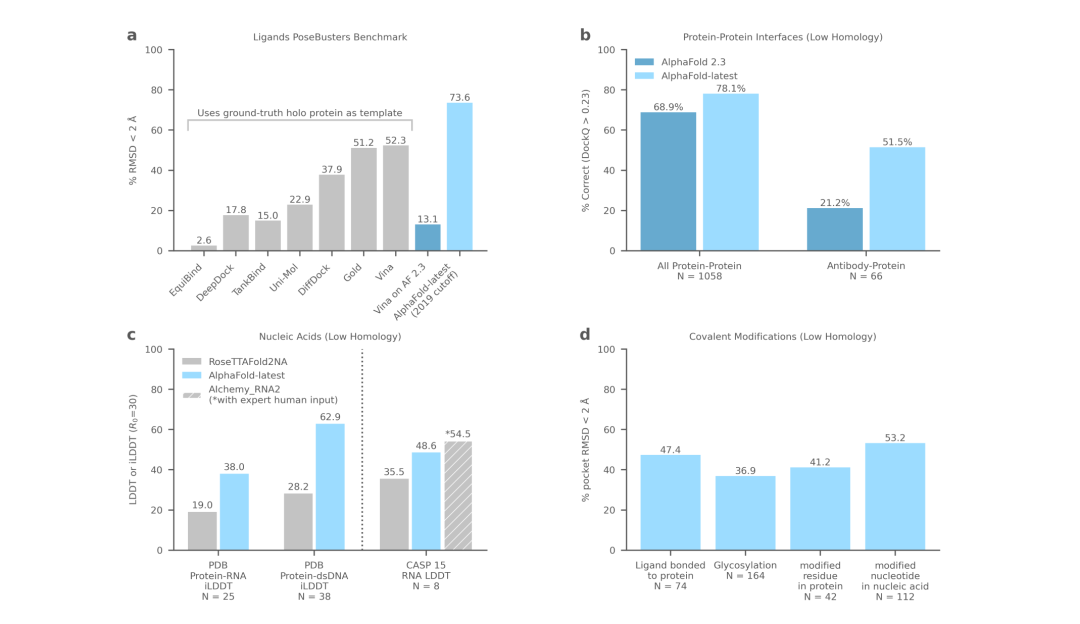
Performance of protein-ligand complexes (a), proteins (b), nucleic acids (c), and covalent modifications (d).
The researchers emphasized that AlphaFold did not solve these structures from scratch but instead inferred patterns from a large number of experimentally determined structures.
Nevertheless, its flexibility in adapting to new molecular categories highlights the generalization capabilities underpinning recent AI breakthroughs.
 Accelerate Drug Discovery
Early analysis also suggests that,The new generation of AlphaFold models significantly outperforms in some protein structure prediction problems related to drug discovery.AlphaFold2, such as antibody binding.
Accurately predicting protein-ligand structures is a highly valuable tool in drug discovery, as it can help scientists identify and design new molecules that may become potential drugs.
The current industry standard is to use "docking methods" to determine the interactions between ligands and proteins. These docking methods require a rigid reference protein structure and a proposed location for ligand binding.
DeepMind's Latest Model Sets New Standards for Protein-Ligand Structure PredictionIn predicting protein-ligand interactions,NewAlphaFold's performance is approximately 20% higher than traditional methods,And it can also predict entirely new proteins that have not yet been structurally characterized.
It can also jointly simulate the positions of all atoms, enabling it to represent the full inherent flexibility of proteins and nucleic acids when interacting with other molecules, which is impossible to achieve using docking methods.
For example, in the validation of PORCN, KRAS, and PI5P4Kγ, the predicted structures from the latest AlphaFold model match the experimentally determined structures very well:
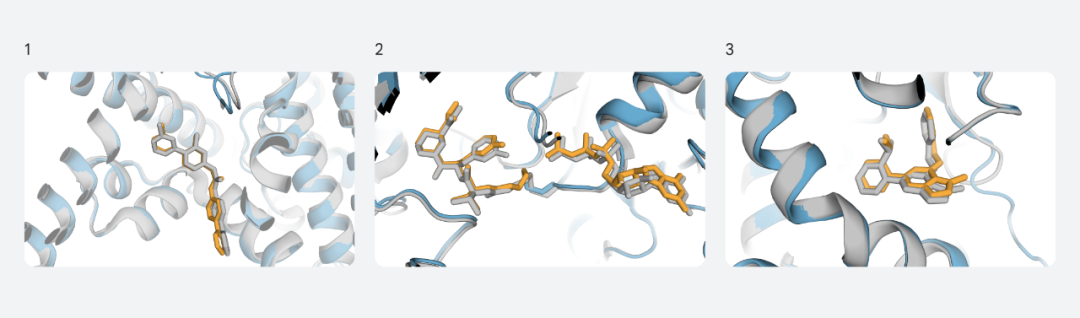
Fig: Predictions for PORCN (1), KRAS (2), and PI5P4Kγ (3)
Isomorphic Labs is applying the next-generation AlphaFold model to therapeutic drug design, helping to rapidly and accurately characterize various types of macromolecular structures that are crucial for treating diseases.

New Insights into Biology
By unlocking the structures of proteins and ligands, as well as nucleic acids and models containing post-translational modifications, the new generation of AlphaFold Fundamental Biology offers a faster and more accurate tool.
One example involves the structure of CasLambda bound to crRNA and DNA, which are part of the CRISPR family.
CasLambda possesses the genome editing capability of the CRISPR-Cas9 system, often referred to as "gene scissors," which researchers can use to alter the DNA of animals, plants, and microorganisms. The smaller size of CasLambda may allow for more efficient use in genome editing.
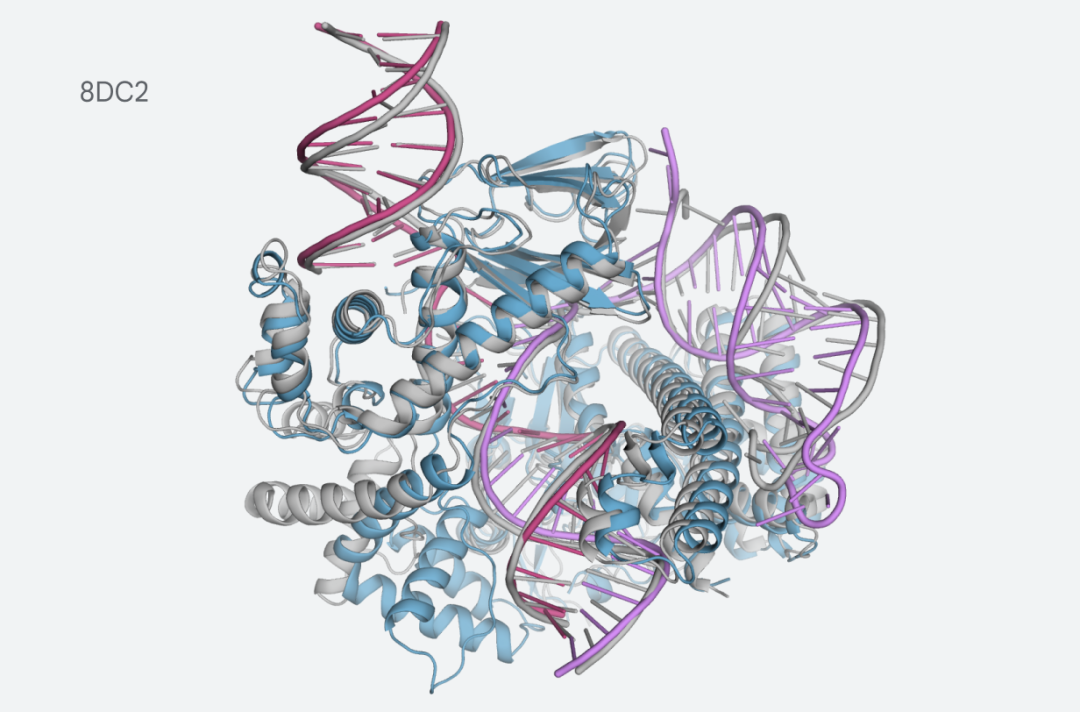
Figure: Predicted structure of CasLambda (Cas12l) bound to crRNA and DNA, which are part of the CRISPR subsystem.
The latest version of AlphaFold can simulate these complex systems, demonstrating that artificial intelligence can help better understand these types of mechanisms and accelerate their application in therapeutic uses.
The release of AlphaFold 3 represents a significant leap forward in molecular modeling and drug discovery. With its ability to predict complex molecular structures and interactions, it has the potential to revolutionize the pharmaceutical market.
While the new AlphaFold heralds an era of unprecedented possibilities, its limitations must be acknowledged.
In a comprehensive white paper, researchers from DeepMind and Isomorphic Labs candidly discussed the system's strengths and weaknesses.
Notably, the system has limitations in predicting the structures of RNA molecules, but both DeepMind and Isomorphic Labs are actively addressing this challenge, further solidifying their commitment to transforming the landscape of molecular biology.
Reference link:
https://www.isomorphiclabs.com/articles/a-glimpse-of-the-next-generation-of-alphafold
—The End—
Recommended Reading