

Who Can Rescue Pfizer from Its Revenue Plunge? RSV Vaccine Abrysvo Emerges as a Key Hope Amid Strategic Restructuring

Pfizer
Pharmaceutical R&D Developer
Pfizer recently announced its latest Q3 financial report for 2023, with revenue of $13.23 billion in the third quarter, a year-on-year decrease of 42%. The expected revenue for the COVID-19 vaccine Comirnaty in 2023 is projected to decline by 70% year-on-year; the expected revenue for the COVID-19 drug Paxlovid in 2023 is projected to decline by 95% year-on-year.
Before the release of its financial report, Pfizer had already announced a cost-cutting plan worth $3.5 billion, such as closing the plant in Peapack, New Jersey. Of this amount, $1 billion is expected to be realized in 2023, and another $25 billion is expected to be achieved in 2024 — meaning that more of Pfizer's streamlining measures will be seen next year.
Of course, layoffs are the main act in the cost-cutting measures. Recently, during a live video conference with employees, Pfizer CEO Albert Bourla suddenly announced the layoff plan without any prior warning. Some employees immediately challenged him: Will my supervisor’s salary be reduced? Other employees expressed dissatisfaction with the company's seemingly "arbitrary layoffs" in the comments section.
"Universal Mega Factory" Returns to Reality, Urgently Needs New Growth to Fill the Gap. With a substantial cash flow, Pfizer acquired Seagen for $43 billion this year, restructuring its oncology division into an independent business unit. The newly appointed Executive Vice President and Chief Oncology R&D Officer reports directly to CEO Albert Bourla. However, it will still take time to turn all these efforts into returns.
From Pfizer's Q3 financial report, who can rescue the company from its revenue decline? Perhaps it's still the vaccines.
The $10 Billion RSV Track: Can Pfizer Outpace GSK?
In Pfizer's quarterly report, the RSV vaccine Abrysvo was a bright spot. This RSV vaccine, approved for marketing in May, achieved $375 million in sales in Q3. In its first quarter on the market, it ranked among Pfizer's top seven products by sales, accounting for 2.8%.
The other six key products are Prevnar (pneumonia vaccine), Eliquis, Comirnaty (COVID-19 vaccine), Ibrance (breast cancer drug), Vyndaqel (rare disease drug), and Xeljanz (JAK inhibitor).
Pfizer expects approximately 80 million elderly people and 1.5 million pregnant women to be suitable for vaccination during this year's to next year's RSV high season. The RSV vaccine Abrysvo will continue to contribute to Pfizer's performance throughout the year.
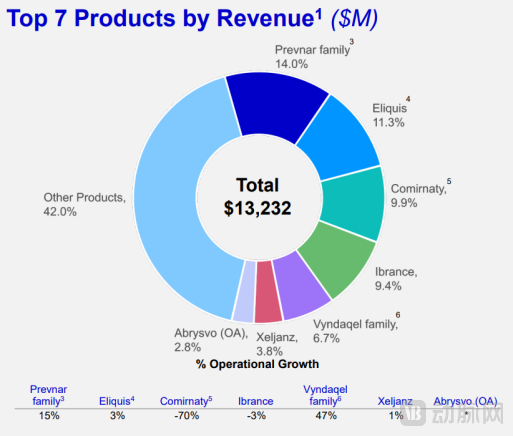
Source: Pfizer 2023 Q3 Report
It is estimated that approximately 64 million people worldwide are infected with RSV (respiratory syncytial virus) each year, resulting in about 160,000 deaths annually, including more than 100,000 children under the age of 5. Elderly individuals are at high risk of developing severe RSV-related illnesses, as RSV can exacerbate conditions such as chronic obstructive pulmonary disease (COPD), asthma, and chronic heart failure.
Under the heavy burden of disease, the research and development of RSV preventive products has also been listed by the WHO as one of the highest priority products globally. However, it was not until this year that RSV vaccines officially entered the commercialization journey: first, GSK's RSV vaccine Arexvy was launched in May, followed by Pfizer's Abrysvo. Both multinational companies rushed to bring their products to market before the peak season arrived.
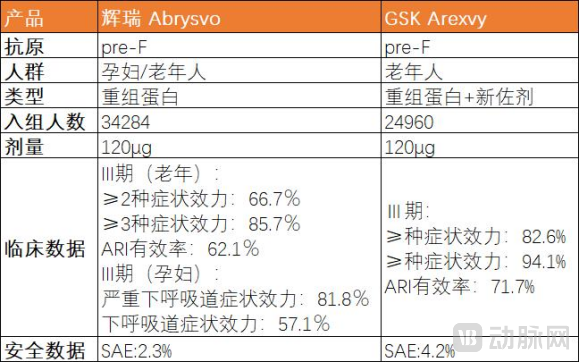
Comparison of Pfizer and GSK RSV Vaccine Products, Compiled by: Northeast Securities
RSV vaccine is considered the "last blue ocean" in the field of human infectious diseases.Data from灼识咨询 shows that the global market size for RSV drugs is expected to grow from $1.8 billion in 2020 to $12.8 billion by 2030, with a compound annual growth rate (CAGR) of 21.4%. This field represents a competition among various companies both in terms of product variety and technological approaches.
Pfizer's vaccine currently has a slight edge as it can be used for active immunization in pregnant women to prevent RSV-related lower respiratory tract disease in infants from birth to 6 months of age, and it has better safety; GSK uses the superior "recombinant protein + new adjuvant" technology route, with a protection rate stronger than Pfizer's. It has already been approved in the United States, Europe, Canada, and Japan.
To compete for the billion-dollar market, GSK has already engaged in a patent war with Pfizer.GSK stated that Pfizer began researching its RSV vaccine program in 2013, at least 7 years later than GSK’s initiation of its RSV project. In 2019, Pfizer challenged the validity of the European version of GSK's patent, and GSK believes that Pfizer was already aware of its RSV patent technology by that time.
Q3 marks the first direct market confrontation between the two products.According to GSK's Q3 financial report, its RSV vaccine Arexvy generated over £700 million (approximately $850 million) in revenue, more than double that of Pfizer, covering over 60% of the retail market terminals in the United States. In Q3, 1.4 million adults received the Arexvy vaccine. Like Pfizer, GSK is also continuing to expand the eligible population for RSV vaccination: recently, clinical trials of Arexvy in people aged 50 to 59 were successful, with an sBLA expected to be submitted within this year.
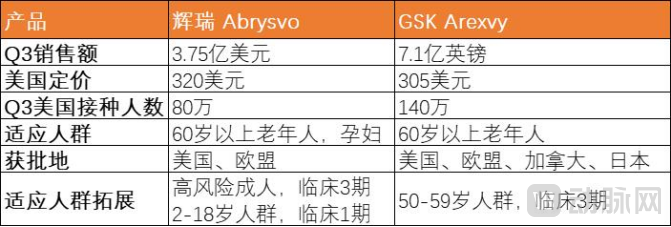
Comparison of Pfizer and GSK RSV Vaccine Products Q3 2023 Data, Compiled from: Company Reports
Moderna, Pfizer's previous patent lawsuit opponent, is also in this field:Moderna announced in July this year that it had submitted a marketing authorization application for its RSV vaccine mRNA-1345 to the European Medicines Agency, Swissmedic, and the Therapeutic Goods Administration of Australia. It has also begun rolling submissions of the Biologics License Application for mRNA-1345 to the U.S. FDA.
Abrysvo has shown potential, but Pfizer still needs to work hard to ensure its continued growth.
Can mRNA Continue to Generate Revenue?
From the pneumococcal vaccine Prevnar, to the COVID-19 vaccine Comirnaty, to the RSV vaccine Abrysvo, Pfizer has regarded respiratory virus or bacterial vaccine products as one of its core pillars.
In this field, the mRNA platform technology and experience are where Pfizer and other major manufacturers differ the most.Pfizer Announces Its modFlu Influenza mRNA Vaccine Candidate, Developed in Partnership with BioNTech, Successfully Met Two Primary Endpoints in the Ongoing Phase 3 Trial for the 18 to 64 Age Cohort, Alongside Its Q3 Earnings Report. This marks the first-generation mRNA vaccine designed for influenza prevention.
Preliminary analysis shows that the mRNA candidate vaccine achieves non-inferiority and superiority compared to the marketed influenza vaccine.
The number of influenza cases grows every year, with an estimated 1 billion cases globally each year, including 3 to 5 million severe cases, resulting in 290,000 to 650,000 influenza-related respiratory deaths. Analysts predict that by 2030, the global influenza vaccine market will exceed $10 billion. In the current influenza vaccine market, Sanofi has taken the lead with its quadrivalent influenza vaccine, generating over $3 billion in global sales for both 2021 and 2022.
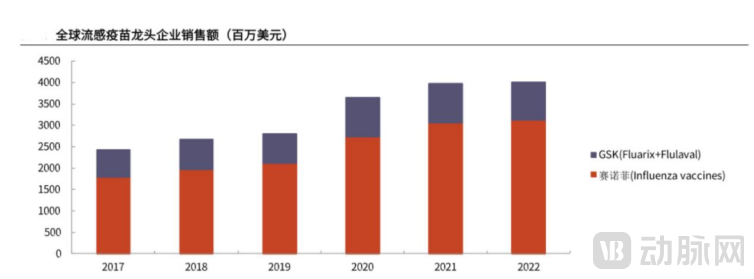
Source: VCBeat
Manufacturing mRNA vaccines is simpler compared to existing recombinant protein vaccines, which helps accelerate the pace of vaccine approval and distribution. Since influenza strains mutate easily, a successful mRNA flu vaccine could potentially improve protection by 40%-60% compared to existing vaccines.
However, the phase 3 trial data from Pfizer showed that the immunogenicity of its mRNA vaccine did not reach the endpoint for influenza B. This is also a common issue with mRNA flu vaccines. For mRNA flu vaccines to replicate the success of the COVID-19 vaccine, they still need to further demonstrate their efficacy and safety.
In addition, Pfizer's combined mRNA vaccine for COVID-19 and influenza also announced positive data a few days ago, with plans to enter Phase 3 clinical trials within the next few months.
But in the mRNA flu vaccine field, Pfizer is a step behind Moderna. In September, Moderna announced that its experimental seasonal flu vaccine, based on the mRNA technology platform, produced a stronger immune response against four strains of the flu virus compared to currently available vaccines on the market. It is now in discussions with regulatory authorities regarding the approval of the vaccine for market release.
Sanofi, the leader in flu vaccines, is also transitioning to mRNA. In 2021, Sanofi acquired Translation Bio for $3.2 billion to bolster its mRNA technology, followed by billions of dollars in subsequent investments in mRNA.. However, Sanofi pointed out in July this year that the first-generation mRNA flu vaccine "will not be successful," and stated that it is developing a more advanced mRNA flu vaccine.
According to the information released in Q3, Pfizer's influenza mRNA vaccine is expected to be launched after 2024, and the combined mRNA vaccine for influenza and COVID-19 is expected to be launched in 2025. Compared to the blue ocean of RSV vaccines, the influenza market is more mature.Pfizer, caught between new and old players, awaits regulatory and market response to see how it can benefit in the influenza field.
China's New Battle in Vaccines
Although it has gained significant momentum in the global market, the vast majority of Pfizer's marketed vaccines have yet to enter the Chinese mainland market. Currently, it only has one key product: Prevenar 13, a pneumococcal conjugate vaccine. However, the monopoly of this product was broken after a domestically produced 13-valent pneumococcal conjugate vaccine was approved by the end of 2020.
Starting from June this year, Pfizer's China vaccine team has been led by Yang Bei, the new General Manager of the China Vaccine Division.Replacing Zhang Lingyan at this position, who pioneered the CSO business model for Pfizer's vaccine innovation. Yang Bei has worked at Pfizer for over 20 years, serving as regional manager, area manager, sales director, and business general manager.
The recent adjustment in Pfizer's China division also involved the vaccine business unit.The Vaccine Business Unit has established the North China Region, South China Region, and Market Platform. The job description for the head of Pfizer's Vaccine Business Unit Market Platform is: responsible for building an innovative market platform, creating a vaccine ecosystem, promoting the innovation-to-market model, and improving business efficiency.
It is speculated that although Pfizer's vaccine line in China has been somewhat "awkward" for a period of time in the past, the appointment of a new and experienced leader indicates that Pfizer aims to make achievements in the domestic vaccine market moving forward.
China's vaccine market has significant room for growth. Taking the flu vaccine as an example, the overall vaccination rate in China is about 5%, far lower than the 48.4% in the United States. Among them, the highest vaccination rate in preschool children is only 12.35%.
Sanofi, which has been cultivating its vaccine business in China relatively early, has reaped success. In Q1 2022, driven by the growth of products such as vaccines, China became Sanofi's second-highest growth market globally for the first time. In July this year, its quadrivalent influenza vaccine officially began supplying the Chinese market.
GSK has formed a deep partnership with ZF Bio, and if the RSV vaccine is one of the few blue oceans, then the yet-to-be-tapped RSV market in China is the bluest of them all. GSK has already submitted a clinical trial application for Arexvy in China. According to a preliminary cooperation agreement reached with ZF Bio, GSK will have priority as the exclusive partner for the co-development and commercialization of any RSV vaccines for the elderly within the cooperation region.
This means that the space left for Pfizer is limited, not to mention the many local vaccine companies, such as several major flu vaccine companies: Hualan Vaccine, Jindike, Sinovac Biotech, Changchun Institute, Wuhan Institute, and Shanghai Institute, etc.
The development of RSV vaccines in China is already underway.Just as Pfizer announced its Q3 financial report, one of the leading companies in RSV in China, Advaccine, announced the phase 2 clinical data of its RSV vaccine.Showing that its ADV110 vaccine has good safety, tolerability, and immunogenicity.
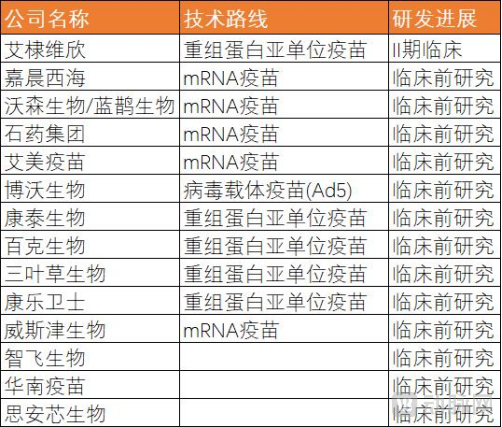
Companies in China that have laid out RSV vaccines, Source: BioWorld
The vaccine battle Pfizer faces may be more complex in China.
References
1.2023 Four Major Vaccine Giants Make Intensive Moves in China? - MedTalent https://mp.weixin.qq.com/s/9K_xhNOLT1mxX3ym_e1gzg
2.Chinese-produced Flu Vaccines Are Breaking Through - VCBeat https://mp.weixin.qq.com/s/-bOLSvaLN9V-wpo69eGn-w