

Li Yanhong Wins Big Pharma's Trust: BioMap Files for IPO After Landmark $1B+ Deal with Sanofi

BioMap
Developer of Innovative Drug R&D Platform
Sanofi
Pharmaceutical Manufacturer
AI Drug Development, After Decades of Commercial Stumbles, Finally Wins Generous Investment from Big Pharma.
On October 10, BioMap, the AI pharmaceutical company founded by Baidu CEO Robin Li, announced its first strategic cooperation agreement with a multinational pharmaceutical giant. The two parties will jointly develop models for biologic drug discovery based on BioMap's large life science model.
In this collaboration, Sanofi will pay BioMap a $10 million upfront payment, plus multiple model development fees and milestone payments expected to be made soon, bringing the total transaction value to over $1 billion.
"This collaboration is the *large-scale cooperation in the life sciences field based on foundational models," commented Dr. Song Le, Chief Technology Officer of BioMap.
In Dr. Song's conclusion, there is a key qualifier, which is "based on foundational large models."
In recent years, the collaboration between AI and life sciences has been increasing in both scope and scale year by year.
Just before BioMap officially announced its collaboration with Sanofi, on September 27, Novo Nordisk China announced a partnership with the U.S.-based technology company Valo Health. This collaboration aims to leverage artificial intelligence to discover and develop new therapies for diseases such as heart disease, stroke, and diabetes. The total value of this partnership could reach up to $2.7 billion, with an upfront payment and near-term milestone payments totaling $60 million. On May 31, XtalPi also announced a collaboration with Eli Lilly, valued at $250 million in total. Previously, globally renowned pharmaceutical companies such as AbbVie have also been actively collaborating with AI-driven drug discovery enterprises.
According to statistics from Deep Pharma Intelligence, a biotechnology market research organization, the total number of collaborations from 2017 to 2023 over six years reached 232. Notably, in 2022 alone, 66 collaborations were established. The upfront payments for these collaborations ranged from tens of millions to hundreds of millions of dollars, reflecting a strong commitment. Researchers from the organization further believe that,After the R&D model shifts to a "data-centric" innovation model, large pharmaceutical companies' attitudes towards AI drug discovery have changed from "skeptical and cautious interest" to believing that AI should play a strategic role.
This collaboration between Sanofi and BioMap has extended to the development of large models, marking a deeper integration of AI and pharmaceuticals.
In fact, AI pharmaceuticals, as a favorite in the investment community, have consistently fallen short of the pharmaceutical industry's expectations. Although AI technology has become almost standard in areas like small molecule crystal form prediction, compound screening, and codon optimization—indeed helping to reduce costs and accelerate R&D—these applications are still concentrated in the preclinical stage. Its role in the costly clinical trial phase remains limited, and it is still difficult to say how much AI has truly increased the success rate of new drug development to date.
In this context, why have pharmaceutical companies changed their attitude towards AI? Can more pharmaceutical companies valuing AI and increasing investment really help AI drug companies shake off the "not profitable" label? Behind this, what changes have occurred in the development trends of AI drug companies?
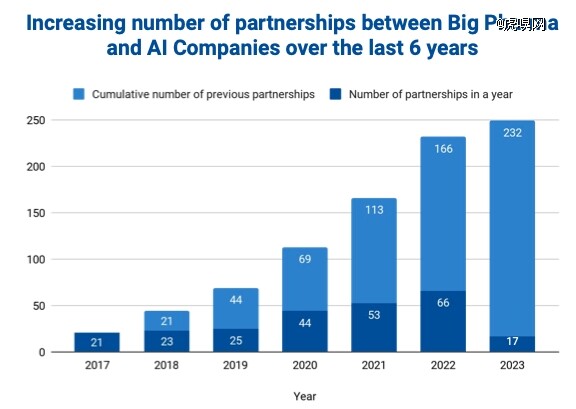 Collaborations between AI pharmaceutical companies and large pharmaceutical companies since 2017. Source: Deep Pharma Intelligence
Generative Large Models Bring New Possibilities
Pharmaceutical companies are increasingly favoring AI-driven drug discovery, primarily due to the sparks ignited by the intersection of large models and large molecules.
"The design of macromolecular drugs and the dimensional challenges of macromolecules themselves are, in fact, the integration points with generative large models*."Zhang Hongjiang, Advisor of the BAAI and Foreign Member of the US National Academy of Engineering (NAE), publicly stated at the "2nd China Bio-Computing Conference" held in September this year.
For a long time, the process of new drug research and development has been "at the mercy of nature." In the era of small molecules, compound screening occupied a large portion of the workload in new drug research and development. Finding molecules that can act on specific targets or genes from various possible molecular spaces and that can function stably within the human body often takes several months, even though these molecules are relatively simple, generally consisting of 10 to 500 atoms.
For example, BeiGene's successful U.S. launch of zanubrutinib (a BTK inhibitor), which is coded as BGB-3111, signifies the 3,111th compound synthesized after the establishment of BeiGene. In order to discover this molecule, researchers synthesized a total of over 15,000 compounds.
Entering the era of large molecules, due to the increased complexity of the drugs themselves, the difficulty of screening is also rising — a typical protein consists of hundreds of amino acids, and its spatial structure can reach up to 10 to the power of 300. If we factor in binding with the target, this number increases by at least dozens of orders of magnitude. The mRNA vaccines that played a significant role in combating the COVID-19 pandemic over the past two years are even more complex than proteins, with sequences reaching as many as 10 to the power of 600 variations.
The problem of large data volume has become more severe today as various combinations and conjugations of small molecules with macromolecules, and macromolecules with macromolecules, are gradually becoming the mainstream in new drug development. The data volume not only exceeds the limits of human reasoning and thinking, but also increasingly strains the computational power of ordinary computers.
Pharmaceutical companies are increasingly unable to bear the cost pressure brought by the "blind box" style new drug development.Moreover, in the past three years, during the global battle against the pandemic, newcomers in the pharmaceutical industry have seized the opportunity by utilizing new technologies such as mRNA and AI, teaching the veteran companies a solid lesson. Big pharmaceutical companies no longer dare to underestimate AI technology, which is also reflected in their strategic layout.
For example: Sanofi, which has partnered with BioMap this time, has successively and publicly announced its foray into mRNA and full commitment to AI after the COVID-19 pandemic.
From the company's collaboration with BioMap, in addition to utilizing large models for drug development, it also involves the development of AI large models — specifically, task-specific models for biologics design and optimization.
In other words, the collaboration between multinational pharmaceutical companies and AI-driven drug discovery enterprises is no longer limited to "gold," but rather focuses on the "finger" that turns stone into gold.
Behind this, the key point is that large models are expected to solve the long-standing problem of the insufficient supply of high-quality data that has plagued AI pharmaceuticals, and to more quickly crack the code of biopharmaceutical R&D. According to a relevant person in charge of BioMap in an announcement about the cooperation with Sanofi, downstream task models can make precise predictions with limited data based on pre-trained foundational models.
Based on the performance of large models in natural language, some technology investors believe that large models could potentially summarize the rules of new drug development from vast amounts of unlabeled data in ways humans cannot understand, and then output them in a way humans can comprehend. According to previously disclosed information from BioMap, large models may also simulate the human immune system to achieve the goal of pre-validating drug safety and efficacy.
For Sanofi, investing tens of millions of dollars in a "custom-made" large AI model could not only revitalize decades of accumulated data but also place a bet on the future, gambling on the possibility of completely changing the fate of new drug development that relies heavily on luck. It can be said that this investment is very worthwhile.
Is the Commercialization Path for AI Pharmaceuticals Clearing?
According to publicly available data from BioMap, they have built the large AI model xTrimo in the life sciences field, which already has over 100 billion parameters. It has achieved SOTA performance (Editor's note: meaning state-of-the-art performance) in more than 20 downstream prediction tasks, including antibody structure, antibody affinity, enzyme function, and immune cell function.
If large models are indeed so powerful, with the support of Sanofi's 50 years of proprietary datasets, AI pharmaceutical technology could advance more rapidly. The growing participation of pharmaceutical companies also holds the potential to bring about the "ChatGPT moment" for AI in the life sciences field more quickly.
However, this does not yet mean that AI pharmaceuticals are ready to fully commercialize.
Since 2007, when AI technology was first officially applied in the field of drug discovery, many models have been explored by relevant companies to address commercialization challenges. Among these, the most well-known to the public are selling software (AI+SaaS), providing services (AI+CRO), and developing pipelines (AI+Biotech).
Against the backdrop of a cooling global investment in innovative drugs, the first two service models for the industry are gradually showing signs of decline. Particularly, the model that focuses on providing services in a specific niche area of preclinical research—while still maintaining decent cash flow—is no longer viewed as having promising development prospects.
"“It is increasingly returning to the logic of pharmaceuticals.” Xie Changyu, a professor at the School of Pharmacy, Zhejiang University, told Huxiu."
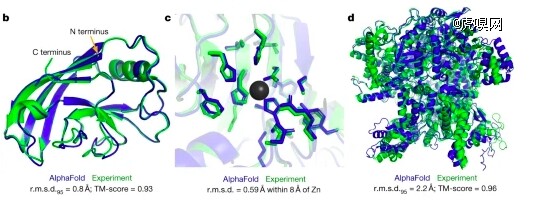 Alphafold Successfully Predicts Protein Structures, and This Is Just the Beginning of AI's Impact on the Pharmaceutical Industry. Source: Nature
Objectively speaking, leading pharmaceutical companies do play a very important role in the development of the AI pharmaceuticals industry, but,From historical experience, the contribution of large pharmaceutical companies to the performance growth of AI-driven pharmaceutical enterprises has always been minimal.
Historical data shows that even for "Schrödinger," known as the "world's first AI drug discovery stock," with over 30 years of experience selling AI drug discovery software and counting all TOP20 major pharmaceutical companies as its clients, the amount of money it earns annually from collaborations with these large pharmaceutical enterprises remains quite limited.
According to the company's financial reports, these major pharmaceutical companies contribute $20 million in revenue to Schrödinger annually, averaging $1 million per company, which has already reached the ceiling of AI investment by each pharmaceutical company. This level of income can only sustain Schrödinger’s 20% annual performance growth, which is neither satisfactory to investors nor sufficient to break through its own development bottleneck.
This also indirectly shows that the inertia of large pharmaceutical companies still exists. "Although they use a lot of AI computing, they habitually still rely on experiments for support," Xie Changyu told Huxiu. This means that the use of AI by large pharmaceutical companies is still far from sufficient, and AI companies providing SaaS software will have some room for growth in the future. China is also expected to catch up, but it will take time.
Companies providing CRO (Contract Research Organization) services can achieve good cash flow through cooperation with pharmaceutical enterprises. However, given the overall cooling of innovative drug investments and fierce competition among CROs, they are bound to operate on slim profit margins. This determines that "even if it may be a promising track in the short term, the pressure will be significant later on," Xie Changyu told Huoxiu.
By contrast, "AI + Biotech" is gradually becoming the most promising direction. Earlier this year, "Schrödinger" had already begun to distance itself from AI, redefining itself as a software + pharmaceutical company—akin to "a company using Office software"—and is actually moving closer to being a biotech company.
Even in the "AI+CRO" direction, the leading company XtalPi is no longer satisfied with providing services to pharmaceutical companies. According to XtalPi's official website, it already has 13 self-developed pipelines, including both small molecules and large molecules, with cutting-edge PROTAC and ADC among them.
Compared with companies that solely sell platforms or software, companies with products have higher commercial value.
In September this year, Insilico Medicine, a leading Chinese "AI+Biotech" company, licensed out a drug candidate in Phase I clinical trials to Exelixis, a U.S.-listed pharmaceutical company. The upfront payment reached $80 million, marking a significant transaction in China's small molecule biopharmaceutical sector*. This deal has also led industry experts to recognize the potential for AI-driven drug discovery to achieve commercial breakthroughs by monetizing R&D pipelines.
However, whether this path can be successfully navigated still depends on the smooth progress of subsequent drug development and whether milestone payments can be successfully secured. Moreover, this is an extremely challenging path, one that only a few companies can successfully traverse.
AI Drug Development Enters the "Hard-Core" Phase
The potential of AI in pharmaceuticals has always been overestimated. Pharmaceutical companies expect AI to address all undruggable targets, reduce clinical trial costs, and increase the success rate of clinical trials.These unmet, overly high expectations also point to the fact that AI pharmaceuticals can no longer avoid the tough issues—they must address not only preclinical problems but also clinical challenges.。
To do more beyond data recording in clinical trials, at least four issues need to be overcome.
First, "data remains the most core issue," Xie Changyu said. "For AI pharmaceuticals to enter the clinical stage, the lack of relevant data is *the* problem."
In the medical field, Wang Lei, the head of MedGPT project of Medlinker, once revealed that even ChatGPT performs unsatisfactorily when answering medical questions without training on professional medical data.
This also shows that high-quality professional data is very important for AI. Pharmaceutical manufacturing is more difficult than materials; from protein to drug, in addition to knowing the sequence and structure, we also need to understand the corresponding functions, and information in this area is still insufficient.
The problem with preclinical data has been addressed by AI pharmaceutical companies through "wet lab" automation and "dry lab" high-throughput computing. However, in the clinical stage, there are still issues such as a lack of high-quality data and inefficient data sharing that have not been fully resolved.
A large amount of data is still "hidden" within pharmaceutical companies, especially vast amounts of failed data. Compared to the published successful cases, this data holds even greater value. This data is the result of significant investments by pharmaceutical companies and is regarded as a treasure, constituting an important commercial secret. Over the past few decades, there has been little to no sharing between major pharmaceutical companies, leading to a great deal of repetitive research and waste. However, these barriers have always been difficult to dismantle.
Originally, the purpose of AI pharmaceutical companies collaborating with large pharmaceutical firms was to address this issue. In an article written by Chen Yinyu of the Shanghai Economic Information Center this February, it was summarized that in the cooperation model of AI pharmaceutical market players, "large pharmaceutical enterprises + start-ups" has become mainstream. In this model, AI pharmaceutical start-ups can leverage the funding, commercialization of research results, and market advantages of leading pharmaceutical companies to improve the efficiency of drug innovation.
And now, as AI pharmaceutical companies provide increasingly "customized" and "personalized" services to drug makers, it also implies, to some extent, that data barriers are becoming thicker. This is because, under this approach, pharmaceutical companies can manipulate their own data within the "high walls" of technology, making it even harder for other organizations to access.
AI pharmaceutical companies that want to obtain clinical data through self-developed methods also find it difficult to achieve due to high thresholds and large expenses. For AI pharmaceutical companies, even if they can access pharmaceutical enterprise data, the non-standardized, non-unified nature of these data, or even the lack of digitization, presents very challenging problems.
Secondly, the talent issue is also a major obstacle to the development of the AI pharmaceuticals industry. This is especially true in China, where the industry started relatively late.
In the aforementioned article, Chen Yinyu pointed out that over 90% of AI pharmaceutical companies choose cross-disciplinary collaboration to advance AI-driven drug discovery. However, due to a scarcity of versatile talents, it is difficult for drug development teams and AI teams to integrate.40% of drug research and development scientists do not understand AI technology.
For many AI pharmaceutical companies, the lack of pharmaceutical talent is also a critical factor. It can be seen that the reason why Insilico Medicine has been able to rapidly advance its product to Phase II clinical trials is largely due to the hiring of veteran pharmaceutical expert Ren Feng as a senior executive.
Guo Xu and Wang Ling from the Chinese Academy of Medical Sciences pointed out in the article "Bottlenecks and Countermeasures in the Development of the AI Pharmaceutical Industry" that to address this issue, universities should appropriately increase enrollment quotas for master's and doctoral students in relevant fields. They should explore a "university + enterprise" joint talent cultivation model. At the same time, efforts should be made to enhance the exchange and introduction of overseas talents, creating a favorable environment for innovation and entrepreneurship.
However, the upgrading of the entire environment is not something that can be resolved in the short term.
Third, China is still not perfect in terms of policies, regulations, and industry standard systems.Chen Yinyu believes that the lack of a unified independent testing database and effective evaluation standards for AI development tools is the key factor causing issues such as disorderly competition and low-level repetitive construction. Additionally, the absence of accumulation of core data like high-quality targets and rigorous intellectual property protection also hinders the industry's development.
To solve these problems, more breakthroughs are needed at the official level.
Fourth, and most importantly, there must be a drug designed entirely by AI that gains approval for market release. This requires not only more AI-designed drugs entering clinical trials but also the continuous iteration and updating of AI technology.
Qi Liu, a tenured professor in the Department of Bioinformatics at Tongji University, pointed out at the 2nd BioCompute Conference that Transformer is just a very small point in the AI architecture and represents a starting point for the development of AI technology. In the field of life sciences, "there will definitely be more excellent and effective architectures proposed in the future."
According to market research firm Research And Markets, the market size of AI pharmaceuticals is expected to reach $2.994 billion (approximately 23.19 billion yuan) by 2026. This is almost three times the market size of AI pharmaceuticals in 2022; compared with more than $60 billion invested in the AI pharmaceuticals field globally in the past nine years, it is just a small fraction.
In the process of rapid advancement, while the participation of large pharmaceutical companies is important, regulatory policies and the breakthroughs in AI pharmaceutical companies' own capabilities are even more crucial.ThisWhich means,AI pharmaceuticals still have a long way to go.
[This article is authorized for release by Hu Xiu, a partner of Zero2IPO. This platform only provides information storage services.] If you have any questions, please contact (editor@zero2ipo.com.cn) for handling by Zero2IPO.