Asia-Pacific Biotech Innovators Shine at 2023 SITC with Groundbreaking Oncology Therapies

BioSyngen
Developer of Immune Cell Products

Gracell
Cell and Gene Therapy Developer

Oricell Therapeutics
Developer of Tumor Immunocyte Products

NovaBridge Biosciences
Biological Agent Developer
Laekna Therapeutics
Innovative Drug Developer

November 5, 2023 / eMedClub News /--In recent years, driven by a variety of favorable factors, the biopharmaceutical industry in the Asia-Pacific region has rapidly risen. Numerous local innovative pharmaceutical companies have embarked on distinctive development paths while also accelerating their pace of aligning with international standards. "Rooted in the present, oriented towards the world" has become the strategic positioning for these innovative pharmaceutical enterprises. Many such companies have made appearances at various authoritative and influential international conferences, voicing their "locally-rooted innovation."
Among them,The Society for Immunotherapy of Cancer (SITC) is one of the largest international conferences focused on cancer immunotherapy., providing attendees with an interdisciplinary educational and interactive platform to jointly advance scientific progress, discover breakthroughs, and strive to improve the prognosis of all cancer patients. The conference attracted thousandsExperts and representatives from academia, industry, regulatory agencies, and government departments.From November 3 to 5, 2023, in the United StatesAt the 38th Annual Meeting of the SITC held in San Diego,Multiple innovative pharmaceutical companies in the Asia-Pacific region have showcased their significance globally.The impressive data from the research project has also drawn significant attention from the scientific and medical communities worldwide.。
Potential Unleashed: Asian Companies Make Breakthrough Progress
eMedClub
BioSyngen
eMedClub

BioSyngen Unveils Groundbreaking Clinical Data at This Year’s SITC Annual Meeting: A First-in-Class T-Cell Therapy Targeting EB Virus for Nasopharyngeal Carcinoma and EBV-Positive Lymphoma

The clinical trial results published this time show that: in terms of efficacy, 4 out of 5 patients with relapsed/refractory EBV-positive lymphoma who received treatment demonstrated an excellent therapeutic response.Objective Response Rate (ORR) Reached 80%. Among them,Patients achieving complete remission (CR) have realized progression-free survival of nearly two years.In addition, for the indication of nasopharyngeal carcinoma, four patients who had previously received ≥ second-line treatment and failed PD-1 antibody therapy all demonstrated excellent therapeutic responses after T-cell therapy.Disease Control Rate (DCR) Reached 100%, Advanced metastatic nasopharyngeal carcinoma to a large extent (-78.9%)Partial Response (PR) lasting more than 12 monthsIn terms of safety, no neurotoxicity (ICANS) or cytokine release syndrome (CRS) above grade 2 was observed during the treatment. Overall, the First-in-class therapy independently developed by BioSyngen demonstrated encouraging efficacy and safety.
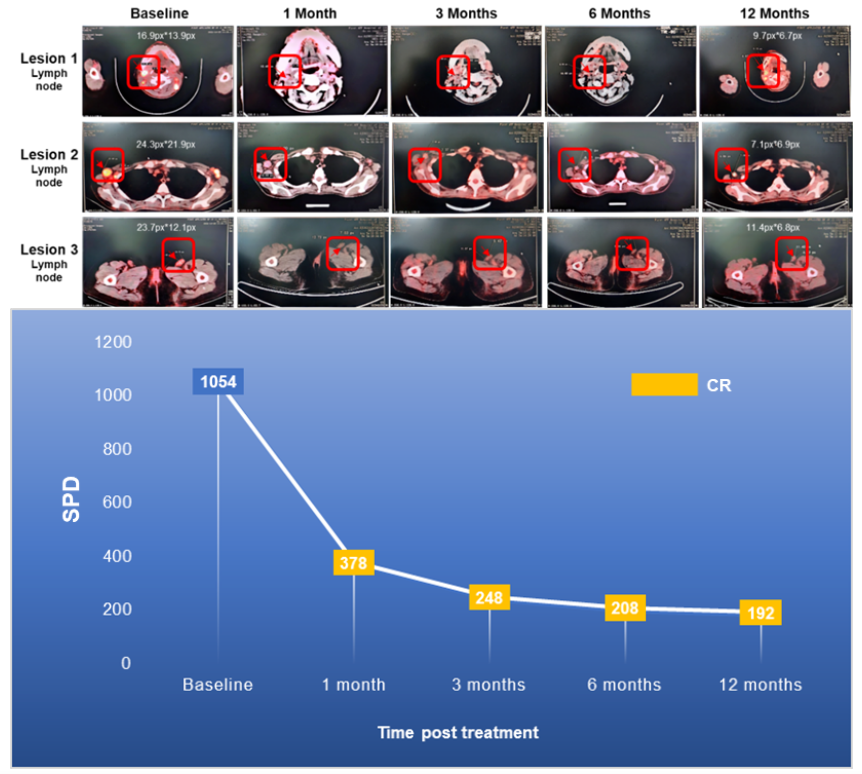
Notably, BioSyngen also disclosed details of two typical cases.
(1) A 35-year-old female patient with EBV-positive T-cell lymphoma who failed treatment with the CHOP regimen (cyclophosphamide + vincristine + doxorubicin + prednisone) received pre-conditioning with fludarabine + cyclophosphamide and was reinfused with 9x10 in November 2021.6/kg cells, the patient only experienced grade 1-2 CRS, but the symptoms resolved spontaneously, and no serious adverse events were reported. According to the 2014 LUGANO criteria,The patient achieved complete remission, and during the nearly two-year follow-up period up to now, the patient remains in a state of sustained remission.。
(2) A 56-year-old male patient diagnosed with nasopharyngeal carcinoma/non-keratinizing squamous cell carcinoma underwent treatments including surgery, radiotherapy combined with cisplatin chemotherapy, and a regimen of docetaxel + cisplatin + fluorouracil, achieving a best overall response of complete remission (CR). However, the cancer recurred with liver metastasis, and subsequent treatments with gemcitabine + nedaplatin + apatinib and gemcitabine + cisplatin proved ineffective.
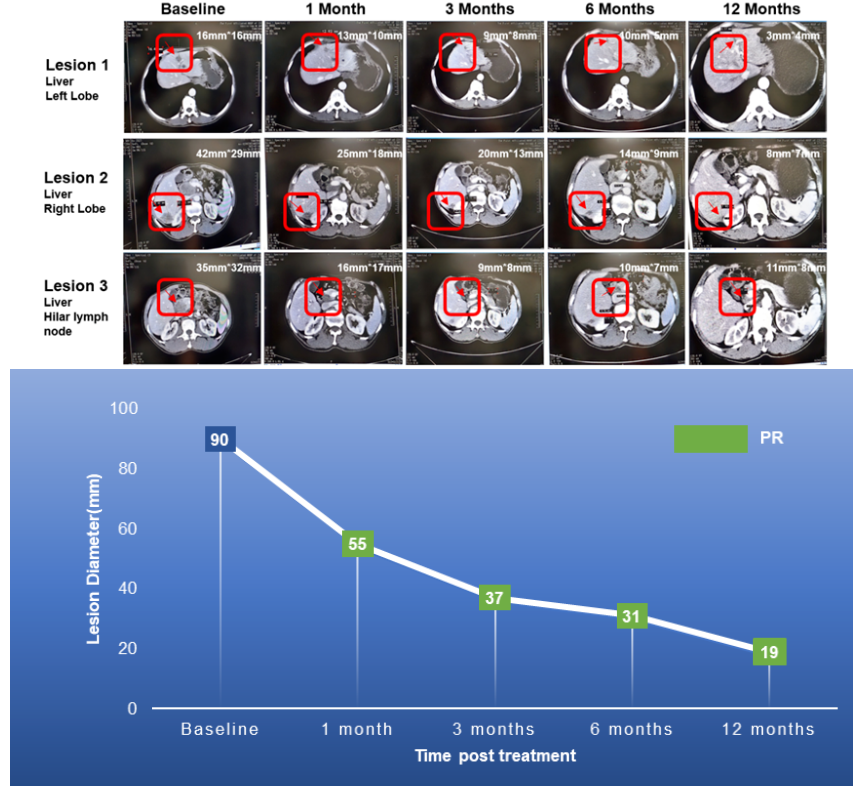
▲ Monitoring Data of the Male Patient After Treatment
(Image source:Reference 2)
In March 2022, the patient received pre-treatment with fludarabine + cyclophosphamide and subsequently received a total of 10x106/kg of cell infusion, the patient did not experience ICANS or CRS, and no serious adverse events were reported, with overall good tolerability. According to the RECIST v1.1 criteria,At 1 month, 3 months, 6 months, and 12 months post-infusion, tumors showed sustained significant relief (78.9%).Pharmacokinetic analysis validated the persistence of the infused T cells and demonstrated a clear correlation between the expansion of the infused T cells and the degree of tumor remission.
EBV infects nearly 95% of the global population and has been classified as a Group 1 carcinogen by the World Health Organization. Tumors associated with EBV mainly include nasopharyngeal carcinoma, EBV-positive gastric cancer, lymphoma, and lymphoproliferative diseases, among others. Nasopharyngeal carcinoma is a malignant tumor that occurs in the epithelial mucosa of the nasopharynx and is one of the common malignant tumors of the head and neck. Its development is closely related to EBV infection.In recent years, immune checkpoint inhibitors have begun to be used in the second-line and above treatment of nasopharyngeal carcinoma. The comprehensive objective response rate (ORR) of PD-1 antibody drugs approved in China and the United States for advanced nasopharyngeal carcinoma is around 20%, which means that about 80% of patients cannot benefit from it, indicating a huge unmet clinical need.. These clinical data represent a significant breakthrough for BioSyngen in the field of treating EBV-positive solid tumors and lymphomas, marking an important milestone. It further demonstrates that its world-first T-cell drug holds considerable potential for treating nasopharyngeal cancer and EBV-positive lymphomas, offering hope for more effective and safer treatment options for patients in the future.
Gracell
eMedClub

Gracell Presents Preclinical Data of a Solid Tumor CAR-T Therapy Developed Based on SMART CART™* Technology in a Poster at the 38th SITC Annual Meeting

SMART CART is Gracell's next-generation CAR-T technology targeting solid tumors, designed to enhance the expansion and persistence of CAR-T cells in the immunosuppressive tumor microenvironment (TME) while improving long-term tumor-killing efficacy.
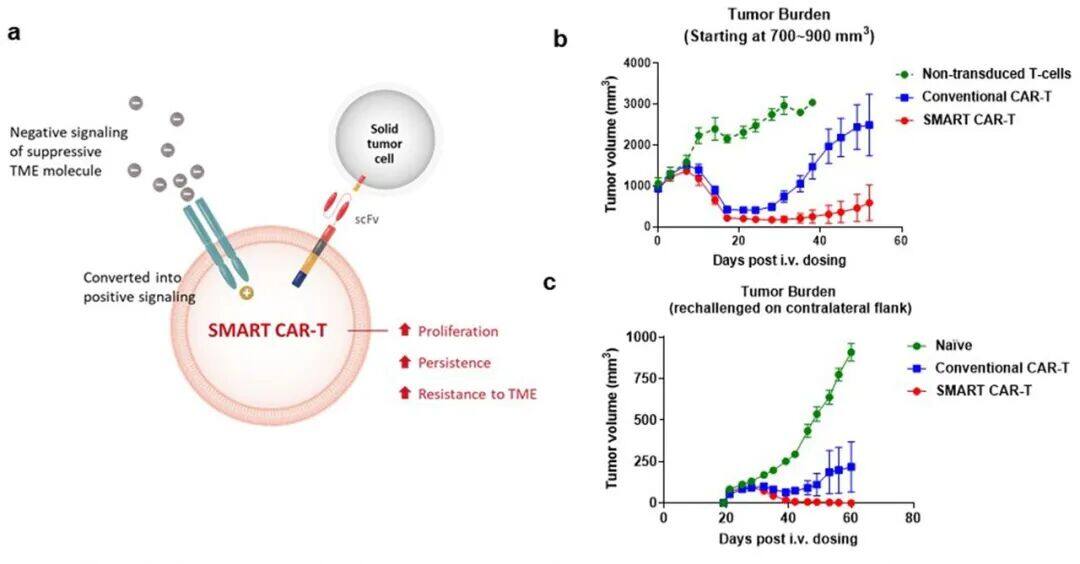
▲ SMART CART (Image Source: Reference 2)
Preclinical data shows that,SMART CART cells show significantly enhanced resistance to TGF-β-mediated apoptosis and exhaustion.In mouse models, SMART CART demonstrated superior tumor-killing activity over traditional CAR-T cells in both continuous tumor stimulation experiments and high tumor burden studies. This also provides strong support for SMART CART cells to advance into clinical trials.
Qrigincell Therapeutics
eMedClub

Qrigincell Therapeutics presented four scientific posters at this year's SITC Annual Meeting, covering the GPRC5D CAR-T cell therapy (OriCAR-017) for multiple myeloma (MM), the GPC3 CAR-T secreting CD3-AFP BiTE project (OriCAR633) for liver cancer, the MSLN CAR-T secreting PD-L1 antibody project (OriCAR627) for gastric/pancreatic cancer, and a CD39/PD-L1 bispecific antibody.

This poster reports that OriCAR-017 has superior MM cell lysis effects in vitro, and low toxicity and high anti-tumor effects in vivo. A phase 1 clinical trial (NCT05016778) shows,ORR Reached 100% in 10 MM Patients After Treatment. Indicates that OriCAR-017 has the potential to be the best in its class.

The study results indicate that the optimized GPC3 CAR-T cells secreting AFP-BiTE exhibit significantly enhanced antitumor activity against hepatocellular carcinoma cells with low GPC3 expression, both in vitro and in mouse tumor models.

MSLN CAR-T cell therapy engineered to secrete PD-L1 antibodies demonstrated significantly enhanced tumor-killing capabilities in in vivo tumor models, further proving that OriCAR627-PD-L1 is a promising potential solution for treating solid tumors.

OriA631-B is a CD39/PD-L1 bispecific antibody. In vitro studies have shown that OriA631-B can enhance the function and promote the proliferation of effector T cells; in vivo studies have shown that OriA631-B can significantly inhibit tumor growth, surpassing the effects of single-target or combination therapies.
Tianjing Biotechnology
eMedClub

Tianjing Biotechnology (Shanghai) Co., Ltd. Presented Updated Data from Two Studies on 4-1BB Bispecific Antibody Pipeline Products Givastomig (TJ-CD4B/ABL111) and ABL503 (TJ-L14B) at the SITC Annual Meeting.

Givastomig is the first CLDN18.2/4-1BB bispecific antibody, in an in vitro co-culture system simulating the tumor microenvironment,Givastomig can exert bystander tumor-killing effects., indicating that Givastomig has the potential to treat highly heterogeneous CLDN18.2-positive solid tumors.

ABL503 is a PD-L1/4-1BB bispecific antibody. Studies have shown that the combination of ABL503 and pembrolizumab further enhances the functional recovery of human CD8+ TILs compared to using pembrolizumab alone.
Laekna Therapeutics
eMedClub

Laekna Therapeutics also presented preclinical data of two self-developed novel bispecific antibodies, LAE111 and LAE113, in poster form.

LAE111 is a potent LILRB1/LILRB2 blocking bispecific antibody. Compared with existing competitive products,LAE111 Demonstrates Superior In Vitro Efficacy in a Series of Functional Assays, Indicating Best-in-Class PotentialAt the same time, the combination of LAE111 and PD-(L)1 inhibitors significantly activated T cell responses. These results will further support the product in conducting subsequent studies.

LAE113 is a novel TIGIT/PVRIG bispecific antibody. Studies have shown that when used in combination with an anti-PD-L1 antibody,LAE113 Exhibits Synergistic Effects in Enhancing IFN-γ Secretion by CD8+ T Cells. These data show that LAE113 has good developability and prospects.
Innovation Accelerates, a Promising Future Ahead
eMedClub
From the research data showcased by these innovative pharmaceutical companies, it can be seen that China's oncology treatment field is witnessing a trend of gradually strengthening corporate innovation drive, novel and diverse candidate product designs, and optimized efficacy and safety. Among them, cell therapy, which has rapidly emerged in recent years, has undergone development "from zero to one and then to a hundred flowers blooming." The "Voice of Asia" at the 38th SITC Annual Meeting also signifies that pharmaceutical companies in the Asia-Pacific region are gradually stepping onto the international stage and gaining global recognition in this process. In the future, it is hoped that through "going global and bringing in," innovative drugs in the Asia-Pacific region can further globalize to lead the development wave.
References:
1.Information Disclosure by Enterprises
2、https://jitc.bmj.com