

Orum Therapeutics Secures $180M Partnership with Bristol Myers Squibb to Target 'Undruggable' Proteins with Novel TPD² Platform
Orum Therapeutics
Cancer Treatment Drug Developer

Bristol-Myers Squibb
Biopharmaceutical and Nutritional Product R&D and Sales
▎Edited by the WuXi AppTec content team
Editor's Note: Today, Bristol-Myers Squibb and Orum Therapeutics have reached a strategic cooperation agreement worth $180 million to jointly develop a potential "first-in-class" cancer therapy. Earlier this year, the content team of WuXi AppTec interviewed Dr. SJ Lee, CEO of Orum, for an in-depth discussion on how the industry can overcome the challenge of "undruggable" targets. On the occasion of Orum’s partnership with Bristol-Myers Squibb, the WuXi AppTec content team will revisit this in-depth interview with our readers.
WuXi AppTec Content Department: Congratulations on the progress your company has made in clinical projects, and thank you for accepting our interview. Orum Therapeutics is developing innovative drugs for cancer treatment. In your opinion, what are the challenges in current treatment interventions, or the current treatment model?
Dr. SJ Lee:One challenge faced by the entire industry is how to develop drugs for "undruggable" targets. Targeted protein degraders are a powerful therapeutic modality that holds promise to address the issue of "undruggable" targets. However,As with all small-molecule drugs, this therapy also raises safety concerns because protein degraders cannot distinguish between targets in healthy and diseased cells.Moreover, although heterobifunctional degraders hold great promise in expanding the range of target proteins, they may be hindered by issues such as low cell permeability, bioavailability problems, pharmacokinetics, and the hook effect. Antibody-drug conjugates (ADCs) have made cytotoxic drugs safer and more effective, achieving success in oncology, but the biggest challenge in this field is that highly toxic payloads also eliminate normal cells expressing key target cell antigens (such as CD33), limiting the application of ADCs in certain tumor types and conditions.
WuXi AppTec Content Department: Could you please talk about how Orum's platform helps address these challenges and what sets it apart from existing methods?
Dr. SJ Lee:We have developed a method, which we call TPD²—also known as Double-Precision Targeted Protein Degradation, combining antibodies and targeted protein degraders.We are integrating various aspects of these treatment modalities. Orum's TPD² candidate drugs provide new payloads based on novel mechanisms of cell killing, targeting proteins that are considered undruggable. Additionally,By combining protein degraders with antibodies, TPD² candidate drugs are designed to specifically target diseased cells to enhance efficacy and safety, thereby overcoming the inherent challenges of small-molecule degraders.The degrader payload itself has germline-dependent activity. For example, GSPT1 degraders can kill leukemia cells without affecting normal hematopoietic stem cells.
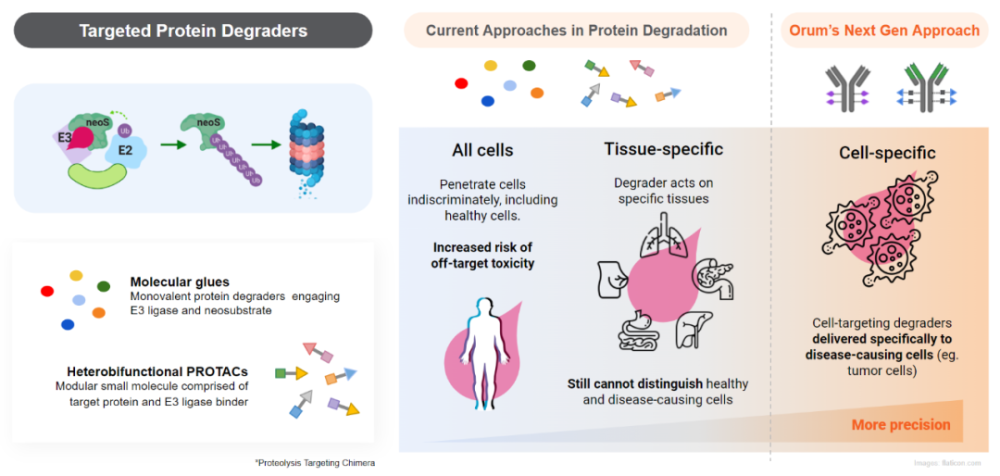
▲
Schematic Diagram of the TPD² Method
(Image Source: Orum Therapeutics Official Website)
WuXi AppTec Content Department:Orum's lead candidate has already completed the first patient dosing in 2022. In order to fully realize the potential of your company's new platform, what key challenges do you believe still need to be addressed?
Dr. SJ Lee:The challenge in fully realizing the potential of our TPD² approach lies in the pairing of cell surface antigens with TPD target proteins, which presents nearly infinite possible combinations. We are collaborating with partners who have expertise in specific disease areas or possess degraders or antibody products capable of binding to their target ligands.Although we are currently focused on oncology, the therapeutic areas for Orum's TPD² approach remain unexplored. We have a unique opportunity to collaborate with those who have deep expertise in non-oncology indications, such as immunology, to explore TPD² programs where we can design degraders to target specific immune cells.
WuXi AppTec ContentSection: Orum Therapeutics remains a relatively young biotechnology company. What do you think global collaboration means for your company?
Dr. SJ Lee:Orum is a global company with laboratories in both the United States and South Korea, giving us access to a diverse pool of technical talent.We also collaborate with high-quality partners such as WuXi AppTec in East China, which is only a two or three-hour flight from Seoul, reducing the lead compound optimization cycle by a few days and significantly accelerating drug discovery efforts.
WuXi AppTec Content Team: Thank you for your valuable insights! If we gather here again in 10 or 15 years, what do you think we will be discussing in terms of the achievements we have made in the industry?
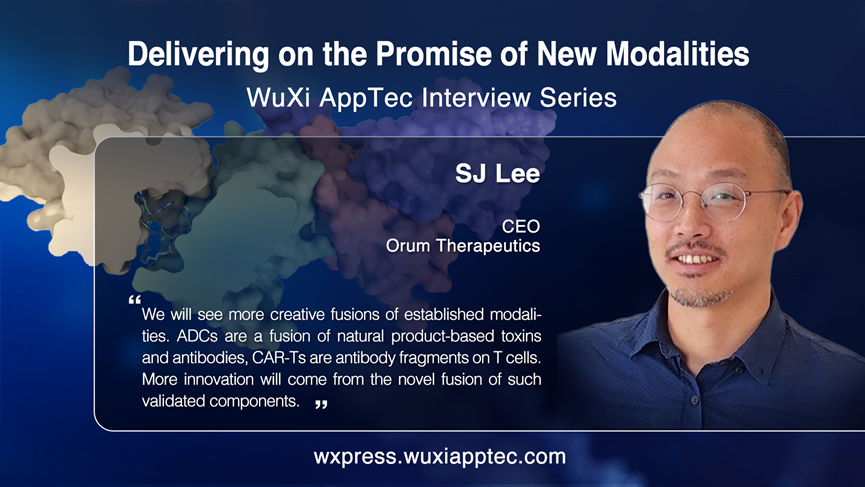
Dr. SJ Lee:We will see more creative fusions of established treatment modalities. ADCs are a combination of antibodies and chemotherapeutic agents, while CAR-Ts are a fusion of antibody fragments and T cells. More innovations will emerge from novel combinations of these active components. A great example is Enhertu, an innovative fusion between effective therapies — a topoisomerase 1 inhibitor combined with an approved antibody. We believe the fusion of antibodies and TPDs will become mainstream in 15 years, and we are confident that Orum Therapeutics will be a leader in this field.