

Cargo Therapeutics Files for IPO with $315M Raise, Backed by CAR-T Pioneer Behind Lyell

Cargo Therapeutics
CAR-T Cell Therapy Developer

November 9, 2023 / eMedClub News /--Recently,Cargo TherapeuticsTo the U.S. Securities and Exchange Commission (sec) SubmitIPOApplication, planned for2023Year11Month9Listed on NASDAQ in the United States on [date]. According tosecThe document shows,CargoExpected to issue more than4100Thousands of shares, provided that its underwriters exercise all options to purchase additional shares.The stock issuance range is15Dollar to17USD, the fundraising will exceed the median value.3.15Billion US dollars. Prior to this, the company's plan was throughIPOPublic Offering1Billion dollars in funding.

The company plans to use approximately $220 million of the net proceeds from its IPO to advance the Phase 2 trial of its lead candidate drug CRG-022, $20 million for R&D, and the remaining cash for operations and other purposes.In addition, Cargo Therapeutics stated that it would regularly evaluate strategic opportunities and use a portion of its net income to license, acquire, or invest in complementary technologies, assets, or intellectual property. It is reported that the aim of this IPO is to provide the company with sufficient cash to sustain operations until 2025.

Cargo Therapeutics, founded in 2021, is committed to unlocking "next-generation" cell therapies.From its establishment to IPO, Cargo Therapeutics only took a short span of 2 years, going through two rounds of financing totaling $43 million. It then secured another $200 million in Series A funding this past March, bringing the cumulative amount to $243 million.However, according to the financial report released by Cargo Therapeutics, the net losses for 2021 and 2022 were $5.85 million and $40.95 million, respectively. So, how does a cell therapy company with no revenue complete multiple rounds of financing and sprint to an IPO in a short period of time?
Top Team + Promising Platform Pipeline
eMedClub
Cargo Therapeutics was co-founded by Stanford University professor and CAR-T pioneer Dr. Crystal Mackall, with the majority of the founders hailing from the Stanford University School of Medicine.Dr. Crystal Mackall worked at the National Cancer Institute (NCI) for 27 years. She is the founding director of the Stanford Cancer Cell Therapy Center and the director of the Stanford Parker Cancer Immunotherapy Institute. She has led multiple clinical trials involving dendritic cell vaccines, cytokines, NK cell therapy, T cell therapy, etc. Additionally, she is a co-scientific founder of Lyell Immunopharma, another cutting-edge cell therapy company that has gone public on Nasdaq.

▲ Dr. Crystal Mackall (Image Source: Internet)
Gina Chapman, CEO and President of Cargo Therapeutics, formerly served as Senior Vice President of Genentech. She previously stated that Cargo is in discussions with an undisclosed CDMO regarding production plans.The average production turnaround time for the company's cellular therapy is 18 days, similar to the timeline of CAR-T therapies already on the market.Moreover, Dr. Robbie Majzner, a medical doctor, and JD Nancy Goodman, a successful cancer advocate, are also key members of the company's core team.

▲ Core Team(FigureSource of the image:NetNetwork)
In addition to having a strong founding team,Cargo Therapeutics also has co-stimulatory factor technology and dual-targeting technology.The former can support the developed cell therapy by utilizing the CD2/CD58 co-stimulation pathway to enhance T-cell persistence and anti-tumor activity. The latter can support Cargo Therapeutics, Inc. in developing multispecific CAR-T therapies, reducing tumor recurrence caused by immune escape, and improving CAR-T efficacy.
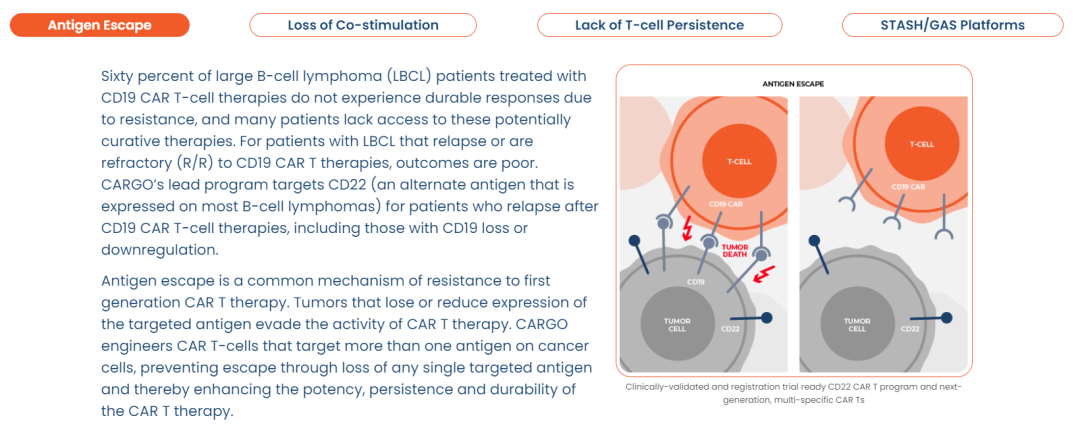
▲ CAR-T(FigureSource: Enterprise)
As the core pipeline of Cargo Therapeutics, Inc.,CRG-022 is a potential "First/Best in class" autologous CD22 CAR-T cell therapy, aimed at treating patients with relapsed or refractory large B-cell lymphoma (R/R LBCL). CD22 is a transmembrane protein expressed on most B-cell malignancies and is restrictively expressed on mature B cells. About 60% of LBCL patients develop resistance after receiving CD19 CAR-T therapy and fail to achieve durable remission, while CRG-022 has the potential to treat patients whose disease recurs after CD19 CAR-T therapy.
The results of its Phase 1 clinical trial showed:The overall response rate (ORR) was 68% and the complete response rate (CR) was 53% among 38 treated patients.. As of the time of this data report,Only 1 of the 20 CR patients relapsed, and the median overall survival reached 22.5 months at the interim analysis.The experimental results preliminarily demonstrate that CD22 CAR T-cell therapy is safe and exhibits antitumor activity in patients with LBCL. Based on these results, CD22 CAR-T has been granted Breakthrough Therapy designation by the FDA.
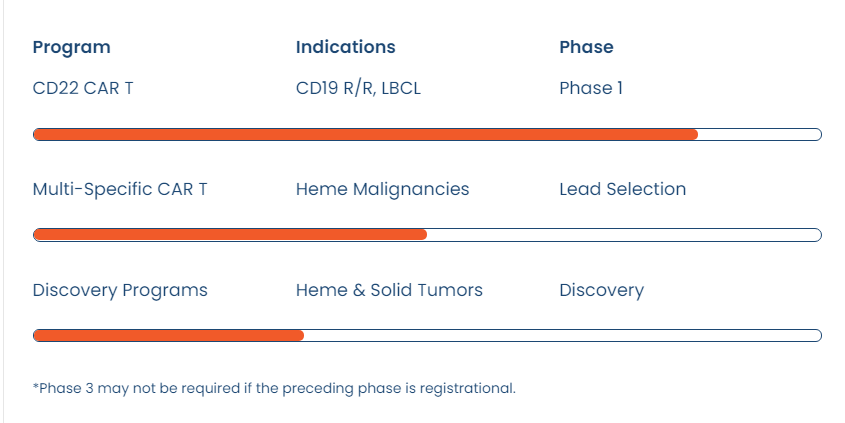
In addition,Cargo Therapeutics has also developed "multispecific" CAR-T cell therapies capable of targeting two or more antigens., aiming to overcome various cancer drug resistance mechanisms and treat multiple malignant hematological tumors through a multi-target approach. Currently, these candidate pipelines are still in the IND preparation stage. Meanwhile, Cargo Therapeutics combines these candidates with flexible, automated process design, next-generation rapid analysis, and viral vector production technology, which is expected to ensure clinical development and eventual commercial supply while maintaining product competitiveness throughout the product lifecycle.
Summary
eMedClub
According to SEC filings, biotech IPOs are not the "norm" this year. However, despite the current "capital winter," Cargo Therapeutics has bravely pursued its IPO, proving that "true gold can stand the test of fire." Hopefully, Cargo Therapeutics can fulfill its management's aspirations by building a truly distinctive platform that meaningfully advances cell therapy and extends the lives of more patients.


Dian Dian "Share”、“Like"and"In View", charge me up a bit~"