Chinese CAR-T Therapy Makes Another Breakthrough: Can the "Million-Dollar Price Tag" Be Removed?

Juventas
Innovative Cell Therapy Drug Developer
Nowadays, cancer treatment has entered the era of precision medicine. So far, CAR-T therapy is one of the most effective methods, especially in the field of hematological tumors, where it has gained a great reputation for its outstanding efficacy.
Since the approval of the world's first CAR-T product in 2017, the lineup of marketed CAR-T products has continued to grow stronger, and the global CAR-T market has rapidly expanded. Although the efficacy of CAR-T products is indeed commendable, their high cost makes them a treatment option for only a few patients, leaving most unable to afford it. However, over the past two years, multiple products manufactured in China have been successively approved for marketing, raising hopeful expectations that the price of CAR-T therapy might be significantly reduced in the future.
The First CAR-T Product in China for Leukemia Treatment
Recently, according to the information on the official website of the National Medical Products Administration, Juventas' self-developed CAR-T product, Nbasecarls Injection (formerly known as Hecarlset), has been approved for marketing in China. It is used to treat adult patients with relapsed or refractory B-cell acute lymphoblastic leukemia (r/r B-ALL). Currently, the IND application for Nbasecarls Injection for the treatment of adult B-ALL has also been approved by the U.S. FDA.
The incidence of leukemia in China is approximately 6.21 per 100,000 people annually, while the annual incidence in the United States is about 12.9 per 100,000. Acute lymphoblastic leukemia (ALL) accounts for approximately 15% of all leukemia cases, of which B-cell acute lymphoblastic leukemia (B-ALL) makes up about 75% of ALL cases.
The relapse rate of adult B-ALL after initial treatment is high, with approximately 60%-70% of patients progressing to the relapsed or refractory stage (r/rB-ALL). Under traditional treatment methods (such as chemotherapy), the prognosis for adult r/rB-ALL patients is extremely poor, with a survival period of only 2-6 months. There has been no significant improvement in survival over the past 30 years. Due to the lack of effective clinical treatments, there is a significant unmet clinical need for its treatment in China and globally.
In recent years, new treatment methods have emerged, including Inotuzumab Ozogamicin and Blinatumomab, which have significantly improved PFS and OS in R/R B-ALL. Earlier use of these drugs provides greater benefits; however, without allogeneic hematopoietic stem cell transplantation, the long-term remission rate for patients remains insufficient. There are still unmet treatment needs for R/R ALL, especially for patients after the first relapse.
Compared with traditional drugs/emerging therapies, CAR-T cells have many unique characteristics. The intrinsic specificity of CAR is currently unmatched by small molecule drugs. CAR-T cells rely on the cytotoxicity of T cells, utilizing this highly efficient endogenous pathway. As a type of living cell drug, its additional benefit is that even a single CAR-T cell can multiply exponentially, thereby killing hundreds or even thousands of target cells. After the target cells are eliminated (antigen no longer exists), CAR-T cells can still persist and continue to patrol for more than ten years, thus preventing disease recurrence.
According to Juventas, Najiolumab Injection is a CD19-targeted CAR-T cell therapy product. It features a globally unique CD19scFv (HI19a) structure and internationally leading manufacturing processes, achieving a 100% production success rate in the pivotal clinical study for adult r/r B-ALL.
Nakio Cell Injection is not only the first China-innovated CAR-T product targeting CD19, but also the first CAR-T cell therapy product in China's leukemia treatment field, offering patients deep and lasting remission and has the potential to reshape the treatment landscape for adult r/r B-ALL patients in China.
Global Launch and Latest Sales of CAR-T Products
As of now, there are 10 CAR-T products that have been launched globally, six of which were approved by the FDA, including Novartis' Kymriah, Gilead/Kite’s Yescarta and Tecartus, BMS's Breyanzi, Celgene's Abecma, and Legend Biotech's Carvykti.
In China, four CAR-T products have been approved, including the recently approved Naciorlen Injection. The other three are Ajilun Injection from Fosun Kite and Relma-cel Injection from Wuxi Juno, both indicated for lymphoma; and Idecabtagene Vicleucel Injection co-developed and commercialized by Innovent Biologics and Juventas for the treatment of adult patients with relapsed or refractory multiple myeloma (R/RMM) who have progressed after at least three prior lines of therapy (including at least one proteasome inhibitor and one immunomodulatory agent), which was just approved for marketing in June this year.
The prices of currently approved CAR-T products on the market are generally high. The selling price of Axicabtagene Ciloleucel Injection in China is 1.2 million yuan per dose, Relmacabtagene Autoleucel Injection is priced at 1.29 million yuan per dose, and Idecabtagene Vicleucel Injection is sold at 1.166 million yuan per dose.
The price of CAR-T products abroad is even two to three times higher than that of domestically produced ones, ranging between 2.5 to 3 million yuan. Currently, the highest priced product is Novartis' Kymriah at 3.264 million yuan per dose, while the lowest priced are Kite Pharma's Yescarta and Tecartus, both at 2.563 million yuan per dose.
Although the price is high, a large amount of clinical data has confirmed the feasibility of CAR-T cells. Since its launch, the overall sales of CAR-T products have been on the rise. Recently, major pharmaceutical companies have successively released their third-quarter reports for 2023, and the report cards for the first half of the year and the third quarter of some CAR-T therapies have also been released accordingly. As expected, most CAR-T products are still favored by patients.
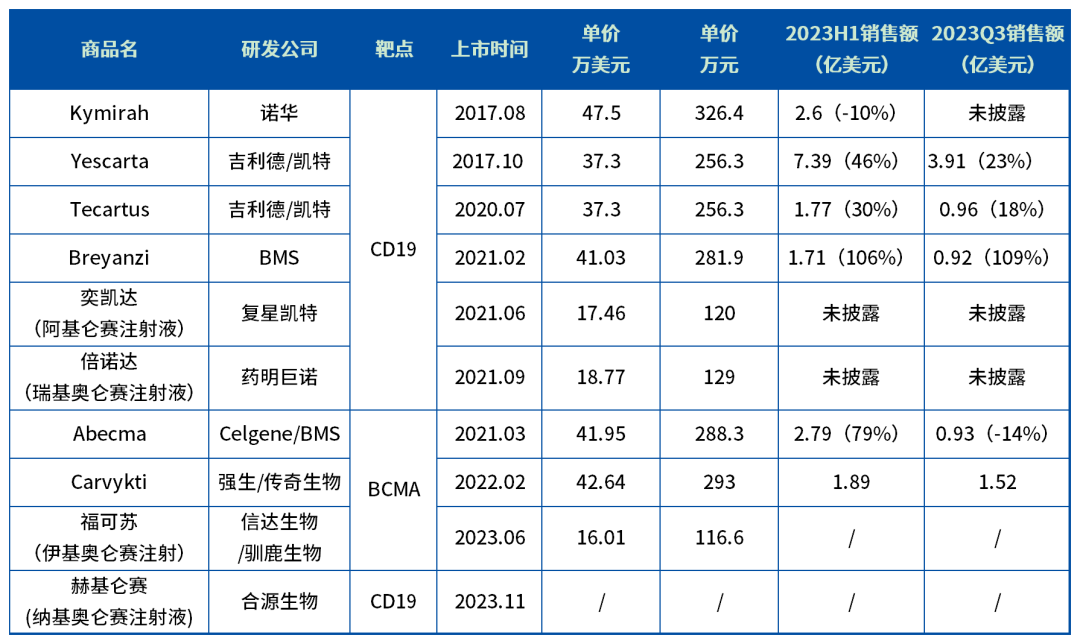
Globally Marketed CAR-T Products and Sales of Some Products, Data Source: Public Data Compilation
Gilead is thriving in the CAR-T drug field, holding two CD19-targeted CAR-T products (Yescarta and Tecartus), both of which have shown strong sales performance. Yescarta achieved the highest sales, reaching $739 million (+46%) in H1 2023; in Q3 2023, it maintained robust growth with quarterly sales hitting $391 million (+23%). Meanwhile, Tecartus reported global sales of $177 million in H1 2023 (+30% year-over-year), with Q3 2023 sales at $96 million (+18%), meeting performance expectations.
Like Gilead, Bristol-Myers Squibb (BMS), which also owns the two CAR-T products targeting CD19, Breyanzi, and targeting BCMA, Abecma, has shown remarkable performance in this field. In the first half of 2023, the combined revenue of these two CAR-T products reached 450 million U.S. dollars. Among them, Breyanzi showed a rapid growth trend, with sales of 171 million U.S. dollars (+106%) in H1 2023 and quarterly sales of 92 million U.S. dollars (+109%) in Q3 2023. Abecma's sales in H1 2023 were 279 million U.S. dollars (+78.8%), with Q3 2023 sales at 93 million U.S. dollars (-14%), showing a slight decline.
In addition, according to Johnson & Johnson's financial report, the sales performance of the BCMA CAR-T therapy Carvykti, developed in collaboration with Legend Biotech, was also a major highlight. Carvykti was only approved for marketing in the U.S. in February 2022, making it one of the later entrants among several FDA-approved CAR-T products. However, its sales reached $189 million in the first half of 2023, surpassing the total sales of $134 million in 2022. In Q3 2023 alone, it generated $152 million in sales. With quarterly revenue growing rapidly, Carvykti’s sales this year are expected to exceed $500 million, and next year it is set to stride into the billion-dollar club, aligning with Johnson & Johnson’s earlier projections for the drug's sales within 1-2 years post-launch.
Compared to Gilead, Johnson & Johnson, and BMS, Novartis seems to be losing momentum in the CAR-T field. According to Novartis' financial report for the first half of 2023, Kymriah's sales in the first half of the year amounted to $260 million, a year-on-year decrease of 10%. In 2022, Kymriah achieved sales of $536 million, also marking a year-on-year decline of 9%. Although Novartis did not specifically disclose Kymriah’s sales for Q3 2023, with the entry of competitors, Kymriah, as the world’s first approved CAR-T therapy, is gradually losing its first-mover advantage.
CAR-T is also gradually opening up the market in China. In September 2021, WuXi Jiaoda's Benoda was approved for marketing. The total revenue for 2022 was 146 million yuan, a year-on-year increase of 373.1%. WuXi Jiaoda's semi-annual report for 2023 shows that its revenue in the first half of the year increased by 32.9% to 87.7 million yuan. This growth was mainly due to the continued commercialization of its currently only commercialized product, Relmacabtagene Autoleucel Injection.
Although the sales performance of another domestically produced CAR-T product, Yikaida (Axicabtagene Ciloleucel Injection) from Fosun Kite, has not been explicitly disclosed, Fosun Pharma's 2022 annual report shows that, as of the end of January 2023, Yikaida has treated nearly 300 patients with r/rLBCL. Based on its price of 1.2 million yuan per dose, the estimated sales revenue of Yikaida to date could reach 360 million yuan.
In China, apart from the already marketed products, the marketing application for Zevor-cel (CT053) injection developed by Carsgen Therapeutics was accepted by the National Medical Products Administration in October 2022; based on its impressive performance in the U.S. market, Legend Biotech also submitted the marketing application for Carvykti in China to the National Medical Products Administration last December, quickly entering the domestic market.
Blocked from Entering Medical Insurance: The "Breakthrough Strategy" of CAR-T Products Made in China
We know that the reason why CAR-T therapy is so expensive is because the product needs to be personalized and customized, making it an individualized medication that cannot achieve large-scale mass production. Each batch of the product consumes high costs and takes 2 to 4 weeks for culture and preparation. The entire treatment process is very complex, involving many technical steps with strict quality control requirements. Currently, there is no mature, standardized production process established globally, and many steps rely on manual operations, resulting in a relatively high failure rate. In terms of the industry, it is still in the early stages of development, and the upstream and downstream resources of the industrial chain, such as raw materials and equipment, are not yet mature, which also leads to increased costs.
Although the pricing of CAR-T therapy in China is much lower compared to foreign countries, for ordinary people, "a million yuan per injection" is still out of reach. Therefore, for the three CAR-T products launched in China, the commercialization path is "long and arduous."
For such high-priced drugs, entering the medical insurance system is an ideal "price-breaking" pathway for patients. However, the road to medical insurance for CAR-T products seems more arduous than that of other innovative drugs. Last month, the National Healthcare Security Administration announced the list of drugs that passed the preliminary review for the 2023 National Medical Insurance Drug Catalog.
The journey of CAR-T therapy in the medical insurance system has attracted much attention. This year marks the third time that the drug Akilun Injection has passed the formal review since 2021, and Relma-cel Injection is also not passing the formal review for the first time. Both products are about to enter the next stage. Since both products failed to make the list in 2022, they are once again striving for inclusion in the medical insurance this year, actively preparing for negotiations every year.
However, based on previous years, the annual treatment cost of all drugs in the medical insurance catalog has not exceeded 300,000 yuan. Considering a 50% reduction in drug prices, it is very challenging to lower the price of "million-yuan anti-cancer drugs," and the negotiation difficulty is significant. Excessively high prices will still impose substantial pressure on the medical insurance fund even if included. Moreover, the current market penetration rate of CAR-T is not as high as other drugs, and the significance of trading price for volume may require multi-faceted consideration. Therefore, it remains difficult for CAR-T products to enter the medical insurance system.
To continuously increase sales revenue, Fosun Kite, WuXi Juvantas, and Innovent Bio/Caribou Biosciences are exploring alternative routes outside of medical insurance, actively attempting various methods conducive to advancing the commercialization process.
Fosun Kite is actively exploring cooperation with all parties in innovative payment methods. Currently, Axicabtagene Ciloleucel Injection has been included in more than 60 commercial health insurance plans and over 80 city-level “inclusive insurance” programs; JW Therapeutics also actively seeks cooperation with major insurance companies. As of December 31, 2022, Relmacabtagene Autoleucel Injection has been listed in 56 commercial insurance products and 75 local government supplementary medical insurance programs.
According to public information from Innovent Biologics and Juventas, in the first batch of prescriptions for the injection of Idecabtagene Vicleucel across China, some patients have passed the commercial insurance claim review and obtained full reimbursement eligibility for the Idecabtagene Vicleucel injection. The claims were directly paid by the insurance company, without the need for patients to pay out of pocket. This innovative payment method has significantly reduced the financial burden on patients with advanced cancer, making cutting-edge therapies more accessible and affordable.
For the recently launched Naciorl Injection, it is unlikely to be covered by medical insurance in the short term. However, Juventas has stated that they will work to establish a multi-dimensional payment system as soon as possible, including commercial insurance and innovative payment methods;惠民保 (public welfare insurance) in multiple provinces and cities across China has already incorporated CAR-T therapy, significantly improving the accessibility of CAR-T treatment drugs.
With the in-depth research of CAR-T treatment technology in China, it is believed that in the future, with the efforts of all parties, CAR-T therapy will definitely break through more bottlenecks, achieve price reduction, and truly benefit more cancer patients.
References:
1. Financial Reports of Various Companies
2. "Nature: Beyond Cancer, the Infinite Potential of CAR-T Cell Therapy" BioWorld, September 3, 2023
3. "Current Status and Future of CART Therapy for Adult B-cell Acute Lymphoblastic Leukemia" Chat About Hematology, March 19, 2023

Editor: Penicillin
Disclaimer: The views expressed in this article are solely those of the author and do not represent the position of Pharmcube. We welcome discussions and additional insights in the comment section; for reprints, be sure to credit the author and source. If the content, copyright, or other issues are involved, please leave a message on this platform, and we will address it promptly.