

AbbVie and Calico's First-in-Class Oral PTPN1/2 Inhibitor ABBV-CLS-484 Enters Clinical Trials, Overcoming 'Undruggable' Target to Combat PD-1 Resistance

Calico Life Sciences
Compound Developer

AbbVie
Innovative Drug Developer

Resistance to PD-1 blockade is a major issue in oncology, as most patients exhibit primary resistance to "immune checkpoint blockade." Even among responding patients, the majority will develop adaptive or secondary resistance. There is an urgent need to develop new immunotherapies and drug combinations to improve overall response rates and treat resistant tumors.
On October 4, in a study published inNatureThe research results on the magazine are fromAbbVie、Calico Life SciencesResearchers from Harvard University and the Broad Institute of MIT reported that, with oral small molecule candidate drugsABBV-CLS-484 in combination with PD-1 inhibitorPancreatic cancer, breast cancer, and metastaticCancer mice live longer than control group mice,Tumor growth is also slower.. Although the survival rate of mice treated with this small molecule alone was relatively low, it was still statistically significant. Importantly, ABBV-CLS-484 also appears toReduce T cell exhaustion in mice, andRevitalizing Exhausted Human T Cells, indicating that the drugMay be able to block the main pathway of immunotherapy resistance。
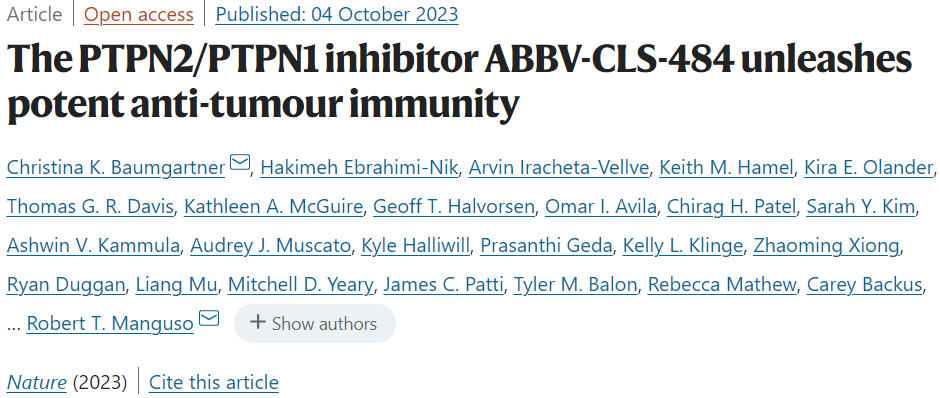
ABBV-CLS-484 is a first-in-class, orally bioavailable, potent protein tyrosine phosphatase PTPN1 and PTPN2 active site inhibitor.PTPN1/2 is a core regulator of inflammatory response,Generally, theyBy interfering with molecules in the JAK-STAT signaling pathway(Key Elements of Inflammation)To act as an immune checkpoint。One of the corresponding authors of the study, Dr. Robert Manguso, said:"When defending against pathogens, it helps keep the immune system in check, but when a concerted effort is needed to destroy malignant cells, it holds us back."”Inhibition of PTPN1/2 releases this part of the immune response, thereby possiblyAdd another powerful weapon to the human anti-cancer arsenal.
The results of the CRISPR screen published by the Manguso laboratory in 2017 showed that PTPN2 could improve the response to immunotherapy.Around the same time, research from other laboratories showed that simultaneously targeting PTPN1/2 could make T cells more effective in combating cancer and sensitize tumor cells to immunotherapy.These data once again prove,PTPN1/2InGene deletions in tumor or immune cells can promote anti-tumor immunity.
However, until recently, combating cancer in this way seemed difficult to achieve. Protein tyrosine phosphatases such as PTPN1/2 were considered "undruggable" targets. There are many reasons for this, one of which could be described as an electrical issue: due to the binding site being positively charged, it only binds with negatively charged molecules, which typically cannot cross the cell membrane to enter the cell. Previous attempts to develop phosphatase inhibitors capable of overcoming this situation have failed.
Nevertheless, the research and development exploration targeting PTPN1/2 continues.In the latest research, Manguso Lab collaborated with AbbVie and Calico Life Sciences to find a solution, ultimately developing ABBV-CLS-484.
Manguso pointed out that, in addition to proving that targeting phosphatases is possible, the drug might also encourage the pharmaceutical industry to broaden its focus beyond biologics in immunotherapy. He said, "Small molecules can offer more flexible dosing options, lower production costs, and easier distribution and storage. The development of small-molecule immunotherapies can benefit more patients in need of better treatment options."
In summary, this study demonstrates that ABBV-CLS-484 can inflame the tumor microenvironment and improve NK cell and CD8 function by enhancing JAK-STAT signaling and reducing T-cell dysfunction.+T cell function. That is to say, unlike existing immunotherapies, ABBV-CLS-484 canTargeting Tumors and Immune Cells Simultaneously, inEnhance Tumor Sensitivity to Immune AttackAt the same time,Enhance the Activity of Anti-Tumor Immune Cells。
More broadly, the study demonstrates that small-molecule inhibitors of key intracellular immune modulators can achieve comparable or better efficacy than antibody-based immune checkpoint blockade in preclinical models.PTPN1/2 inhibitors offer a promising new strategy for cancer immunotherapy, and ABBV-CLS-484 is currently being evaluated in patients with advanced solid tumors (ClinicalTrials.gov; NCT04777994).Researchers said that, to their knowledge, ABBV-CLS-484 isThe First Active Site Phosphatase Inhibitor to Enter Clinical Evaluation for Cancer Immunotherapy, and may pave the way for other treatments targeting this important enzyme.
References:
1# AbbVie and Calico immunotherapy boosts PD-1 response and tackles T cell exhaustion in mice (Source: FIERCE Biotech)
2# Baumgartner CK, Ebrahimi-Nik H, Iracheta-Vellve A, et al. The PTPN2/PTPN1 inhibitor ABBV-CLS-484 unleashes potent anti-tumour immunity. Nature. 2023

PharmaCube Pro
New Targets, New Technologies, New Therapies