

Amid Capital Winter, 20 Chinese Medtech Companies Secure Over ¥100M Funding: What Makes Them Stand Out?

SONOSEMI
Active Vascular Implantable and Interventional Medical Device R&D and Manufacturer

MitrAssist Lifesciences
Cardiovascular Innovative Medical Device R&D Manufacturer

LifeShield
Innovative Medical Device R&D and Manufacturer

HearHill
Cardiovascular Innovation Product Developer

EVAHEART
Cardiovascular Medical Device Developer

Arthrone
Orthopedic Instrument R&D and Manufacturer
Century Healthcare
Medical Device Manufacturer, R&D, and Distributor

SPH Health Commerce
Prescription Drug New Retail "Internet+" Development Platform Provider

Ligatech
Interventional Consumables Developer

TEKSQRAY
Provider of Integrated Digital Smart Pathology Solutions
TRIASTEK
3D-Printed Drug R&D and Equipment Developer

Huichuang Medical
Near-Infrared Brain Function Imaging Product Developer

Leadinno Medical Valley
Developer of Medical Devices and Consumables in the Field of Pain and Neuromodulation

Green Medical Era
Medical Device Developer

Qihan Biotech
Gene Editing Technology Developer

Atom Therapeutics
Innovative Drug Developer

Horimed
OCT Imaging Equipment R&D and Manufacturer
Since the capital winter, several medical star companies worldwide have ceased operations or applied for bankruptcy protection due to failure to raise funds, such as gene therapy provider LocanaBio, cell therapy company Tessa Therapeutics, and cancer drug developer BAKX Therapeutics.
Not only unicorns in the medical field, but also many startups are affected by the capital market and have difficulty obtaining financing. According to the "VCBeat 2023 H1 Global Healthcare Industry Capital Report" released by VCBeat: The total amount of financing in China's healthcare industry has dropped from 92.7 billion yuan in the first half of 2021 to 41.1 billion yuan in the first half of 2023, a decrease of approximately 56%. Meanwhile, the average financing amount for medical projects has significantly decreased from 170 million yuan in the first half of 2021 to 63 million yuan in the first half of 2023, marking a decline of about 63%.
Against the backdrop of cautious moves by investment institutions, there are still many innovative projects that have successfully completed financing in the market. Especially as the average financing amount has plummeted significantly, the completion of hundred-million-level financing by some projects is even more commendable.
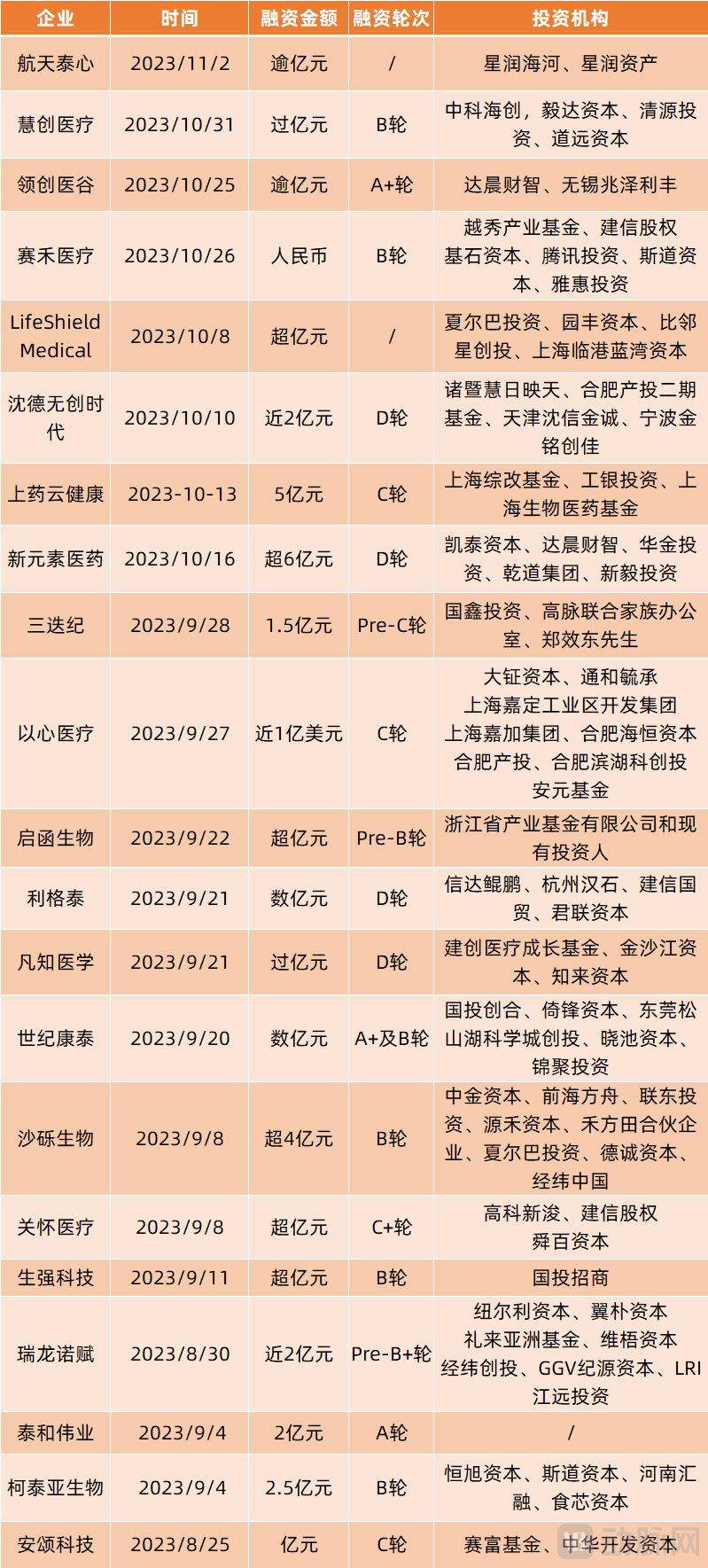
VCBeat has compiled statistics on 20 recently announced financing events worth hundreds of millions of yuan, and found that these companies are at different stages and in different fields, but they share many similar traits. Perhaps, these traits are one of the reasons they were able to successfully complete large-scale financing, and also one of the reasons why investors are willing to provide them with strong financial support.
The medical industry has fallen into a winter period, with many once-hot细分 tracks now becoming deserted. However, there are still some tracks that remain popular in the market, even becoming "safe havens" for investment institutions during this cold spell.
Among the 20 companies that have secured hundreds of millions in financing, SONOSEMI, MitrAssist Lifesciences, Rocketheart Technology, and LifeShield (formerly known as PulmoShield Medical) are enterprises in the cardiovascular intervention field. Notably, both Rocketheart Technology and LifeShield operate in the artificial heart niche. It is worth mentioning that artificial heart companies such as HearHill, Tongling Biomimetic, and EVAHEART have also successively completed hundreds of millions in financing. This indicates that...Despite the "winter" period, the artificial heart sector still garners extremely high attention in the capital market.。
In addition to track factors, the technical strength of Rocketheart Technology Co., Ltd. and LifeShield also added chips to their billion-level financing. For example, Rocketheart Technology originated from China Academy of Launch Vehicle Technology. Its developed implantable artificial heart HeartConⅡ is a third-generation full magnetic suspension blood pump, which can not only provide full-flow left heart assistance for adults but also offer left heart assistance treatment for children and adolescents. It also has the potential to provide right heart assistance and biventricular assistance treatment for patients with right heart failure. Currently, the product is undergoing registration inspection and animal experiments, with clinical trials expected to start in 2024.
The technology of LifeShield originates from Aachen, Germany. It is reported that LifeShield has absorbed the advanced technology and R&D experience from Enmodes, a leading enterprise in the global short-term circulatory support field. Mr. Xing Cheng, Managing Partner of Sherpa Healthcare Partners, stated: "The LifeShield team has integrated the advanced technology of the German team with the efficient development and industrial operation capabilities of the Chinese team, balancing cross-disciplinary innovation and accumulating multiple underlying technical capabilities."
Based on strong technical and innovative capabilities, LifeShield's interventional artificial heart adopts an innovative "non-perfusion" sealing design, optimizing core components and overall design. This improves the operational efficiency and blood compatibility of the interventional pump while effectively reducing the product size.
Beyond artificial hearts, another sector where investors are placing heavy bets is upstream raw materials.Among the 20 companies that have completed hundreds of millions of yuan in financing, CareMedical, Arthrone, Century Healthcare, Cytiva Biotech, and Chengdu Tachem Co., Ltd. are all upstream players in the industrial chain, providing raw materials to downstream enterprises or simultaneously offering both raw materials and their application products.
Taking CareMedical as an example, it starts from the upstream raw material end and focuses on the layout of membrane-related biomedical materials. Its membrane products cover markets such as gene therapy, vaccine production, antibody drugs, blood purification, and ECMO. At the same time, CareMedical is also committed to the research and development of innovative terminal blood purification products. Its self-developed blood purification innovations will obtain certification from the National Medical Products Administration and enter the market for sale in the coming years.
On July 19, 2023, the "List of Shortlisted Units for the 'Open Challenge' of Biomedical Materials Innovation Tasks (First Batch)" was announced. CareMedical, along with its participating company DeepBlue Technology, took the lead in two biomedical materials innovation tasks: medical polyethersulfone and medical polysulfone, and participated in the innovation task of ECMO raw material "poly-4-methyl-1-pentene." In recognition of CareMedical's strong R&D capabilities, it completed two hundred-million-level financings within three months.
Another case is Arthrone, a company that has broken the overseas monopoly on ceramic femoral heads. This Chinese company possesses the production technology for two types of ceramic materials—zirconia and alumina—and its zirconia ceramic femoral head has entered the National Medical Products Administration's special approval process for innovative medical devices.
It is reported that ceramic femoral heads, as the core cost component of artificial joints, are currently mainly monopolized by the German company CeramTec. Data shows that CeramTec is the sole supplier of ceramic materials for globally leading joint manufacturers such as Johnson & Johnson, Smith & Nephew, Stryker, Zimmer Biomet, AK Medical, Chunli Medical, and Wego Orthopaedics. In response to this, Arthrone, since its establishment in 2017, has focused on tackling the production technology of ceramic materials. It has now independently developed domestically produced ceramic femoral heads, breaking the overseas monopoly. Compared with imported products, its ceramic femoral heads adopt unique patented technology and strict production quality control processes, demonstrating excellent product performance and significant cost advantages.
In addition to the aforementioned upstream biotechnology material companies, Century Healthcare, which has the capability to research and develop collagen biomaterials, Create Biotech, which focuses on amino acids, their derivatives, and oligosaccharide products, and Chengdu Tachem Co., Ltd., which provides upstream starting materials for peptide drugs, have all completed hundreds of millions of yuan in financing.
The third "safe harbor" track is digitalization.SPH Health Commerce, Ligatech, Shenzhen Shengqiang Technology Co., Ltd, and TRIASTEK are all companies strongly associated with digitalization.
For example, SPH Health Commerce, which is advancing its strategic business transformation and upgrading, has simultaneously established a digital service system centered around pharmaceutical enterprises and an innovative payment and health management service system for patients. Currently, SPH Health Commerce has collaborated with over 300 innovative pharmaceutical companies, serving more than 6 million patients and achieving the first order landing for over 80% of innovative drugs. It has also established service links with dozens of insurance companies and serves more than 50 Class A tertiary hospital internet hospitals and nearly 200 medical institutions.
Ligatech is a digital sports medicine platform enterprise. It uses digital sports medicine as the entry point for diagnosis and treatment, deploying a full-process product lineup from diagnosis, treatment to sports management, covering imaging systems + artificial intelligence, powered devices, implants, and other supporting consumables. Among these, Ligatech's self-developed innovative orthopedic imaging equipment, the dual-plane imaging system, provides doctors with "3D + full-length + weight-bearing position + dynamic" imaging information through a fast, low-radiation technical pathway, addressing issues such as the lack of functional weight-bearing and dynamic information in traditional orthopedic imaging.
The other two digital-related enterprises are as follows: Shenzhen Shengqiang Technology Co., Ltd. is an industry leader in integrated intelligent pathology solutions, having collaborated with over a hundred hospitals, diagnostic companies, and AI companies. It has helped multiple Class III Grade A hospitals' pathology departments build comprehensive digital and intelligent solutions and has established a provincial-level pathology consultation platform centered around Anhui Provincial Hospital. TRIASTEK is a provider of digital pharmaceutical process technology, actively exploring the diverse application scenarios of 3D printing technology in drug manufacturing. It has already formed partnerships with multinational corporations such as Eli Lilly, Boehringer Ingelheim, Merck, Siemens, and domestic pharmaceutical enterprises like Shufang.
Statistically, among the 20 companies that have completed hundreds of millions of yuan in financing, 11 belong to the artificial heart, upstream materials, and digitalization sectors, accounting for over 50%. Currently, the overall investment and financing environment in the medical industry is cooling down, but these three sub-sectors are showing signs of activity.
From the perspective of enterprises, a common trait among these 20 companies that have completed hundred-million-level financing is their mastery of disruptive technologies. For instance, Huichuang Medical, Leadinno Medical Valley, Green Medical Era, and Hangzhou Qihan Biotech Co., Ltd., all secured hundred-million-level financing due to their possession of disruptive technologies.
Specifically, Huichuang Medical's breakthroughFunctional Near-Infrared Spectroscopy (fNIRS)It is a non-invasive brain functional imaging technology that mainly utilizes the difference in absorption rates of oxyhemoglobin and deoxyhemoglobin in brain tissue at different wavelengths of near-infrared light to detect cortical hemodynamic activity in real time. Based on the relationship between hemodynamic changes and neurovascular coupling, it infers the neural activity of the brain.
Nowadays, with the increasing popularity of brain science, brain function detection equipment is also developing rapidly. Near-infrared brain function imaging devices, which boast advantages such as being non-invasive, portable, and accurate, have gained more attention in recent years.
On the other hand, the use of photobiomodulation in treating Alzheimer's disease has opened a new door for near-infrared technology. According to reports, Huichuang Medical has applied for...Near-Infrared Light Therapy for Degenerative DiseasesThe principle patent. Currently, Huichuang Medical's phototherapy product for Alzheimer's disease has completed dozens of patient research clinical trials, showing significantly better effects than existing drugs, and the product has entered the green channel. In addition to Alzheimer's disease, Huichuang Medical has also conducted phototherapy scientific research on other degenerative diseases and mental brain diseases such as autism and depression, achieving good therapeutic effects.
Pan Haifeng, Partner of Clear Source Investment, stated: "Huichuang Medical is a project we have been tracking and investing in multiple rounds since the early stage. Our focus in the first two rounds was on Huichuang's brain disease diagnosis capabilities. In this round, our participation in the additional investment is driven by our interest in Huichuang's phototherapy AD product. We hope this capital increase will help Huichuang successfully advance the research, development, and clinical trials of its phototherapy AD product."
Leadinno Medical Valley is another company that has achieved a technological breakthrough, independently developing in the field of neuromodulation.Wireless Power-Assisted Neurostimulation Technology, and has developed the first wireless-powered spinal cord stimulation (SCS) product in China. The product is about to enter the clinical trial stage. It is reported that the wireless-powered implantable neurostimulation product overcomes the clinical application limitations of traditional active implantable neurostimulation products, frees itself from the constraints of traditional implantable pulse generators and battery efficiency limitations, and reduces problems such as electrode displacement.
Clinically, the long-term efficacy and safety of Spinal Cord Stimulation (SCS) have been widely confirmed, but it has problems such as high cost, surgical difficulty, and poor patient compliance. However, the wireless SCS independently developed by Leadinno Medical Valley has advantages over active implantable SCS, including minimally invasive safety, high patient compliance, short learning curve, good treatment effect, and low cost, which will help significantly improve the penetration rate of neuromodulation.
In addition, Leadinno Medical Valley's wireless-powered neural electrical stimulation technology is a platform-based technology, which can also be applied in the future to neuro-modulation products such as Deep Brain Stimulation (DBS), Vagus Nerve Stimulation (VNS), Sacral Nerve Stimulation (SNS), and Peripheral Nerve Stimulation (PNS), making these products "wireless" as well.
Based on the advanced and disruptive nature of this technology platform, Leadinno Medical Valley successfully completed two rounds of financing at the level of hundreds of millions in both 2022 and 2023. This also demonstrates the strong confidence of the capital market in the wireless power-carrying neurostimulation technology platform.
Not only is Leadinno Medical Valley pursuing minimally invasive solutions, but Green Medical Era is also pursuing minimally invasive approaches, and it even goes a step further by striving for non-invasive solutions.
Green Medical Era has independently developedSuperconducting MRI-guided Phased-focused Ultrasound Non-invasive Treatment Technology, namely the new "Magnetic Wave Knife" technology. The Magnetic Wave Knife focuses ultrasound on the local area of the tumor, generating a temperature above 65 degrees Celsius to kill the tumor through thermal ablation. Compared with other surgeries, the Magnetic Wave Knife surgery not only has no incisions but also causes very minimal adverse reactions in patients.
Dr. Zhang Minglong, Deputy General Manager of Chongqing Dianshi Chuangjian Fund, stated: "Focused ultrasound offers patients accessible non-invasive treatment with advantages such as non-invasive therapy, no surgery, no bleeding, one-time and repeatable treatment. Moreover, magnetic resonance-guided phased array focused ultrasound provides more precise targeting, real-time monitoring, treatment visualization, real-time efficacy evaluation, enhanced safety, simpler operation, and a broader range of indications."
Currently, Green Medical Era has built the MagWave innovative shared technology platform and will continue to tackle multiple treatment areas such as the nervous system, body tumors, gynecology, andrology, and orthopedics, providing more patients with safe and effective non-invasive treatment solutions.
In summary, these disruptive technologies all have clear application scenarios and can address the limitations and pain points of traditional solutions. Meanwhile, these innovative technologies are platform-based, applicable to other processes or extendable to products in other fields, offering an extremely broad market prospect.
In addition to companies that have secured financing through innovative technologies, some companies have obtained hundreds of millions in funding due to the completion of commercial validation or the upcoming launch of commercialization. Among them, SONOSEMI and MitrAssist Lifesciences in the cardiovascular intervention field are representative examples.
On October 26, SONOSEMI completed a Series B financing round of over 2 billion yuan. The funds will be mainly used for the research, development, production, and commercialization of core products. A day later, SONOSEMI announced that its self-developed coronary intravascular shock wave treatment system had officially received approval from the National Medical Products Administration (NMPA) for market launch, becoming the first domestically produced coronary shock wave treatment system approved in China.This round of financing comes just before the commercialization of SONOSEMI's core products, which will help accelerate their market promotion.。
Cardiovascular Innovation Platform EnterpriseMitrAssist Lifesciences has evolved from pure research and development to the current commercialization stage.This round of funding will support the clinical trials and market access work for its valve products, the R&D work for polymer valve products, as well as the market sales efforts for non-invasive heart failure monitoring devices and coronary drug-coated balloons. It is reported that MitrAssist Lifesciences' non-invasive heart failure management device, after being launched in the U.S., Europe, India, and Japan, has also been approved for marketing in China this year. To achieve better commercialization, MitrAssist Lifesciences has established a sales team in the United States and built a distributor system in multiple countries.
Horimed, a company in the cardiovascular intervention field, has recently completed tens of millions of yuan in financing. The funds will be mainly used to accelerate the commercial promotion of its listed products. An investor mentioned: Horimed's products have entered multiple Class A tertiary hospitals.Commercialization has been validated.Moreover, this year's sales performance has exceeded expectations, and in the future, efforts to promote will be further increased to enhance the company's revenue and profits.
Moreover, FireGen Medical, an in vitro diagnostics company that recently completed a financing round of over 100 million yuan, has also made breakthroughs in commercialization. Currently, FireGen Medical has distributors in more than 30 countries overseas, providing products and services to thousands of hospitals, pharmaceutical companies, research institutions, genetic testing companies, communities, and households worldwide. Notably, FireGen Medical’s overseas revenue accounts for more than one-third of its total income, achieving a dual circulation in both domestic and international markets, with rapidly growing revenue.
Compared with innovative companies in the R&D stage, investment institutions in the current environment place more emphasis on companies that can achieve self-sustaining or have their commercialization verified. Because in a downturn, having cash flow is the key to survival. Those companies with disruptive innovative technologies that ultimately fail due to lack of financial support will become case studies in venture capital textbooks, serving as essential lessons for entrepreneurs when raising funds.