Tirzepatide: Lilly's First-in-Class GIPR/GLP-1R Dual Agonist Drives Strong Commercial Performance with Expansive Pipeline in Diabetes, Obesity, and NASH

Eli Lilly
Global Pharmaceutical R&D and Production Company
On November 8, Eli Lilly announced that the U.S. FDA approved the weight loss indication for tirzepatide, branded as Zepbound.
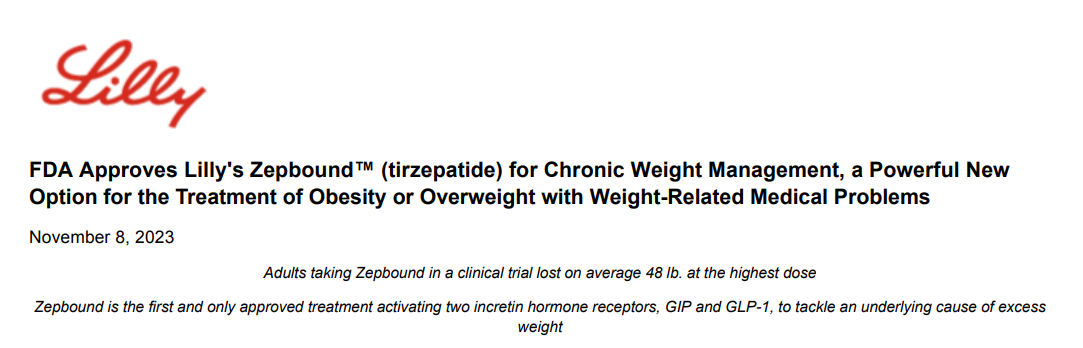
Image Source: Eli Lilly Official Website
Tirzepatide is the world's first GIPR/GLP-1R dual agonist. It was approved by the U.S. FDA in May 2022 for the treatment of type 2 diabetes (T2DM), and subsequently received approval in Japan and Europe in September 2022, with rapid market uptake following its launch.
According to the recent Q3 financial report released by Eli Lilly and Company, driven by its star drug tirzepatide, the company achieved $9.5 billion in revenue for the third quarter. Tirzepatide generated $1.4 billion in revenue in Q3, with a total income of $2.957 billion in the first three quarters of this year.
So far, tirzepatide has been developed for 9 indications, including T2DM, obesity, non-alcoholic steatohepatitis (NASH), heart failure with preserved ejection fraction, obstructive sleep apnea (OSA), chronic kidney disease (CKD), etc. In China, NDA has been filed for T2DM and weight loss indications.
T2DM Indication
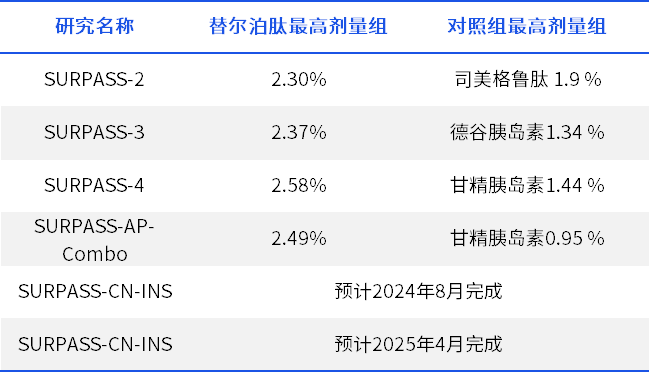
For the T2DM indication, Eli Lilly conducted the SURPASS series of studies, among which SURPASS-2, SURPASS-3, and SURPASS-4 evaluated the efficacy of tirzepatide compared to semaglutide, degludec insulin, and glargine insulin, respectively. The highest-dose group showed better HbA1c reduction than the control groups. Three important Phase 3 clinical trials for this indication were also conducted in China.
Source: Eli Lilly and Company Official Website
Weight Loss Indications
Tirzepatide for weight loss was approved for marketing in the United States on November 8, 2023, and an application for marketing approval has also been submitted in China.
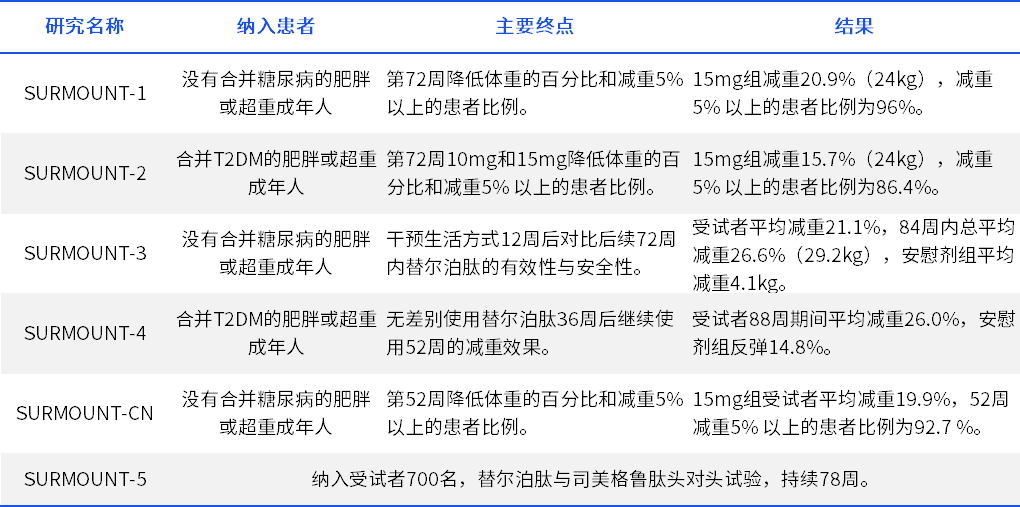
The SURMOUNT series of studies for weight loss indications were initiated in 2019, recruiting over 5,000 obese patients across six registered studies. Results related to SURMOUNT-1~4 and the China regional clinical trial, SURMOUNT-CN, have been published, as shown in the table below.
Source: Eli Lilly and Company Official Website
The FDA approval was based on data from the two Phase III clinical trials, SURMOUNT-1 and SURMOUNT-2. In SURMOUNT-1, treatment with 15mg tirzepatide for 72 weeks resulted in an average weight loss of 20.9% (24kg), with 96% of patients losing more than 5% of their body weight. In SURMOUNT-2, the 15mg group experienced a 15.7% weight loss (24kg), with 86.4% of patients losing more than 5% of their body weight.
In October this year, Eli Lilly and Company announced the comprehensive results of the SURMOUNT-3 clinical trial. The trial enrolled non-type 2 diabetes adult patients with a BMI ≥ 30 kg/m² or BMI ≥ 27 kg/m² accompanied by at least one comorbidity, comparing the efficacy and safety of tirzepatide versus placebo for weight loss after intensive lifestyle intervention.
Results showed that: At 72 weeks, tirzepatide reached the primary endpoints for efficacy and treatment evaluation, with patients experiencing an average weight loss of 21.1%. By 84 weeks (72 weeks plus 12 weeks of intensive lifestyle intervention), the total average weight loss in the tirzepatide group was as high as 26.6% (29.2 kg), compared to only 3.8% (4.1 kg) in the placebo group.
It is worth noting that semaglutide has also undergone a study similar to SURMOUNT-3, called STEP-3. The average weight loss result of tirzepatide compared to semaglutide is slightly better, 26.6% vs 17.6%. In addition, Eli Lilly and Company launched a head-to-head clinical trial of tirzepatide versus semaglutide, SURMOUNT-5, in April 2023. The results are highly anticipated.
NASH and Other Indications
In addition to the fastest-progressing indications of diabetes and weight loss, Eli Lilly and Company has also launched clinical studies for non-alcoholic steatohepatitis (NASH), obstructive sleep apnea (OSA), heart failure with preserved ejection fraction (HFpEF), chronic kidney disease (CKD), and other indications for tirzepatide.
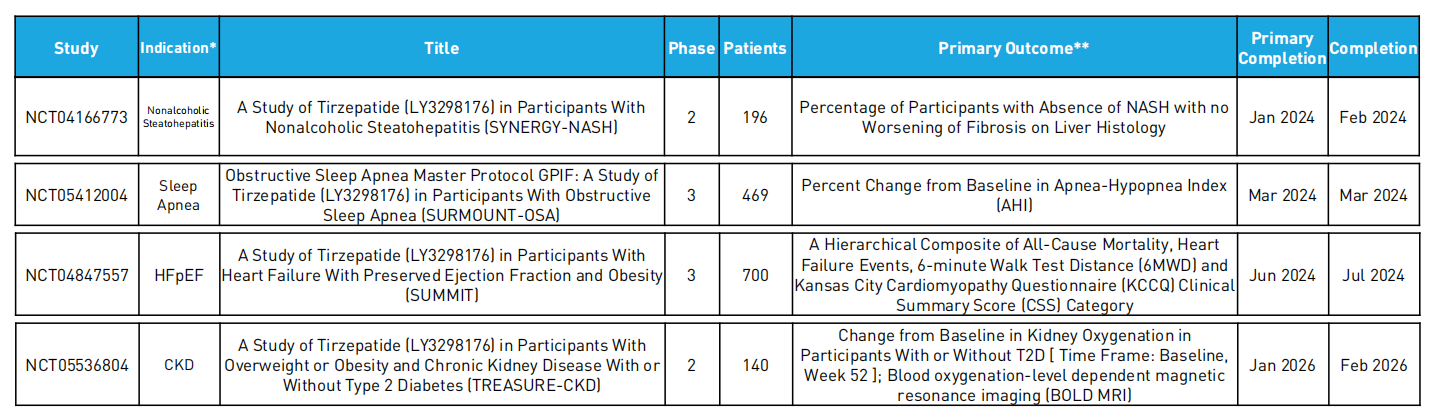
Image Source: Eli Lilly Official Website
For NASH, Eli Lilly and Company launched the SYNERGY-NASH study in November 2019, with the primary endpoint expected to be completed by January 2024.
Nonalcoholic fatty liver disease (NAFLD) refers to liver injury caused by excessive fat deposition in stem cells due to factors other than alcohol and other causes. The global prevalence of NAFLD is 15%-30%, of which approximately 15%-25% of patients progress to NASH. Currently, apart from saroglitazar, a PPARα agonist, there are almost no drugs available for NASH. According to predictions by relevant organizations, the market capacity for NASH will exceed $10 billion by 2025. Initial results from SYNERGY-NASH indicate that tirzepatide reduces biomarkers such as ALT, K-18, and Pro-C3 in trial participants. Interestingly, in the Phase 2 trial of semaglutide targeting NASH, all dose groups achieved the primary endpoints of NASH resolution without worsening of liver fibrosis.
For OSA, Eli Lilly initiated the Phase 3 study SURMOUNT-OSA in June 2022, with clinical completion expected in March 2024.
For HFpEF, Eli Lilly launched the Phase 3 study SUMMIT in April 2021, targeting obese patients and those with heart failure with preserved ejection fraction. The relevant clinical trials are expected to be completed by July 2024.
For CKD, Eli Lilly initiated the Phase 2 study TREASURE-CKD in February 2023, with an expected completion date of February 2026. Notably, in October this year, semaglutide announced the early termination of its Phase 3 clinical trial FLOW for treating Type 2 diabetes patients with renal impairment and chronic kidney disease due to excellent efficacy. Data readout is anticipated in the first half of 2024.
GIPR/GLP-1R
What are the advantages of dual-target agonists?
GIP, whose Chinese name is Glucose-Dependent Insulinotropic Peptide, belongs to the incretin family secreted by human intestinal mucosal cells, along with GLP-1. GIP can regulate postprandial blood glucose and also influence energy balance through central action. The traditional view held that the activation of GIPR (Glucose-Dependent Insulinotropic Peptide Receptor) stimulates glucagon secretion, thereby exacerbating hyperglycemia in patients with T2DM. However, recent studies have found that when GIP binds to GIPR in pancreatic α-cells, it can promote insulin secretion via the interaction between α and β cells in the islets. There has been ongoing debate regarding whether to adopt an activation or inhibition strategy for the GIPR target. Nevertheless, the impressive performance of tirzepatide has gradually shifted the focus towards GIPR agonists.
GIPR can be detected in human islets and white adipose tissue. GIPR is widely expressed in the cerebral cortex, hippocampus, olfactory bulb, and brainstem of rodents. When a GIPR agonist is used in combination with a GLP-1R agonist, it can enhance the anorectic effect produced by GLP-1, which is one of the developmental rationales for tirzepatide's weight loss effects. In June 2023, researchers from Duke University, the German Diabetes Research Center, and Eli Lilly published an article confirming that in humans, the insulinotropic action of tirzepatide is co-mediated by GLP-1R and GIPR.
According to PharmCube data, besides Eli Lilly's tirzepatide, more than 20 GIPR/GLP-1R dual-target agonists are under development globally, including foreign companies like Viking and Chinese pharmaceutical companies such as BrightGene Bio-Medical, Hengrui Medicine, and Hansoh Pharmaceutical.
GIPR/GLP-1R Dual Agonists in Global Research
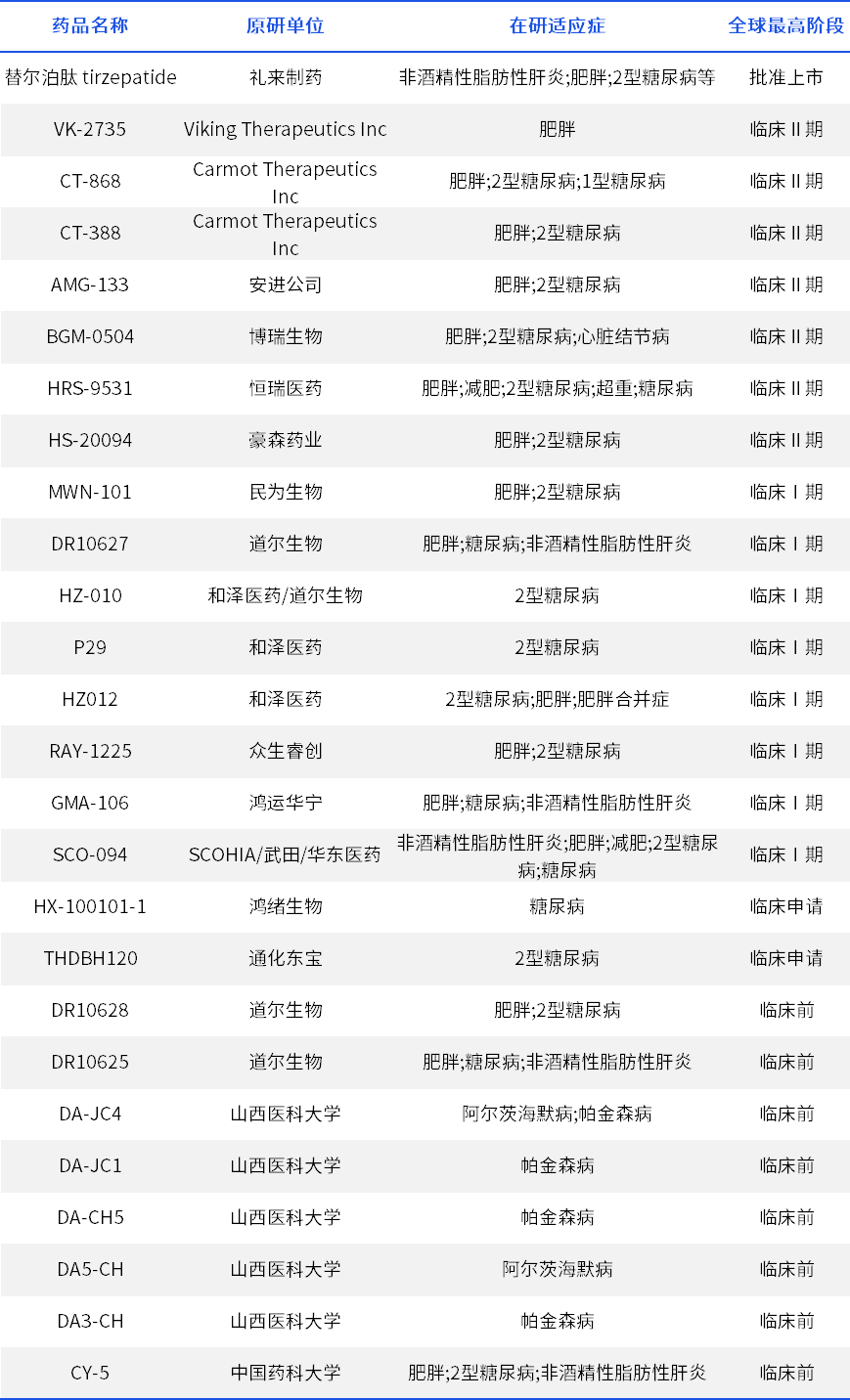
Note: The data is manually compiled by the author and does not represent all ongoing projects. If there are any omissions, corrections are welcome.
Data Source: Pharma Intelligence Data, Boyao Arrangement
Conclusion
Due to the high overlap in product lines, Eli Lilly and Novo Nordisk are always compared.
Novo Nordisk's semaglutide has taken the first-mover advantage and is more comprehensive than tirzepatide in terms of indication layout. However, in the indication for weight loss, currently published data shows that tirzepatide is slightly better than semaglutide. Coupled with semaglutide’s patent issues and production capacity limitations, the total income of semaglutide in the first three quarters of this year was 100.2 billion Danish kroner (approximately 14.2 billion US dollars), with a slowdown in quarter-on-quarter growth. After the launch of tirzepatide, part of semaglutide’s market may be squeezed. However, tirzepatide also faces production capacity issues, so the core of future competition may lie in who can first break through the bottleneck of production capacity.
References
Eli Lilly, Novo Nordisk Official Website
The incretin co-agonist tirzepatide requiresGIPR for hormonesecretion from hunman islets. Nature Metabolism.

Editor: Liuli
Disclaimer: This article is a reprint from Yaozhi.com. The images and text are the original property of their respective owners. The purpose of the reprint is to convey more information and does not represent the views of this platform. If there are any issues regarding the content, copyright, or other aspects, please leave a message on this platform, and we will address it promptly.