


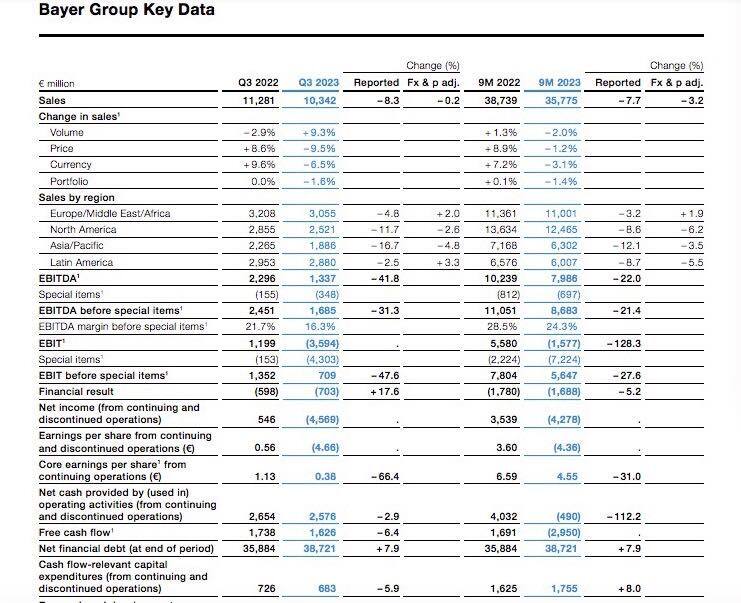
Bayer AG recently announced its Q3 report, showing a revenue of €10.342 billion (approximately RMB 80.581 billion) but a quarterly loss of €4.569 billion (approximately RMB 35.553 billion). CEO Bill Anderson stated during the Q3 earnings call that Bayer is considering spinning off its consumer health or crop science division.
Loss of 33.349 billion yuan in the first three quarters
Bayer's latest Q3 report shows that the company's revenue for the first three quarters reached 35.775 billion euros (approximately 278.744 billion yuan). In the third quarter, Bayer reported a loss of 4.569 billion euros (approximately 35.553 billion yuan), a significant drop from the net profit of 546 million euros (approximately 4.254 billion yuan) in the same period last year. The loss in the third quarter also brought Bayer’s total loss for the first three quarters of this year to 4.278 billion euros (approximately 33.349 billion yuan).
Bayer's operations span three major segments: Crop Science, Pharmaceuticals, and Consumer Health. In the third quarter, the pharmaceuticals segment generated revenue of €4.538 billion (approximately 35.379 billion yuan), remaining largely stable compared to the same period last year (€4.955 billion). Bayer stated that Nubeqa (an oral next-generation androgen receptor inhibitor for prostate cancer) and Kerendia (used to treat chronic kidney disease) continued to perform strongly, while its radiology-related business also maintained growth. In its Q3 report, Bayer noted a significant decline in sales in China, attributing it to the impact of China’s tendering procedures on its drug Adalat.
Consumer Health business unit's Q3 revenue was 1.41 billion euros (approximately 10.994 billion yuan), with a slight decline in the Allergy and Cold business, while the Dermatology business showed strong performance, achieving growth across all regions.
In the third quarter, the crop science business achieved revenue of 4.365 billion euros (approximately 34.034 billion yuan). Bayer stated that, following strong growth last year, although glyphosate products saw increased sales volumes across all regions, price reductions offset this advantage. The decline in earnings from the crop science segment also became an important factor affecting overall performance.
Downward Adjustment of the Original Full-Year Target for 2023
Bayer's management is obviously not satisfied with such performance. During the Q3 earnings call held last week, CEO Bill Anderson stated that nearly 50 billion euros in revenue came with almost zero cash flow, and the stock price performance was equally unsatisfactory, "which is clearly unacceptable."
Bayer Chooses Not to Maintain the Status Quo, Closely Monitors Corporate Structure While Strategizing on Research and Operational Models to Maximize Value from Strong Base Assets. Bill Anderson stated that options under evaluation include spinning off the consumer health division or the crop science division, while other possibilities such as splitting the company into three parts were considered but ultimately ruled out. Additionally, Bayer is planning measures to strengthen financial performance and promote innovation. By the end of next year, Bill Anderson mentioned, Bayer will eliminate multiple management and coordination levels; approximately 95% of decision-making will shift from managers to employees.
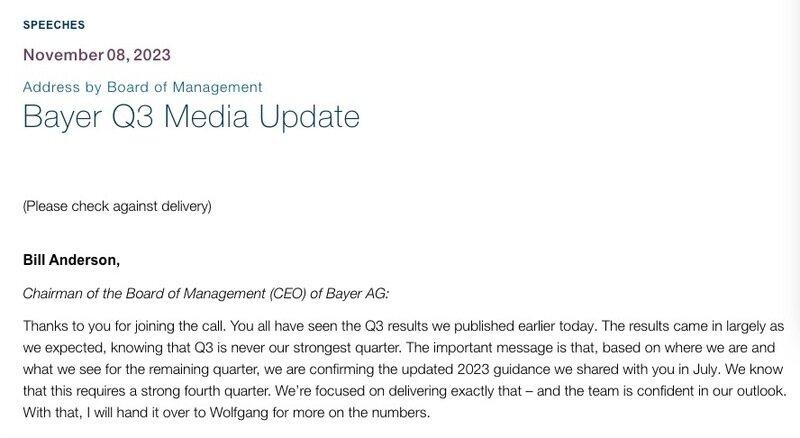
Bill Anderson stated that Bayer has lowered its original full-year target for 2023. In fact, shortly after the release of the half-year report, due to the continued significant decline in glyphosate product sales, Bayer had already downgraded its outlook for the full year of 2023. This includes projecting sales to be between 48.5 billion euros and 49.5 billion euros, compared to the initial forecast range of 51 billion euros to 52 billion euros. The core earnings per share, adjusted for currency effects, were revised from 7.20 euros to 7.40 euros down to 6.20 euros to 6.40 euros. Additionally, Bayer anticipates that the Crop Science division’s sales will decrease by approximately 5% year-over-year, whereas the initial expectation was for growth of about 3%.
Reporter Zhang Xiulan of The Beijing News
Proofread by Baoqing Liu