Legend Biotech Strikes Major Global Licensing Deal with Novartis for DLL3-Targeted CAR-T Therapy Following Janssen Success
Legend Biotech
Tumor Cell Immunotherapy Developer

Johnson & Johnson
Medical Device R&D and Manufacturer
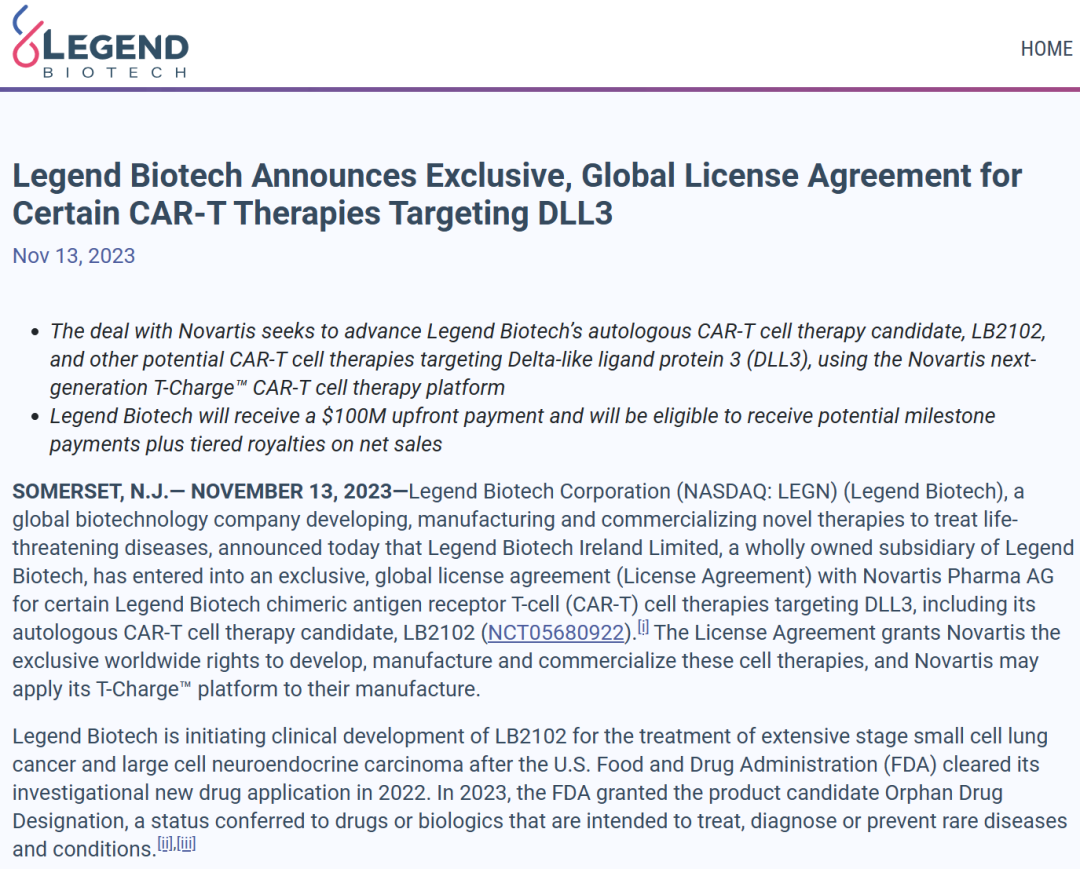
Legend BiotechYesterday (November 13) withNovartisReach an agreement,Targeting DLL3 CAR-T therapy (Including its autologous CAR-T cell candidate therapy LB2102) The global exclusive rights for the development, manufacturing, and commercialization were granted to Novartis, with Novartis paying a $100 million upfront payment and up to $1.01 billion inClinical, regulatory, and commercial milestone payments, as well as tiered royalties.
This is following the successful collaboration with Johnson & Johnson in developing a BCMA-targeted CAR-T therapy.CarvyktiAfter successfully going public in the United States, Legend Biotech once again chose to entrust the commercialization of its products to a veteran MNC.
Carvykti was approved for marketing by the U.S. FDA and Japan's Ministry of Health, Labour and Welfare (MHLW) in 2022, and received conditional marketing authorization from the European Commission (EC) for use inTreatmentMultiple Myeloma.
According to the financial report,The first half of 2023,Sales of BCMA CAR-T Therapy Carvykti$170 million, year-on-year growth388%; According to the 50% profit-sharing ratio, Legend Biotech can obtain$94.5 million。
The rapid growth in performance has made Legend Biotech"The model of 'collaborating with established MNCs to advance R&D and commercialization' points out a relatively viable commercial path for the overseas expansion of China's innovative drugs."
Can the "Legend Model" Create Another Legend by Partnering Again with a Long-standing MNC?
01
Two Major Models for Chinese Innovative Drugs to Go Global: Self-Built Team, Licensing
October 28,Junshi BiosciencesOverseas PartnersCoherus BiosciencesAnnounced, PD-1 monoclonal antibody Toripalimab LOQTORZI™ (Toripalimab) has been approved by the FDA for the treatment of two nasopharyngeal carcinoma (NPC) indications.This is the first marketing approval for a China-produced PD-1 in the United States. November 9,HutchmedAnnounce its partnersTakedaObtain FRUZAQLA™(Fruquintinib) FDA Approval. This is an oral targeted therapy, which isThe First and Only in the United StatesA highly selective inhibitor targeting all three VEGF receptor kinases approved for the treatment of previously treated metastatic colorectal cancer, regardless of the patient's biomarker status.
Prior to this, only BeiGene's BTK inhibitor zanubrutinib, which was approved by the FDA in November 2019, and Legend Biotech's CAR-T therapy Carvykti, which was approved by the FDA in February 2022, had been launched.
A close look at the four Chinese innovative drugs that have率先 "entered" overseas markets reveals that the overseas strategies of these China-based innovative pharmaceutical companies are "diversifying."
Represented by BeiGene, "Self-Built School", opting to build an overseas commercialization team from scratch. The advantage of this model is the ability to establish long-term competitiveness, laying a solid foundation for the commercialization of subsequent innovative products. However, the disadvantages are also evident, as it is extremely 'cash-intensive,' leading to investor dissatisfaction due to BeiGene's ongoing losses."
The other three companies (Legend Biotech, Junshi Biosciences, and Hutchison Pharmaceuticals) are all “Authorized School", choosing to "stand on the shoulders of giants." Legend Biotech's partner, Johnson & Johnson, is a century-old pharmaceutical company and one of the top 10 pharmaceutical companies in the world; Junshi Biosciences' partner isCoherus has focused on introducing the North American rights of drugs, advancing R&D and commercialization since its establishment in 2010; Takeda Pharmaceutical, which collaborates with Hutchison Medicine, is the largest pharmaceutical enterprise in Asia.
The advantage of this model lies in its ability to "leverage resources," utilizing the resources of partner companies in overseas markets to quickly bring innovative products to market and rapidly scale up. The collaboration between Legend Biotech and Johnson & Johnson is an excellent example. Of course, under this model, how companies will commercialize their future innovative products is a pressing issue that needs to be addressed.
Although both belong to the "authorized faction," the revenue-sharing rights of each company vary significantly.
Johnson & Johnson's Janssen Pharmaceuticals and Legend BiotechCarvykti (then known ascilta-cel) inDecember 2017Signed AgreementIn China,Johnson & Johnson Pay$350 millionAdvance payment. In sales,Rights in China are split 70:30, while overseas rights are split 50:50.。
Generally, License-out new drugs can only obtain a sales share ranging from a few percent to twenty percent.It is extremely rare for Legend Biotech to receive a 50% share, primarily because the framework of the deal with Johnson & Johnson isShare Overseas Clinical Development and Commercialization Costs, which often requires the authorizing party to have sufficient cash flow for support.
By comparison, Junshi Biosciences inFebruary 2021Collaboration with Coherus on the development and commercialization of PD-1 monoclonal antibody drug Toripalimab in the United States and Canada.For Toripalimab,Coherus is responsible for all commercial activities in the United States and Canada, while Coherus pays$150 million upfront payment, and$380 Million Milestone AmountAnd20% of sales revenue sharing。
Hutchmed reached an agreement with Takeda Pharmaceutical in January this yearAn agreement to further advance the development, commercialization, and production of fruquintinib globally, excluding mainland China, Hong Kong, and Macao.Hutchmed is entitled to receiveDown payment of 400 million US dollars, and can be as high as$730 Million in Potential Future Milestone Payments, with a total amount of up to 1.13 billion US dollars, plusRoyalties Based on Net Sales。
02
"Legend Biotech" Mode Continues
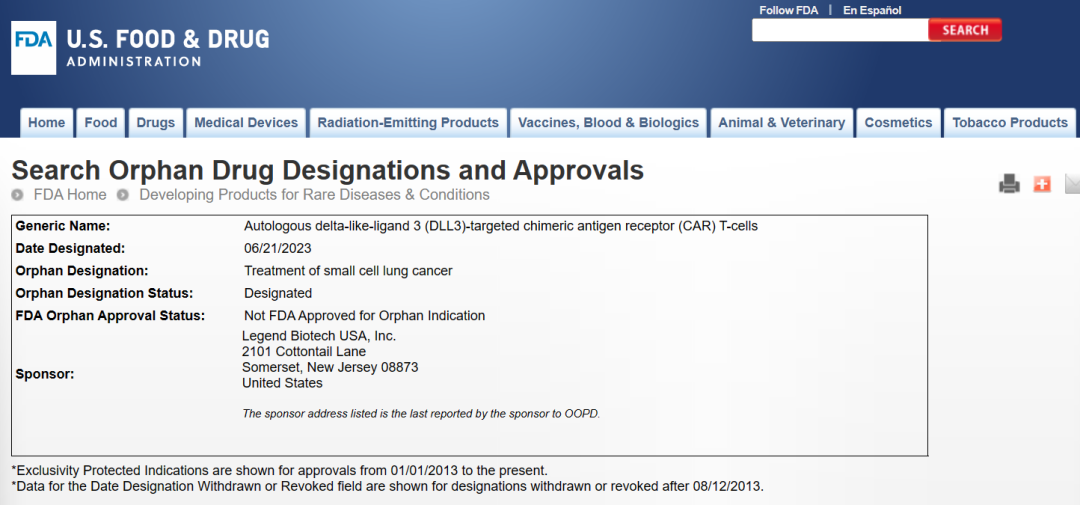
This collaboration with NovartisIn the CAR-T therapy targeting DLL3,LB2102 is the most advanced in progress. In June 2023,LB2102 Granted FDA Orphan Drug Designation for the Treatment ofSmall Cell Lung Cancer.
Currently, the drug is used forTreatment of Extensive-Stage Small Cell Lung Cancer and Large Cell Neuroendocrine CarcinomaLungCancerClinical trials are currently underway in the U.S. market.According to the license agreement, Legend Biotech will conduct a Phase I clinical trial of LB2102 in the United States, and Novartis will be responsible for all other development of the licensed product.
The agreement indicates that Novartis can incorporate its next-generation CAR-T cell therapy production platform——T-Charge PlatformApplied to Collaborative CAR-T ProductsProductionIt is reported that the T-Charge platform aims to reduce the need for prolonged ex vivo culture, giving T cells greater proliferative potential and reducing T cell exhaustion.
The production platform is currently being used for Novartis' two CAR-T candidate drugs, including YTB323 for blood cancer and autoimmune diseases, and PHE885 for multiple myeloma. LB2102 will be Novartis'For the first timeApply T-Charge to cell therapy candidates targeting solid tumors.
To know,So far, the global CAR-T cell therapy field has yet to produce a true "blockbuster," with "limited production capacity" being one of the reasons.
And it has been listedThe World's FirstNovartis, the company behind CAR-T products, is not only pushingCommercialization of CAR-T ProductsRich experience in this aspect, and also has a considerable scale in CAR-T production, even undertaking external "orders":
In April 2023, Legend Biotech entered into an agreement with Johnson & Johnson and Novartis for the technology transfer, production, and clinical supply services of CAR-T products, strengthening CAR-T manufacturing. According to the agreement, Legend Biotech and Johnson & Johnson will initiate the necessary technology transfer activities with Novartis to enable Novartis to execute.CarvyktiProduction process.
The licensed cooperation for the DLL3-targeted CAR-T therapy has fully extended Legend Biotech's "Collaborate with established MNCs to advance R&D & commercialization" Innovative Drug Overseas Strategy.

As more and more news comes about the successful overseas expansion of Chinese innovative drugs, going global is no longer "out of reach" for Chinese pharmaceutical companies.
On the contrary, the path is gradually becoming clear. Whether it is "self-built" or "authorized," companies need to make choices based on their own situations and adapt to local conditions. The most important thing is to move forward.
· END ·
--Video Dynamics--
▲The Hottest Category in Gene Therapy


Pharmaceuticals | Biologics | ADC | mRNA | CAR—T | PD-1 | Medical Devices | Imaging | IVD | Cardiovascular | Orthopedics | Oral Cavity | Ophthalmology | Surgical Robot | Internet Healthcare| Hospital | CXO | Life ScienceStudy
Deep Original | Annual Review | Trend Analysis | Cross-Cycle Series | Stock Market Dynamics | Enterprise Dynamics | Executive Movements | Pharmaceutical Financial Reports | Medical Device Financial Report | Major Acquisition | Strategic Split | Executive Interview | Compensation | Policy Analysis | Medicare Negotiation | DRG/DIP | Centralized Procurement | JPM | Latest News | CIIE | CMEF
Medical Device Rankings | Medtronic | Abbott | Johnson & Johnson Medical | Siemens Healthineers | BD | Stryker | GE Healthcare | Roche Diagnostics | Philips | Boston Scientific | Mindray Medical | United Imaging Healthcare | Minimally Invasive Medical | Lepu Medical | Weigao | Danaher | Thermo Fisher
Pharmaceutical Rankings | Pfizer | AbbVie | Roche Pharmaceuticals | Johnson & Johnson | Merck & Co. | AstraZeneca | Bristol-Myers Squibb | Sanofi | Novartis | GSK | Hengrui | BeiGene | ShiYao | Innovent Biologics | Junshi Biosciences | Legend Biotech | I-Mab Biopharma | CStone Pharmaceuticals | Rongchang Biotech | Zai Lab | WuXi AppTec | Qiming Venture Partners | Lilly Asia
--Industry Community--