

Selecta Biosciences and Cartesian Therapeutics Merge to Advance mRNA-Engineered BCMA CAR-T Therapy Descartes-08 into Phase 3 Clinical Development

Selecta Biosciences
First-Generation Nanoparticle Immune Modulation Drug Developer

Cartesian Therapeutics
Pharmaceutical R&D Developer

November 16, 2023 / eMedClub News /--Recently,Selecta Biosciences Announces Merger with Cartesian Therapeutics, Fully Integrated into a Publicly Traded Company Focused on Developing RNA Cell Therapies for Autoimmune DiseasesThe combined company will be led by Dr. Carsten Brunn of Selecta Biosciences, with Cartesian’s co-founders Murat Kalayoglu and Michael Singer serving on the board of directors.
The combined company is expected to have a cash balance at the close of the transaction.More than $110 million, including $60.25 million from concurrent private financing.These funds will be used to advance Cartesian's Descartes-08 project into Phase 3 clinical trials.。
Dr. Carsten Brunn stated, "Several potential value-driving milestones are expected to be achieved in the near future, including the anticipated release of Phase 2b study data for Descartes-08 in mid-2024. This merger presents a significant opportunity for Selecta shareholders, and we look forward to maximizing the potential of this robust pipeline and technology."
Selecta
Selecta Biosciences, Inc. was founded in 2008 and is dedicated to developing nanoparticle immunomodulatory drugs for the treatment and prevention of human diseases. It has established an exclusive immune tolerance platform, ImmTOR, which combines nanoparticle technology with FDA-approved anti-inflammatory and immunomodulatory drugs to mitigate unwanted immune responses. This delivery technology has been clinically validated multiple times.

Selecta Biosciences is advancing the application of this technology in the field of gene therapy,It was found that ImmTOR can induce AAV vector-specific immune tolerance, reduce the severity of the body's immune response to AAV gene therapy, and may enable repeated dosing.At the same time, Selecta is also exploring the potential of ImmTOR in the treatment of autoimmune diseases. Before the merger, Selecta had already started collaborations with multiple companies.
January 2022,Selecta Biosciences Announces Collaboration with Ginkgo Bioworks to Develop Next-Generation AAV Capsids, aiming to enhance the safety and efficacy of AAV gene therapy. According to the collaboration terms, Ginkgo is eligible to receive upfront research and development fees and potential payments totaling up to $1.1 billion. Ginkgo will be responsible for the design and engineering of the AAV capsid, while Selecta will oversee subsequent preclinical and clinical studies. In the same year, Selecta also entered into a strategic licensing agreement with Takeda.Repeat Dosing Enabled by Selecta’s Proprietary Immune Tolerance Platform, ImmTOR, to Develop Next-Generation Gene Therapies for Two Indications in the Lysosomal Storage Disorders Field, The total amount of this cooperation is as high as 1.124 billion US dollars.
Overall, Selecta's deep cultivation in delivery technology might allow its delivery platform advantages to be better utilized through this merger.
Cartesian
Cartesian, founded in 2016, is a biotechnology company focused on RNA-engineered cell therapies. It has developed the proprietary RNA Armory platform, designed to enable precise control and optimization of engineered cells using multiple modalities (including autologous, allogeneic, and in vivo transfection).It combines the advantages of traditional nanoparticle-based RNA therapies with those of conventional DNA-engineered cell therapies.Its CAR-T therapy does not require pre-treatment chemotherapy, has a predictable half-life, and avoids the risk of genomic integration., while being easy to engineer with tissue-specific homing proteins, and is expected to further reduce costs.
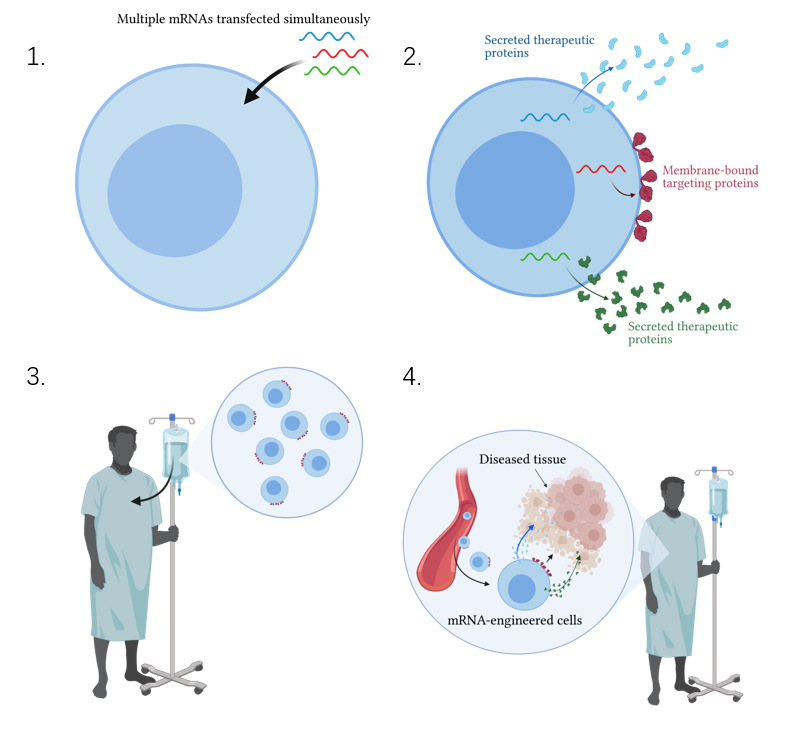
▲ RNA Armory℠ Platform Technology Principle
(Image Source: Cartesian)
Cartesian's lead pipeline candidate is Descartes-08, an mRNA-engineered autologous BCMA CAR-T therapy developed using the RNA Armory technology platform for the treatment of generalized myasthenia gravis (gMG).It uses LNP to deliver mRNA for the transient expression of CAR to generate CAR-T cells, replacing viral transduction and reducing the inherent risks of traditional CAR-T cell therapy, making outpatient treatment possible.
In June this year, the results of the Phase 2 trial of Descartes-08 were published in The Lancet Neurology. Fourteen patients with generalized MG received six infusions of rCAR-T. The average follow-up time was 6 months, and rCAR-T was well-tolerated without dose-limiting toxicity, cytokine release syndrome, or neurotoxicity.At 6 months, patients showed an average improvement three times greater than the threshold considered clinically meaningful.. For the majority of patients, the clinical benefits are long-lasting. Among them,Three patients achieved complete or near-complete eradication of all disease symptoms.。
It is worth mentioning that,The indications for Descartes-08 have been further expanded to include systemic lupus erythematosus, with its Phase 2 clinical study expected to commence in the first half of 2024., and in the middle and second half of next year, Phase 2 studies targeting ocular autoimmune diseases and vasculitis-related autoimmune research will also be initiated.
In addition, Cartesian's pipeline under research also includesDescartes-15 and Descartes-33Descartes-15 is the next-generation autologous BCMA rCAR-T therapy, which demonstrated superior efficacy to Descartes-08 in preclinical studies and is intended for the treatment of autoantibody-associated autoimmune diseases. Descartes-33 is an allogeneic mesenchymal stem cell therapy currently in the preclinical research stage.
The merger of the two companies, with a greater focus on Cartesian's clinical pipeline, may be due to the fact that the current efficacy and safety of Descartes-08 are within the company's expected range and have the potential for continued development.The potential. This therapy is already in the late stage of clinical development, and the market is still in a blank state at present. The merger will facilitate resource integration and provide more favorable financial and technical support for the development of this product as well as the advancement of subsequent products.
Summary
eMedClub
Against the backdrop of today’s environment, corporate mergers are not uncommon. Selecta Biosciences possesses exclusive delivery technology and a relatively abundant cash flow, while Cartesian Therapeutics is a leading company in the LNP mRNA CAR-T therapy track within the autoimmune space. The merger of these two strong entities into a publicly listed company is conducive to survival in the current climate and holds promise for launching a "comeback" product. After all, autoimmune diseases represent the second-largest market after oncology, and the first-mover advantage of early players may continue to yield benefits.


Dian Dian "Share”、“Like" and "In view", give me a little recharge~"