▎WuXi AppTec Content Team Report
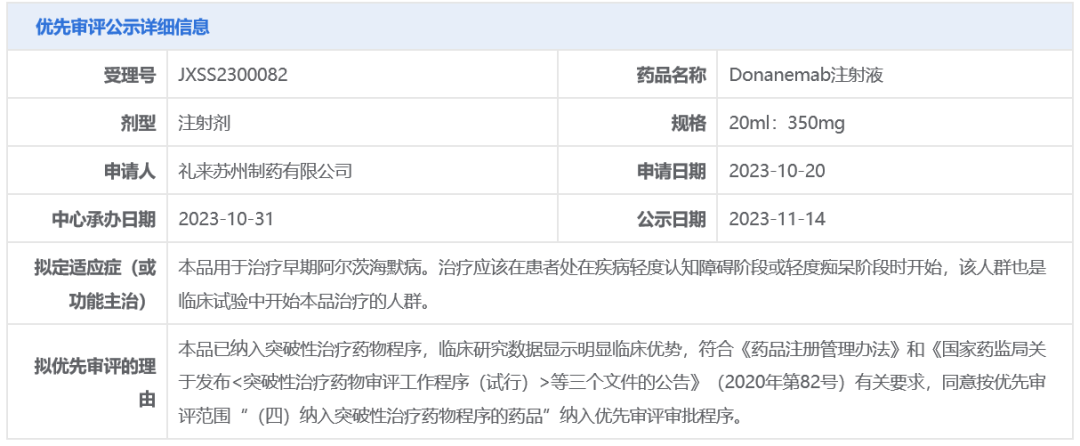
On November 14, the official website of the Center for Drug Evaluation (CDE) under the China National Medical Products Administration (NMPA) announced that the new drug application for donanemab injection submitted by Eli Lilly and Company is proposed to be included in the priority review.Intended for the treatment ofEarly Alzheimer's Disease。Public information shows,Donanemab targets beta-amyloid plaques known as N3pG, and a Biologics License Application (BLA) has been submitted in the United States, receiving Priority Review designation from the FDA.。The product is indicated for the early symptomatic Alzheimer's disease.Also included in the CDE's Breakthrough Therapy designation。Screenshot source: CDEOfficial WebsiteDOnanemab is a drug developed byβ-Amyloid SubtypesN3pGCombined monoclonal antibody.It can bind to β-amyloid in amyloid plaques in the brains of Alzheimer's patients, thereby promoting the clearance of amyloid deposits in the patient's brain.According to the biomarker study results previously released by Eli Lilly, donanemab not only leads to the rapid clearance of amyloid plaques but alsoSignificantly reduce the level of P-tau217 in patients' plasma。This is an investigational blood biomarker developed by Eli Lilly, associated with amyloid, tau pathology, and the diagnosis of Alzheimer's disease.Break related. In addition,Donanemab can also reduce the levels of GFAP, an inflammatory biomarker associated with astrocytosis in the brain.. This evidence suggests that the drug can reduce various pathological processes associated with Alzheimer's disease. In July this year, Eli Lilly and Company announced the Phase 3 results of donanemab.TRAILBLAZER-ALZ 2TestThe full results. The analysis shows that donanemabSignificantly slows cognitive and functional decline in patients with early symptoms of Alzheimer's disease and delays disease progression.. Subgroup analysis showed,Subjects in the earliest stage of the disease benefited more significantly, with a 60% reduction in cognitive and functional decline compared to placebo.Moreover, regardless of the patient's baseline pathological stage, donanemab treatment significantly reduced amyloid plaque levels. At 18 months, donanemab treatment achieved this effect in all participants.Reduced amyloid plaques by an average of 84% (vs 1%). The detailed data of the study were presented at the 2023 Alzheimer's Association International Conference (AAIC) and simultaneously published in the Journal of the American Medical Association (JAMA).
In China, Eli Lilly has previously completed a Phase 1 study evaluating the safety, tolerability, and pharmacokinetics of donanemab in healthy Chinese subjects.In September 2022, the company againLaunch an international multicenter study codenamed TRAILBLAZER-ALZ 5((Including China), randomized, double-blind, placebo-controlled Phase 3 study to evaluate donanemab inEarly Symptomatic Alzheimer's Disease with Brain Tau Protein Pathology (Including Mild Cognitive Impairment Due to Alzheimer's Disease and Mild Alzheimer's Disease)Safety and effectiveness in subjects.The Chinese part of the study was conducted byJia Jianping, Chief Physician of Xuanwu Hospital, Capital Medical UniversityServing as the principal investigator,To be conducted across nearly 50 research centers in China,ChinaThe target number of participants is 400.。
[1] Official website of the Center for Drug Evaluation (CDE) of the National Medical Products Administration (NMPA) of China. Retrieved Nov 14, 2023, from https://www.cde.org.cn/main/xxgk/listpage/2f78f372d351c6851af7431c7710a731[2] Results from Lilly's Landmark Phase 3 Trial of Donanemab Presented at Alzheimer's Association Conference and Published in JAMA. Retrieved July 17, 2023 from https://investor.lilly.com/news-releases/news-release-details/results-lillys-landmark-phase-3-trial-donanemab-presented[3] Eli Lilly and Company Announces Positive Results from First Head-to-Head Study of Donanemab for Early Symptomatic Alzheimer's Disease. Retrieved Dec 7, 2022, from https://mp.weixin.qq.com/s/qNizxi4Zox-ko5OR0-KpJwThis articleFrom the WuXi AppTec content team. Individuals are welcome to share this article on their personal social media feeds, but unauthorized republication by media or organizations in any form on other platforms is strictly prohibited.For reprint authorization, please leave a message to contact us on the "MedView" WeChat Official Account. For other cooperation needs, please contact wuxi_media@wuxiapptec.com.
Disclaimer: The content team of WuXi AppTec focuses on introducing the research progress in global biopharmaceuticals and health. This article is for information exchange purposes only, and the views expressed in the article do not represent the position of WuXi AppTec, nor does it mean that WuXi AppTec supports or opposes the views in the article. This article is not a recommendation for treatment plans. If you need guidance on treatment options, please visit a正规 hospital.